Curriculum
Mathematics Grade XI
Grade 11 Mathematics
0/14
-
Chapter 1: Sets
 Preview
 -
Chapter 2: Relations and Functions
Preview
-
Chapter 3: Trigonometric Functions
Preview
-
Chapter 4: Complex Numbers and Quadratic Equations
Preview
-
Chapter 5: Linear Inequalities
Preview
-
Chapter 6: Permutations and Combinations
Preview
-
Chapter 7: Binomial Theorem
Preview
-
Chapter 8: Sequences and Series
Preview
-
Chapter 9: Straight Lines
Preview
-
Chapter 10: Conic Sections
Preview
-
Chapter 11: Introduction to Three Dimensional Geometry
Preview
-
Chapter 12: Limits and Derivatives
Preview
-
Chapter 13: Statistics
Preview
-
Chapter 14: Probability
Preview
Chapter 9: Straight Lines
|
Class 11 • Mathematics • Chapter 9 Straight LinesDescribing a straight line with a single equation, and reading its slope and position from it.
|
|
Chapter Roadmap Slope of a Line • Parallel and Perpendicular • Point-Slope and Two-Point • Slope-Intercept and Intercept • General and Normal Form • Distance of a Point • Key Results • Applications |
| 1 |
Why Straight Lines Matter |
A straight line is the simplest shape in coordinate geometry, yet it sits behind a huge amount of mathematics and science. A road on a map, the path of light, the relationship between cost and quantity, and the trend line through a set of readings can all be modelled by straight lines. The great idea of coordinate geometry is that every straight line can be captured by a single equation, so geometry questions become algebra questions that we can solve neatly.
In this chapter you will learn to measure how steep a line is using its slope, to tell when two lines are parallel or at right angles, to write the equation of a line in several handy forms, and to find the shortest distance from a point to a line. Each form of the equation is suited to a particular piece of information, so a large part of the skill is choosing the right form for the question in front of you.
The slope m tells you how steep a line is and which way it tilts. Two lines are parallel when their slopes are equal, and perpendicular when the product of their slopes is −1. Once you know a slope and one point, the whole line is fixed.
|
| 2 |
Key Terms You Must Know |
| Term | Meaning | Example |
| Slope | A measure of steepness, m = (change in y)/(change in x). | A line through (0,0) and (1,2) has slope 2 |
| Intercept | Where a line cuts an axis; the x-intercept and y-intercept. | y = 2x + 3 has y-intercept 3 |
| Point-slope form | y − y₁ = m(x − x₁), using one point and the slope. | Through (1,2) with m = 3 |
| Slope-intercept form | y = mx + c, using the slope and the y-intercept. | y = 2x − 5 |
| Intercept form | x/a + y/b = 1, where a and b are the intercepts. | x/3 + y/2 = 1 |
| General form | Ax + By + C = 0, with slope −A/B. | 3x + 4y − 12 = 0 |
| Distance from a line | Shortest (perpendicular) distance from a point to a line. | |Ax₁ + By₁ + C| / √(A² + B²) |
| 3 |
Core Concepts, Step by Step |
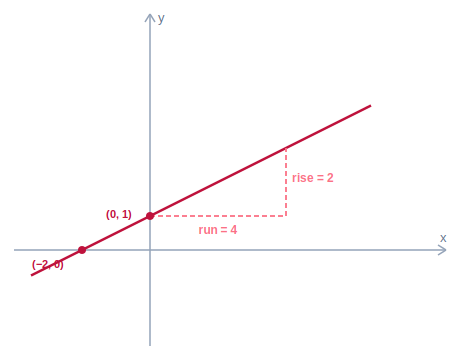
1. The Slope of a LineThe slope (or gradient) measures how steep a line is. For two points (x₁, y₁) and (x₂, y₂) on the line, the slope is m = (y₂ − y₁)/(x₂ − x₁), the change in y divided by the change in x. If the line makes an angle θ with the positive x-axis, then m = tan θ. A line rising to the right has a positive slope, one falling to the right has a negative slope, a horizontal line has slope 0, and a vertical line has no defined slope.
|
|
Slope: rise divided by run
|
2. Parallel and Perpendicular LinesSlopes make it very easy to compare directions. Two lines are parallel exactly when their slopes are equal, m₁ = m₂, because they tilt by the same amount. Two lines are perpendicular exactly when the product of their slopes is −1, that is m₁ m₂ = −1. More generally, the angle θ between two lines with slopes m₁ and m₂ satisfies tan θ = |(m₁ − m₂)/(1 + m₁ m₂)|. Three points are collinear (lie on one line) when the slope between each pair is the same.
|
3. The Point-Slope and Two-Point FormsIf you know one point (x₁, y₁) on a line and its slope m, the equation is y − y₁ = m(x − x₁); this is the point-slope form. If instead you know two points, first work out the slope from them, then use either point in the point-slope form. This pair of forms covers the most common situations, where a line is fixed by a point and a direction, or by two points it passes through.
|
4. The Slope-Intercept and Intercept FormsWhen you know the slope m and the y-intercept c (where the line crosses the y-axis), the equation is simply y = mx + c, the slope-intercept form. When you know the x-intercept a and the y-intercept b, the equation is x/a + y/b = 1, the intercept form. The intercept form is very quick for sketching a line, because you just mark a on the x-axis and b on the y-axis and join them. The table below gathers all the forms together.
|
|
The standard forms of the equation of a line
|
5. The General Form and the Normal FormAny straight line can be written in the general form Ax + By + C = 0. From it the slope is read off as −A/B (when B is not 0). This single form contains all the others. The normal form x cos ω + y sin ω = p describes the line by the length p of the perpendicular dropped to it from the origin and the angle ω that perpendicular makes with the x-axis. It is useful whenever a problem talks about the perpendicular distance from the origin.
|
6. Distance of a Point From a LineThe shortest distance from a point to a line is measured along the perpendicular. For the point (x₁, y₁) and the line Ax + By + C = 0, this distance is d = |Ax₁ + By₁ + C| / √(A² + B²). The absolute value bars keep the distance positive whichever side of the line the point is on. For two parallel lines Ax + By + C₁ = 0 and Ax + By + C₂ = 0, the distance between them is |C₁ − C₂| / √(A² + B²).
|
| 4 |
Key Results & Proofs |
Three results underpin the whole chapter. Each follows quickly from the meaning of slope.
Statement. The line through the point (x₁, y₁) with slope m has equation y − y₁ = m(x − x₁). Proof Use the fact that the slope between any two points of a line is the same.
Putting (x₁, y₁) = (0, c) gives the slope-intercept form y = mx + c at once. |
||||||||||||||||
Statement. Two lines with slopes m₁ and m₂ are perpendicular if and only if m₁ m₂ = −1. Proof Compare the angles the two lines make with the x-axis.
So a line of slope 2 is perpendicular to a line of slope −1/2, because 2 × (−1/2) = −1. |
||||||||||||||||||||
Statement. The line Ax + By + C = 0 (with B not 0) has slope −A/B. Proof Rearrange the general form into slope-intercept form.
So 3x + 4y − 12 = 0 has slope −3/4, and its y-intercept is 12/4 = 3. |
|||||||||||||||||||||
| 5 |
Worked Examples |
Question: Find the slope of the line through the points (2, 3) and (5, 9). ▶ Show full workingUse m = (y₂ − y₁)/(x₂ − x₁).
Answer: The slope is 2. |
Question: Find the slope of the line 3x + 4y = 12. ▶ Show full workingWrite it as 3x + 4y − 12 = 0 and use slope = −A/B.
Answer: The slope is −3/4. |
Question: Are the lines y = 2x + 1 and y = 2x − 5 parallel? ▶ Show full workingCompare their slopes.
Answer: Yes, they are parallel. |
||||||||
Question: Are two lines with slopes 3 and −1/3 perpendicular? ▶ Show full workingMultiply the slopes and check for −1.
Answer: Yes, the lines are perpendicular. |
Question: Find the equation of the line through (1, 2) with slope 3. ▶ Show full workingUse the point-slope form y − y₁ = m(x − x₁).
Answer: y = 3x − 1. |
Question: Find the equation of the line through (2, 3) and (4, 7). ▶ Show full workingFind the slope first, then use the point-slope form.
Answer: y = 2x − 1. |
Question: Write the equation of the line with slope 2 and y-intercept −5. ▶ Show full workingUse the slope-intercept form y = mx + c directly.
Answer: y = 2x − 5. |
Question: Write the line 2x + 3y = 6 in intercept form and state its intercepts. ▶ Show full workingDivide through so the right side becomes 1.
Answer: Intercept form x/3 + y/2 = 1; x-intercept 3 and y-intercept 2. |
|||||||||||||
Question: Find the distance of the point (3, 4) from the line 3x + 4y − 5 = 0. ▶ Show full workingUse d = |Ax₁ + By₁ + C| / √(A² + B²).
Answer: The distance is 4 units. |
Question: Find the distance between the parallel lines 3x + 4y + 5 = 0 and 3x + 4y − 10 = 0. ▶ Show full workingUse d = |C₁ − C₂| / √(A² + B²).
Answer: The distance is 3 units. |
Question: Find the equation of the line through the origin and the point (3, 6). ▶ Show full workingThe origin is (0, 0); find the slope, then use slope-intercept form with c = 0.
Answer: y = 2x. |
Question: Find k if the lines 2x + ky = 5 and 3x − 2y = 7 are perpendicular. ▶ Show full workingFind each slope using −A/B, then use m₁ m₂ = −1.
Answer: k = 3. |
| 6 |
Where You Meet This in Real Life |
|
Maps and navigation Roads, flight paths and the grid of a city are modelled with straight lines, and slope tells you how steep a climb or descent is. |
|
Economics and business Cost, revenue and demand often vary linearly with quantity, so their graphs are straight lines whose slope carries real meaning. |
|
Science and readings When two measured quantities are related linearly, the trend line through the readings lets you predict values you did not measure. |
|
Construction and design Ramps, staircases and roofs are built to set gradients, which are exactly the slopes of straight lines. |
|
Computer graphics Drawing and moving shapes on a screen relies on the equations of lines and the distances between points and lines. |
| 7 |
Practice Sets A to D |
|
Practice Set A – Basics |
|
A1. Find the slope of the line through (1, 1) and (4, 7). ▶ Reveal full workingUse m = (y₂ − y₁)/(x₂ − x₁).
Answer: 2. |
|
A2. Find the slope of the line 2x − y + 3 = 0. ▶ Reveal full workingUse slope = −A/B.
Answer: 2. |
|
A3. Write the equation of the line through the origin with slope −2. ▶ Reveal full workingUse slope-intercept form with c = 0.
Answer: y = −2x. |
|
A4. State the y-intercept of the line y = 3x + 7. ▶ Reveal full workingCompare with y = mx + c.
Answer: 7. |
|||||||
|
Practice Set B – Conceptual |
|
B1. What is the condition for two lines to be parallel? ▶ Reveal full workingCompare their slopes.
Answer: Their slopes are equal. |
|||||||
|
B2. What is the condition for two lines to be perpendicular? ▶ Reveal full workingLook at the product of the slopes.
Answer: The product of their slopes is −1. |
|||||||
|
B3. What is the slope of a horizontal line, and of a vertical line? ▶ Reveal full workingThink about the change in y and the change in x.
Answer: Horizontal: slope 0; vertical: slope undefined. |
|||||||
|
B4. What do a and b mean in the intercept form x/a + y/b = 1? ▶ Reveal full workingSet one variable to 0 at a time.
Answer: a is the x-intercept and b is the y-intercept. |
|||||||
|
Practice Set C – Application / Numerical |
|
C1. Find the equation of the line through (2, −1) with slope 4. ▶ Reveal full workingUse the point-slope form.
Answer: y = 4x − 9. |
|
C2. Find the equation of the line through (1, 2) and (3, 8). ▶ Reveal full workingFind the slope, then use point-slope form.
Answer: y = 3x − 1. |
|
C3. Find the distance of the point (1, 2) from the line 4x + 3y − 10 = 0. ▶ Reveal full workingUse the distance formula.
Answer: 0 (the point is on the line). |
|
C4. Find the distance between the parallel lines 5x − 12y + 6 = 0 and 5x − 12y − 7 = 0. ▶ Reveal full workingUse d = |C₁ − C₂| / √(A² + B²).
Answer: 1 unit. |
|
Practice Set D – HOTS / Word Problems |
|
D1. Show that the points (1, 4), (3, −2) and (−3, 16) are collinear. ▶ Reveal full workingThree points are collinear when the slope between each pair is the same.
Answer: They are collinear (each slope is −3). |
||||||||||||
|
D2. A line makes intercepts 3 and 4 on the x-axis and y-axis. Find its equation and its distance from the origin. ▶ Reveal full workingUse the intercept form, then the distance formula from the origin.
Answer: Equation 4x + 3y − 12 = 0; distance 2.4 units. |
|
D3. Find k if the line through (2, k) and (3, 5) has slope 2. ▶ Reveal full workingSet the slope between the points equal to 2.
Answer: k = 3. |
|
D4. Find the distance between the parallel lines 2x + 3y = 7 and 2x + 3y = 14. ▶ Reveal full workingWrite both as Ax + By + C = 0, then use the parallel-line distance formula.
Answer: 7/√13 units (about 1.94). |
||||||||||||
|
Chapter Summary Everything in One Glance
|
||||||||||||||||||
| 8 |
Are You Exam-Ready? |
|
8-Point Exam Quick-Check
|
||||||||||||||||||||||||||||||||
|
School Revise Virtual Lab Practice the concepts in this chapter with interactive simulations and visual tools.
|
|
Class 11 Mathematics Chapter 9: Straight Lines, Complete Notes and Practice These free Class 11 Maths Chapter 9 Straight Lines notes follow the latest NCERT 2026-27 syllabus and give complete, exam-ready coverage for board exams and competitive foundations. Includes worked examples, step-by-step proofs and graded practice, free on SchoolRevise.com. |
 Google