Curriculum
Mathematics Grade XI
Grade 11 Mathematics
0/14
-
Chapter 1: Sets
 Preview
 -
Chapter 2: Relations and Functions
Preview
-
Chapter 3: Trigonometric Functions
Preview
-
Chapter 4: Complex Numbers and Quadratic Equations
Preview
-
Chapter 5: Linear Inequalities
Preview
-
Chapter 6: Permutations and Combinations
Preview
-
Chapter 7: Binomial Theorem
Preview
-
Chapter 8: Sequences and Series
Preview
-
Chapter 9: Straight Lines
Preview
-
Chapter 10: Conic Sections
Preview
-
Chapter 11: Introduction to Three Dimensional Geometry
Preview
-
Chapter 12: Limits and Derivatives
Preview
-
Chapter 13: Statistics
Preview
-
Chapter 14: Probability
Preview
Worksheets
0/14

Chapter 10: Conic Sections
|
Class 11 • Mathematics • Chapter 10 Conic SectionsThe circle, parabola, ellipse and hyperbola, all born from slicing a cone.
|
|
Chapter Roadmap Sections of a Cone • Circle • Parabola • Ellipse • Hyperbola • Eccentricity • Key Results • Applications |
| 1 |
Why Conic Sections Matter |
Take a double cone and slice it with a flat plane. Depending on the angle of the cut, the edge of the slice is a circle, an ellipse, a parabola or a hyperbola. These four curves, the conic sections, appear all through science and engineering: planets move in ellipses, a thrown ball traces a parabola, and the shadow of a lamp on a wall can be a hyperbola.
In this chapter we study each conic through its equation in the coordinate plane. We will find the centre and radius of a circle, the focus and directrix of a parabola, and the foci and eccentricity of an ellipse and a hyperbola. A single number, the eccentricity, ties all four curves together and tells you which conic you are looking at, so it is worth keeping in mind from the start.
All four conics come from cutting a cone. The eccentricity e decides which one you get: a circle has e = 0, an ellipse has e < 1, a parabola has e = 1, and a hyperbola has e > 1.
|
| 2 |
Key Terms You Must Know |
| Term | Meaning | Example |
| Conic section | A curve formed when a plane cuts a cone: circle, ellipse, parabola or hyperbola. | A planet’s orbit is an ellipse |
| Circle | All points at a fixed distance (radius) from a fixed point (centre). | (x − h)² + (y − k)² = r² |
| Focus | A fixed point used to define a conic. | Parabola y² = 4ax has focus (a, 0) |
| Directrix | A fixed line used with the focus to define a conic. | x = −a for y² = 4ax |
| Eccentricity | The number e that fixes the shape of a conic. | Ellipse e = c/a < 1 |
| Latus rectum | The chord through a focus, perpendicular to the axis. | Length 4a for y² = 4ax |
| Vertex | A point where the curve meets its axis. | Parabola y² = 4ax has vertex (0, 0) |
| 3 |
Core Concepts, Step by Step |
1. Sections of a ConeImagine a double cone, two cones joined tip to tip. When a plane cuts straight across, parallel to the base, the section is a circle. Tilt the plane a little and the circle stretches into an ellipse. Tilt it until it is parallel to one slanting edge of the cone and the curve opens out into a parabola. Tilt it steeper still, so it cuts both halves of the double cone, and you get a hyperbola with its two branches. The same cone produces all four curves, which is why they are studied together.
|
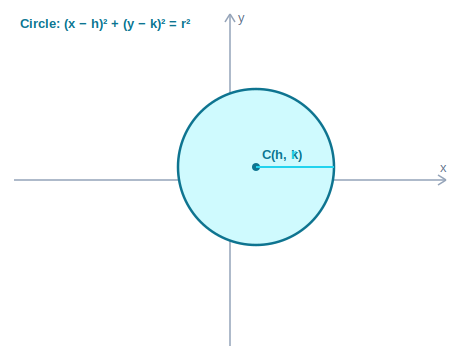
2. The CircleA circle is the set of all points that are a fixed distance, the radius r, from a fixed point, the centre (h, k). Using the distance formula, its equation is (x − h)² + (y − k)² = r². When the centre is the origin this becomes x² + y² = r². The same circle can also appear in the expanded general form x² + y² + 2gx + 2fy + c = 0, whose centre is (−g, −f) and whose radius is √(g² + f² − c).
|
|
The circle: centre C(h, k) and radius r
|
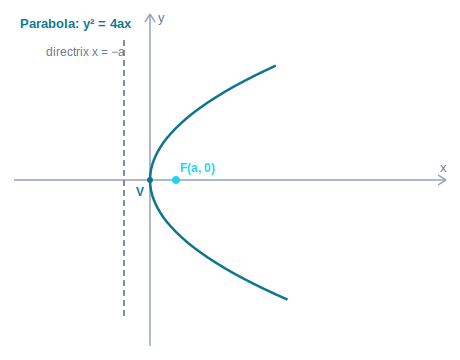
3. The ParabolaA parabola is the set of all points equally far from a fixed point, the focus, and a fixed line, the directrix. Its standard equation, opening to the right, is y² = 4ax, with vertex at the origin, focus at (a, 0) and directrix x = −a. The chord through the focus perpendicular to the axis, the latus rectum, has length 4a. Similar equations describe parabolas opening left (y² = −4ax), upward (x² = 4ay) and downward (x² = −4ay).
|
|
The parabola y² = 4ax: vertex, focus and directrix
|
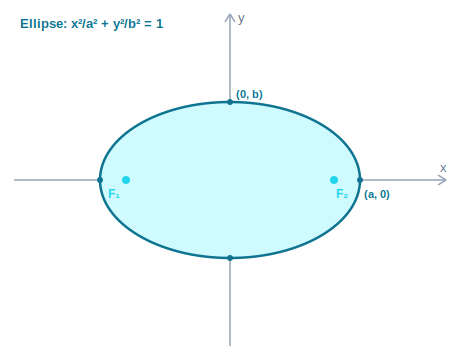
4. The EllipseAn ellipse is the set of all points whose distances from two fixed points, the foci, add up to a constant. Its standard equation is x²/a² + y²/b² = 1 with a > b. The foci sit at (±c, 0) where c² = a² − b², the length 2a is the major axis and 2b the minor axis. The eccentricity e = c/a lies between 0 and 1, and the latus rectum has length 2b²/a. A small e gives a nearly circular ellipse; a larger e gives a flatter one.
|
|
The ellipse: two foci, major and minor axes
|
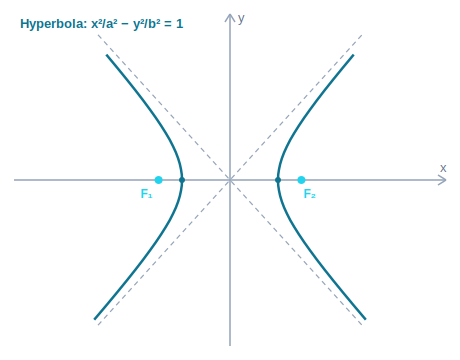
5. The HyperbolaA hyperbola is the set of all points whose distances from two foci have a constant difference. Its standard equation is x²/a² − y²/b² = 1, giving two opening branches. The foci are at (±c, 0) where this time c² = a² + b², so the only change from the ellipse is a plus sign. The eccentricity e = c/a is greater than 1, and the latus rectum again has length 2b²/a. Take care over that single sign: it is the most common slip in this chapter.
|
|
The hyperbola: two branches, foci and asymptotes
|
6. Eccentricity Ties Them TogetherAlthough the four conics look different, one number unites them. The eccentricity e measures how far a conic departs from being a circle. A circle has e = 0, an ellipse has 0 < e < 1, a parabola has e = 1 exactly, and a hyperbola has e > 1. The table below collects the standard equations and key features so you can compare them at a glance.
|
|
The four conics at a glance
|
| 4 |
Key Results & Proofs |
Three results give the equations their meaning. Each comes directly from the distance formula and the definition of the curve.
Statement. The circle with centre (h, k) and radius r has equation (x − h)² + (y − k)² = r². Proof Apply the distance formula to the centre and a general point.
With centre at the origin (h = 0, k = 0) this reduces to the familiar x² + y² = r². |
|||||||||||||
Statement. A parabola with focus (a, 0) and directrix x = −a has equation y² = 4ax. Proof Set the distance to the focus equal to the distance to the directrix.
Putting x = a gives y² = 4a², so y = ±2a; the latus rectum has length 4a. |
|||||||||||||||||||||
Statement. The circle x² + y² + 2gx + 2fy + c = 0 has centre (−g, −f) and radius √(g² + f² − c). Proof Complete the square to turn the general form into the standard form.
If g² + f² − c is negative there is no real circle, since a radius cannot be imaginary. |
||||||||||||||||
| 5 |
Worked Examples |
Question: Find the centre and radius of the circle (x − 2)² + (y + 3)² = 25. ▶ Show full workingCompare with (x − h)² + (y − k)² = r².
Answer: Centre (2, −3), radius 5. |
||||||||
Question: Find the equation of the circle with centre (1, 2) and radius 3. ▶ Show full workingSubstitute into (x − h)² + (y − k)² = r².
Answer: (x − 1)² + (y − 2)² = 9. |
Question: Find the centre and radius of x² + y² − 4x − 6y − 12 = 0. ▶ Show full workingCompare with x² + y² + 2gx + 2fy + c = 0.
Answer: Centre (2, 3), radius 5. |
||||||||||||||||
Question: For the parabola y² = 12x, find the focus, directrix and length of the latus rectum. ▶ Show full workingCompare with y² = 4ax to find a.
Answer: Focus (3, 0), directrix x = −3, latus rectum 12. |
||||||||||||||
Question: Find the equation of the parabola with focus (2, 0) and directrix x = −2. ▶ Show full workingThe focus is (a, 0) and the directrix x = −a, so read off a.
Answer: y² = 8x. |
|||||||||
Question: For the ellipse x²/25 + y²/9 = 1, find a, b, the foci and the eccentricity. ▶ Show full workingCompare with x²/a² + y²/b² = 1, then use c² = a² − b².
Answer: a = 5, b = 3, foci (±4, 0), e = 4/5. |
||||||||||||||||
Question: Find the length of the latus rectum of the ellipse x²/16 + y²/9 = 1. ▶ Show full workingUse latus rectum = 2b²/a, with a the larger semi-axis.
Answer: The latus rectum is 4.5 units. |
|||||||||||||
Question: For the hyperbola x²/9 − y²/16 = 1, find the foci and the eccentricity. ▶ Show full workingCompare with x²/a² − y²/b² = 1, then use c² = a² + b².
Answer: Foci (±5, 0), eccentricity 5/3. |
||||||||||||||||
Question: Find the equation of the ellipse with foci (±3, 0) and a = 5. ▶ Show full workingUse c = 3, a = 5 and b² = a² − c².
Answer: x²/25 + y²/16 = 1. |
Question: Find the equation of the circle with centre (3, 4) that passes through the origin. ▶ Show full workingThe radius is the distance from the centre to the origin.
Answer: (x − 3)² + (y − 4)² = 25. |
Question: For the parabola x² = 8y, find the focus and the directrix. ▶ Show full workingThis parabola opens upward; compare with x² = 4ay.
Answer: Focus (0, 2), directrix y = −2. |
|||||||||||
Question: Find the eccentricity of the hyperbola x²/16 − y²/9 = 1. ▶ Show full workingFind c using c² = a² + b², then e = c/a.
Answer: The eccentricity is 5/4. |
|||||||||||||
| 6 |
Where You Meet This in Real Life |
|
Planetary orbits Planets and comets move around the Sun in ellipses, with the Sun at one focus, a discovery made by Kepler. |
|
Projectiles A ball, a jet of water or a long jump follows a parabolic path under gravity, ignoring air resistance. |
|
Dishes and headlights Satellite dishes, telescopes and car headlights use parabolic shapes to focus or spread out signals and light. |
|
Bridges and arches Suspension cables and many arches take the shape of a parabola, which spreads load smoothly. |
|
Navigation and design Hyperbolas appear in long-range navigation systems and in the cooling towers of power stations, whose curved sides are hyperbolic. |
| 7 |
Practice Sets A to D |
|
Practice Set A – Basics |
|
A1. Find the centre and radius of (x + 1)² + (y − 2)² = 16. ▶ Reveal full workingCompare with the standard form.
Answer: Centre (−1, 2), radius 4. |
|||||||
|
A2. Write the equation of the circle with centre at the origin and radius 7. ▶ Reveal full workingUse x² + y² = r².
Answer: x² + y² = 49. |
|
A3. For the parabola y² = 4x, find the focus. ▶ Reveal full workingCompare with y² = 4ax.
Answer: Focus (1, 0). |
|||||||
|
A4. Is x²/9 + y²/4 = 1 an ellipse or a hyperbola? ▶ Reveal full workingLook at the sign between the two terms.
Answer: An ellipse. |
||||
|
Practice Set B – Conceptual |
|
B1. What shape is formed when a plane cuts a cone parallel to its base? ▶ Reveal full workingThink about the slice across the cone.
Answer: A circle. |
|||||||
|
B2. What is the eccentricity of a circle, and of a parabola? ▶ Reveal full workingRecall the eccentricity scale.
Answer: Circle: e = 0; parabola: e = 1. |
|||||||
|
B3. How does the foci relation differ between an ellipse and a hyperbola? ▶ Reveal full workingCompare the two formulae for c.
Answer: Ellipse uses a minus; hyperbola uses a plus. |
|||||||
|
B4. What is the latus rectum of a conic? ▶ Reveal full workingDescribe the chord through the focus.
Answer: The chord through a focus, perpendicular to the axis. |
|||||||
|
Practice Set C – Application / Numerical |
|
C1. Find the centre and radius of x² + y² − 6x + 4y − 3 = 0. ▶ Reveal full workingCompare with the general form.
Answer: Centre (3, −2), radius 4. |
|||||||||||
|
C2. For the parabola y² = 20x, find the latus rectum and the directrix. ▶ Reveal full workingCompare with y² = 4ax.
Answer: Latus rectum 20, directrix x = −5. |
||||||||||
|
C3. Find the eccentricity of the ellipse x²/100 + y²/64 = 1. ▶ Reveal full workingUse c² = a² − b² and e = c/a.
Answer: e = 0.6. |
||||||||||||
|
C4. Find the foci of the hyperbola x²/25 − y²/144 = 1. ▶ Reveal full workingUse c² = a² + b².
Answer: Foci (±13, 0). |
|||||||||||
|
Practice Set D – HOTS / Word Problems |
|
D1. Find the equation of the ellipse with vertices (±6, 0) and foci (±4, 0). ▶ Reveal full workingRead a and c, then find b² = a² − c².
Answer: x²/36 + y²/20 = 1. |
||||||||||||
|
D2. Find the equation of the parabola with vertex at the origin, axis along the x-axis, passing through (2, 3). ▶ Reveal full workingUse y² = 4ax and substitute the point to find a.
Answer: y² = (9/2)x. |
|
D3. A circle has centre (2, −3) and passes through (5, 1). Find its equation. ▶ Reveal full workingThe radius is the distance from the centre to the given point.
Answer: (x − 2)² + (y + 3)² = 25. |
|
D4. Find the eccentricity of an ellipse whose latus rectum is half its major axis. ▶ Reveal full workingSet 2b²/a equal to half of 2a, then use e² = 1 − b²/a².
Answer: e = 1/√2. |
|
Chapter Summary Everything in One Glance
|
||||||||||||||||||
| 8 |
Are You Exam-Ready? |
|
8-Point Exam Quick-Check
|
||||||||||||||||||||||||||||||||
|
School Revise Virtual Lab Practice the concepts in this chapter with interactive simulations and visual tools.
|
|
Class 11 Mathematics Chapter 10: Conic Sections, Complete Notes and Practice These free Class 11 Maths Chapter 10 Conic Sections notes follow the latest NCERT 2026-27 syllabus and give complete, exam-ready coverage for board exams and competitive foundations. Includes worked examples, step-by-step proofs and graded practice, free on SchoolRevise.com. |
 Google