Curriculum
Mathematics Grade XI
Grade 11 Mathematics
0/14
-
Chapter 1: Sets
 Preview
 -
Chapter 2: Relations and Functions
Preview
-
Chapter 3: Trigonometric Functions
Preview
-
Chapter 4: Complex Numbers and Quadratic Equations
Preview
-
Chapter 5: Linear Inequalities
Preview
-
Chapter 6: Permutations and Combinations
Preview
-
Chapter 7: Binomial Theorem
Preview
-
Chapter 8: Sequences and Series
Preview
-
Chapter 9: Straight Lines
Preview
-
Chapter 10: Conic Sections
Preview
-
Chapter 11: Introduction to Three Dimensional Geometry
Preview
-
Chapter 12: Limits and Derivatives
Preview
-
Chapter 13: Statistics
Preview
-
Chapter 14: Probability
Preview
Worksheets
0/14

Chapter 2: Relations and Functions
|
Class 11 • Mathematics • Chapter 2 Relations and FunctionsHow mathematics connects the elements of one set with another in a clear, ordered way.
|
|
Chapter Roadmap Ordered Pairs • Cartesian Product • Relations • Domain, Codomain & Range • Functions • Types of Functions • Algebra of Real Functions • Real-Life Applications |
| 1 |
Why Relations and Functions Matter |
Think about how your school stores data. Every student is tied to a unique roll number, every roll number is tied to a single set of marks, and every subject is tied to a teacher. Each of these is really a pairing between two groups of objects, and that simple idea of pairing is what this chapter formalises.
In Class 11 you already know what a set is. This chapter takes the next step: it studies how the elements of one set can be matched with the elements of another. When the matching follows one special rule, that every input gets exactly one output, we call it a function, the single most important object in all of higher mathematics. Functions describe how distance depends on time, how an OTT app maps each viewer to recommendations, and how a calculator turns one number into another.
A relation is any set of ordered pairs linking two sets. A function is a relation where every element of the first set is linked to exactly one element of the second. Every function is a relation, but not every relation is a function.
|
| 2 |
Key Terms You Must Know |
| Term | Meaning | Example |
| Ordered pair | Two elements written in a fixed order, (a, b); order matters so (a, b) ≠ (b, a) unless a = b. | (2, 5) is different from (5, 2) |
| Cartesian product A × B | The set of all ordered pairs whose first element is from A and second from B. | A = {1, 2}, B = {x} → A × B = {(1, x), (2, x)} |
| Relation R | Any subset of A × B; it links some elements of A to elements of B. | R = {(1, x)} on the sets above |
| Domain | The set of all first elements that actually appear in the relation. | Domain of {(1, x)} is {1} |
| Codomain | The whole set B from which outputs are allowed. | B = {x, y} |
| Range | The set of second elements that actually appear; a subset of the codomain. | Range of {(1, x)} is {x} |
| Function | A relation where each input has exactly one output. | f(x) = x + 3 |
| 3 |
Core Concepts, Step by Step |
1. Ordered Pairs and Their EqualityAn ordered pair (a, b) records two objects in a definite order. The first slot is the first coordinate, the second slot the second coordinate. Two ordered pairs are equal only when both coordinates match: (a, b) = (c, d) means a = c and b = d. So (3, 7) and (7, 3) are different points, just as the seat (Row 3, Seat 7) is not the same as (Row 7, Seat 3).
|
2. The Cartesian Product A × BGiven two non-empty sets A and B, the Cartesian product A × B is the collection of every ordered pair (a, b) with a ∈ A and b ∈ B. If A has m elements and B has n elements, then A × B has exactly m × n ordered pairs, written n(A × B) = n(A) · n(B). Note that A × B and B × A are generally different sets.
|
3. Relations: Picking Out the Pairs You Care AboutA relation R from A to B is simply a subset of A × B. You choose the pairs that satisfy some rule, such as “is double of” or “is less than”. The domain is the set of all first coordinates used, the range is the set of all second coordinates used, and the codomain is the full set B. If A × B has m · n pairs, then the total number of possible relations from A to B is 2 raised to the power (m · n), because each pair is either in R or out of it.
|
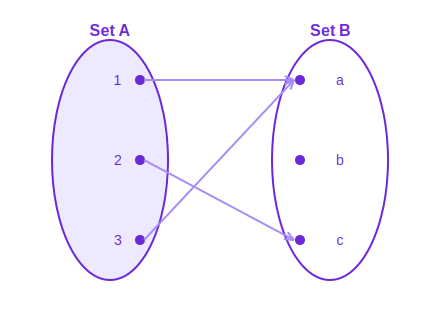
4. Functions: The Special RelationsA relation f from A to B is a function if every element of A is paired with one and only one element of B. No input may be left out, and no input may point to two different outputs. We write f : A → B and f(x) = y, meaning y is the image of x. The set A is the domain, B is the codomain, and the set of all actual images is the range. The mapping diagram below shows the idea at a glance.
|
|
A function as a mapping: each input has exactly one arrow out
|
5. Standard Real FunctionsNCERT highlights several real-valued functions you must recognise:
• Identity f(x) = x, output equals input. • Constant f(x) = c, same output for every input. • Polynomial f(x) = a₀ + a₁x + a₂x² + … with whole-number powers. • Rational f(x) = p(x) / q(x), defined wherever q(x) ≠ 0. • Modulus f(x) = |x|, which returns the non-negative size of x. • Signum f(x) = 1, 0, or −1 according to whether x is positive, zero, or negative. • Greatest integer f(x) = [x], the largest integer not exceeding x, so [2.7] = 2 and [−1.3] = −2. |
|
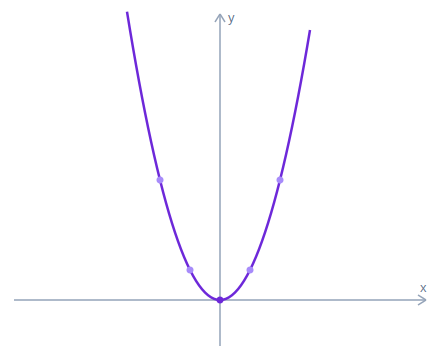
Graph of the square function f(x) = x²
|
6. Algebra of Real FunctionsIf f and g are real functions with overlapping domains, you can combine them: (f + g)(x) = f(x) + g(x), (f − g)(x) = f(x) − g(x), and (fg)(x) = f(x) · g(x). You can also scale a function by a real number k to get (kf)(x) = k · f(x). The quotient (f / g)(x) = f(x) / g(x) is defined only where g(x) ≠ 0. The domain of a combined function is the intersection of the two domains (with zeros of g removed for division).
|
| 4 |
Key Results & Proofs |
This chapter is built mostly on definitions, but two counting results are genuinely proved. Here they are, reasoned line by line; everything else in the chapter follows from the definitions of pair, relation and function.
Statement. If n(A) = m and n(B) = n, then n(A × B) = m × n. Proof Counting ordered pairs is a two-step choice.
Every one of the m first-coordinates pairs with all n second-coordinates, so there are m × n ordered pairs in all. |
|||||||||||||||
Statement. If n(A) = m and n(B) = n, the number of possible relations from A to B is 2^(m·n). Proof A relation is any subset of A × B, so we count subsets.
Each distinct pattern of keep/drop choices is a different relation, so there are exactly 2^(m·n) of them, including the empty relation and the whole set A × B. |
||||||||||||||||||||
| 5 |
Worked Examples |
Question: If A = {1, 2} and B = {a, b}, write A × B and find n(A × B). ▶ Show full workingA × B is every pairing with the first element from A and the second from B.
Answer: A × B = {(1, a), (1, b), (2, a), (2, b)}; n(A × B) = 4. |
Question: If n(A) = 3 and n(B) = 4, how many relations are possible from A to B? ▶ Show full workingCount all the pairs first; then each pair is either kept or dropped.
Answer: 4096 relations. |
Question: Given (x + 1, 5) = (3, 2y − 1), find x and y. ▶ Show full workingEqual ordered pairs mean equal first parts and equal second parts.
Answer: x = 2, y = 3. |
Question: Let A = {1, 2, 3, 4} and R = {(a, b) : b = a + 1}. Write R, its domain and range. ▶ Show full workingTest each value of a; the partner b must also belong to A.
Answer: R = {(1, 2), (2, 3), (3, 4)}; domain {1, 2, 3}, range {2, 3, 4}. |
|||||||||||||||||
Question: Is R = {(1, 2), (1, 3), (2, 4)} a function from {1, 2} to {2, 3, 4}? ▶ Show full workingA function allows each input exactly one output, so check every input.
Answer: No, R is not a function. |
||||||||
Question: If f(x) = x² − 3x + 2, find f(0), f(2) and f(−1). ▶ Show full working‘f(0)’ means replace every x in the formula with 0, and so on.
Answer: f(0) = 2, f(2) = 0, f(−1) = 6. |
Question: Find the domain and range of f(x) = |x − 2|. ▶ Show full workingThe modulus measures size, so it accepts any input and never returns a negative.
Answer: Domain R; range [0, ∞). |
|||||||||||||
Question: Evaluate the signum function at x = 4, x = 0 and x = −7. ▶ Show full workingSignum reports only the sign of a number: +1, 0 or −1.
Answer: 1, 0 and −1 respectively. |
Question: If [x] is the greatest integer function, find [3.6], [−2.4] and [5]. ▶ Show full working[x] rounds down to the integer at or below x, never up.
Answer: 3, −3 and 5. |
Question: If f(x) = x + 1 and g(x) = 2x, find (f + g)(x), (fg)(x) and (f / g)(3). ▶ Show full workingAdd or multiply the formulas; for division, work each out at 3 then divide.
Answer: 3x + 1; 2x² + 2x; (f / g)(3) = 2/3. |
Question: Find the domain of f(x) = 1 / (x − 5). ▶ Show full workingWe may never divide by zero, so keep the denominator non-zero.
Answer: Domain = R − {5}. |
Question: Find the domain of f(x) = √(x − 3). ▶ Show full workingA square root needs the inside to be zero or positive.
Answer: Domain = [3, ∞). |
||||||||
| 6 |
Where You Meet This in Real Life |
|
Databases and spreadsheets Every lookup table, whether roll number to marks or product code to price, is a function: one key, one value. Relational databases are literally built on the idea of relations between sets of data. |
|
Maps and GPS A location is an ordered pair of coordinates (latitude, longitude). The order matters, exactly like ordered pairs, which is why swapping the two values lands you in a different place. |
|
Recommendation engines Streaming and shopping apps define a function from each viewer to a list of suggestions, recomputed as your inputs change. |
|
Currency and unit conversion Converting rupees to dirhams, or kilometres to miles, is a function: one amount in gives one amount out through a fixed rule. |
|
Computer programming Every program function takes inputs and returns one defined output, the exact mathematical idea of a function, used billions of times a day. |
| 7 |
Practice Sets A-D |
|
Practice Set A – Basics |
|
A1. If A = {p, q} and B = {1, 2, 3}, write A × B and state n(A × B). ▶ Reveal full workingPair each element of A with each element of B.
Answer: A × B as listed; n(A × B) = 6. |
|
A2. Find x and y if (2x, y + 1) = (6, 4). ▶ Reveal full workingMatch the first and second coordinates separately.
Answer: x = 3, y = 3. |
|
A3. State the domain and range of {(1, 4), (2, 5), (3, 6)}. ▶ Reveal full workingDomain = the first numbers; range = the second numbers.
Answer: Domain {1, 2, 3}; range {4, 5, 6}. |
|
A4. If f(x) = 3x − 2, find f(1) and f(−2). ▶ Reveal full workingReplace x by the given number each time.
Answer: f(1) = 1, f(−2) = −8. |
|
Practice Set B – Conceptual |
|
B1. Is every relation a function? Justify with an example. ▶ Reveal full workingA function needs each input to have exactly one output.
Answer: No; only relations with unique outputs are functions. |
|||||||
|
B2. How many relations are possible from a set with 2 elements to a set with 3 elements? ▶ Reveal full workingCount the pairs, then use 2 choices per pair.
Answer: 64. |
|
B3. Classify f(x) = 7 and g(x) = x as standard functions. ▶ Reveal full workingLook at what each function returns.
Answer: f is constant; g is identity. |
|||||||
|
B4. Why is the greatest integer of −0.5 equal to −1 and not 0? ▶ Reveal full working[x] rounds down to the integer at or below x.
Answer: [−0.5] = −1. |
|||||||
|
Practice Set C – Application / Numerical |
|
C1. Find the domain of f(x) = (x + 2) / (x² − 9). ▶ Reveal full workingThe bottom of a fraction cannot be zero.
Answer: Domain = R − {−3, 3}. |
||||||||||||
|
C2. If f(x) = x² and g(x) = x − 1, find (f − g)(x) and (fg)(2). ▶ Reveal full workingSubtract the formulas; for (fg)(2) evaluate each at 2 then multiply.
Answer: x² − x + 1; (fg)(2) = 4. |
|
C3. Find the range of f(x) = x² + 1 for real x. ▶ Reveal full workingSquaring any real number never gives a negative.
Answer: Range = [1, ∞). |
|||||||
|
C4. Find the domain of f(x) = √(4 − x). ▶ Reveal full workingThe inside of the root must be 0 or positive.
Answer: Domain = (−∞, 4]. |
|||||||
|
Practice Set D – HOTS / Multi-step |
|
D1. If A × B has 9 elements and two of them are (1, 3) and (2, 5), find possible sets A and B. ▶ Reveal full working9 = n(A) × n(B); the simplest split is 3 × 3.
Answer: n(A) = n(B) = 3; e.g. A = {1, 2, 3}, B = {3, 5, 7}. |
|||||||||||
|
D2. Find the domain of f(x) = √(x − 1) / (x − 4). ▶ Reveal full workingTwo rules apply: the inside of the root ≥ 0, and the bottom ≠ 0.
Answer: Domain = [1, 4) ∪ (4, ∞). |
||||||||||
|
D3. If f(x) = (x − 1)/(x + 1), show that f(1/x) = −f(x) for x ≠ 0, −1. ▶ Reveal full workingReplace x by 1/x, clear the small fractions, then compare with −f(x).
Answer: f(1/x) = −f(x), as required. |
||||||||||||||||
|
D4. A relation R on {1, 2, 3, 4, 5, 6} is defined by (a, b) ∈ R if b is exactly divisible by a. Write the domain and range of R. ▶ Reveal full workingFor each a, list the multiples b that lie in the set.
Answer: Domain = range = {1, 2, 3, 4, 5, 6}. |
||||||||||||
|
Chapter Summary Everything in One Glance
|
||||||||||||||||||
| 8 |
Are You Exam-Ready? |
|
8-Point Exam Quick-Check
|
||||||||||||||||||||||||||||||||
|
School Revise Virtual Lab Practice the concepts in this chapter with interactive simulations and visual tools.
|
|
Class 11 Mathematics Chapter 2: Relations and Functions, Complete Notes and Practice These free Class 11 Maths Chapter 2 Relations and Functions notes are fully aligned with the latest NCERT 2026-27 syllabus and cover every topic students need for board exams and competitive foundations. Includes worked examples, step-by-step proofs and graded practice, free on SchoolRevise.com. |
 Google