Curriculum
Mathematics Grade XI
Grade 11 Mathematics
0/14
-
Chapter 1: Sets
 Preview
 -
Chapter 2: Relations and Functions
Preview
-
Chapter 3: Trigonometric Functions
Preview
-
Chapter 4: Complex Numbers and Quadratic Equations
Preview
-
Chapter 5: Linear Inequalities
Preview
-
Chapter 6: Permutations and Combinations
Preview
-
Chapter 7: Binomial Theorem
Preview
-
Chapter 8: Sequences and Series
Preview
-
Chapter 9: Straight Lines
Preview
-
Chapter 10: Conic Sections
Preview
-
Chapter 11: Introduction to Three Dimensional Geometry
Preview
-
Chapter 12: Limits and Derivatives
Preview
-
Chapter 13: Statistics
Preview
-
Chapter 14: Probability
Preview
Chapter 12: Limits and Derivatives
|
Class 11 • Mathematics • Chapter 12 Limits and DerivativesThe first taste of calculus: getting close to a value, and measuring how fast things change.
|
|
Chapter Roadmap Idea of a Limit • Algebra of Limits • Limits of Polynomials • Standard Limits • Derivative From First Principles • Rules of Differentiation • Key Results • Applications |
| 1 |
Why Limits and Derivatives Matter |
Calculus is the mathematics of change, and this chapter is your first step into it. A limit asks what value a function heads towards as the input gets closer and closer to some number, even if it never quite arrives. A derivative then uses limits to measure the exact rate at which a quantity is changing, such as the speed of a car at one instant or the slope of a curve at one point.
These two ideas power almost all of modern science and engineering. Speed, acceleration, growth rates, and the slope of a graph are all derivatives. In this chapter you will build an intuitive feel for limits, learn the rules for working them out, meet two standard limits that appear everywhere, and then define the derivative from first principles before using quick rules to differentiate common functions.
A limit is the value a function approaches as x approaches a chosen number. The derivative f′(x) is a special limit that gives the slope of the curve, and equals limₕ→₀ [f(x + h) − f(x)] / h.
|
| 2 |
Key Terms You Must Know |
| Term | Meaning | Example |
| Limit | The value a function f(x) approaches as x approaches a number a. | limₓ→₂ (x + 3) = 5 |
| Algebra of limits | Limits add, subtract, multiply and divide like ordinary numbers. | lim(f + g) = lim f + lim g |
| Indeterminate 0/0 | A form that needs more work, such as factoring, before the limit is found. | (x² − 9)/(x − 3) at x = 3 |
| Standard limit | A known limit used as a building block. | limₓ→₀ (sin x)/x = 1 |
| Derivative | The instantaneous rate of change, written f′(x) or dy/dx. | slope of the curve at a point |
| First principles | Finding a derivative straight from the limit definition. | f′(x) = limₕ→₀ [f(x+h) − f(x)]/h |
| Differentiation | The process of finding a derivative. | d/dx (x²) = 2x |
| 3 |
Core Concepts, Step by Step |
1. The Intuitive Idea of a LimitA limit describes where a function is heading. We write limₓ→ₐ f(x) = L to mean that as x gets closer and closer to a, the value f(x) gets closer and closer to L. The point a itself need not be in the picture; what matters is the value the function is approaching from both sides. The table below shows the values of f(x) = x² as x closes in on 2 from below and from above; the outputs close in on 4.
|
|
Values of f(x) = x² as x approaches 2
|
2. The Algebra of LimitsLimits behave just like ordinary arithmetic, which makes them easy to handle. If lim f(x) and lim g(x) both exist, then the limit of a sum is the sum of the limits, the limit of a product is the product of the limits, and the limit of a quotient is the quotient of the limits (provided the bottom limit is not 0). A constant multiple comes straight out: lim [k f(x)] = k lim f(x). These rules let us break a complicated limit into simple pieces.
|
3. Limits of Polynomials and Rational FunctionsFor a polynomial, the limit as x approaches a is found by simply substituting x = a, because polynomials are smooth and unbroken. For a rational function (one polynomial divided by another), substitute first; if the bottom is not 0 you are done. If substitution gives the indeterminate form 0/0, it means a common factor is hiding, so factorise the top and bottom, cancel the common factor, and then substitute. This single technique solves most rational limits in the chapter.
|
4. Two Standard LimitsTwo limits appear so often that they are worth knowing by heart. The first is the trigonometric limit limₓ→₀ (sin x)/x = 1, where x is measured in radians. The second is the algebraic limit limₓ→ₐ (xⁿ − aⁿ)/(x − a) = n aⁿ₋¹. Many harder limits are solved by rearranging them until one of these standard forms appears, then replacing it with its known value.
|
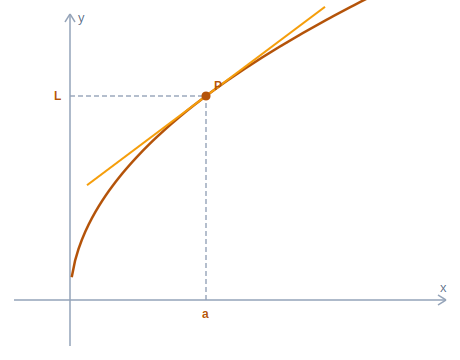
5. The Derivative From First PrinciplesThe derivative of a function f at a point measures how fast f is changing there, and equals the slope of the curve at that point. By definition, f′(x) = limₕ→₀ [f(x + h) − f(x)] / h. The fraction is the slope of the line joining two nearby points on the curve; as h shrinks to 0, that line becomes the tangent, and its slope is the derivative. Working a derivative out straight from this definition is called using first principles.
|
|
A curve: as x → a, f(x) → L, and the tangent at P has slope f ′(a)
|
6. Rules of DifferentiationOnce a few derivatives are known, rules let us differentiate quickly without first principles every time. The power rule gives d/dx (xⁿ) = n xⁿ₋¹, the derivative of a constant is 0, and derivatives add term by term. For products, (uv)′ = u′v + uv′, and for quotients, (u/v)′ = (u′v − uv′)/v². The standard trigonometric derivatives are d/dx (sin x) = cos x and d/dx (cos x) = −sin x. The table below lists the ones used most often.
|
|
Standard derivatives to know
|
| 4 |
Key Results & Proofs |
Three results show where the differentiation rules come from. Each is built straight from the definition of a limit or a derivative.
Statement. For a positive whole number n, the derivative of xⁿ is n xⁿ₋¹. Proof Use the derivative as a limit and the standard limit for (xⁿ − aⁿ)/(x − a).
So d/dx (x₅) = 5x⁴, and d/dx (x) = 1, since the power 1 gives 1·x⁰ = 1. |
|||||||||||||||||
Statement. The derivative of a constant is 0, and the derivative of a sum is the sum of the derivatives. Proof Apply the first-principles definition to a constant and to a sum.
With the power rule, this lets us differentiate any polynomial term by term. |
||||||||||||||||
Statement. The derivative of sin x is cos x. Proof Expand sin(x + h), then use the two standard limits.
A similar argument gives d/dx (cos x) = −sin x. |
||||||||||||||||||||
| 5 |
Worked Examples |
Question: Evaluate limₓ→₂ (x² + 3). ▶ Show full workingA polynomial is smooth, so just substitute x = 2.
Answer: The limit is 7. |
Question: Evaluate limₓ→₃ (x² − 9)/(x − 3). ▶ Show full workingSubstituting gives 0/0, so factorise and cancel first.
Answer: The limit is 6. |
|||||||||||||||||
Question: Evaluate limₓ→₀ (sin x)/x. ▶ Show full workingThis is one of the two standard limits.
Answer: The limit is 1. |
Question: Evaluate limₓ→₀ (sin 3x)/x. ▶ Show full workingMake the inside of sin match the denominator, then use the standard limit.
Answer: The limit is 3. |
|||||||||||||
Question: Evaluate limₓ→₂ (x⁵ − 32)/(x − 2). ▶ Show full workingThis matches the standard limit (xⁿ − aⁿ)/(x − a) with n = 5, a = 2.
Answer: The limit is 80. |
|||||||||||||
Question: Find the derivative of f(x) = x² from first principles. ▶ Show full workingUse f′(x) = limₕ→₀ [f(x + h) − f(x)] / h.
Answer: f′(x) = 2x. |
Question: Differentiate y = x⁷. ▶ Show full workingUse the power rule d/dx (xⁿ) = n xⁿ₋¹.
Answer: dy/dx = 7x⁶. |
Question: Differentiate y = 3x² + 5x − 2. ▶ Show full workingDifferentiate term by term using the power and constant rules.
Answer: dy/dx = 6x + 5. |
Question: Differentiate y = sin x + cos x. ▶ Show full workingUse the standard trigonometric derivatives.
Answer: dy/dx = cos x − sin x. |
Question: Differentiate y = x² sin x. ▶ Show full workingThis is a product, so use (uv)′ = u′v + uv′ with u = x² and v = sin x.
Answer: dy/dx = 2x sin x + x² cos x. |
Question: Differentiate y = (2x + 1)/(x − 1). ▶ Show full workingThis is a quotient, so use (u/v)′ = (u′v − uv′)/v².
Answer: dy/dx = −3/(x − 1)². |
Question: Find the derivative of f(x) = 1/x from first principles. ▶ Show full workingUse the definition and combine the fractions over a common denominator.
Answer: f′(x) = −1/x². |
| 6 |
Where You Meet This in Real Life |
|
Speed and motion Speed is the derivative of distance with respect to time, and acceleration is the derivative of speed, so calculus describes all motion. |
|
Rates of change How fast a population grows, a tank fills, or a temperature falls are all derivatives of one quantity with respect to another. |
|
Slopes and design The derivative gives the slope of a curve at a point, used to design smooth roads, ramps and curved surfaces. |
|
Economics Marginal cost and marginal revenue, which guide business decisions, are derivatives of cost and revenue. |
|
Physics and engineering From electric currents to the cooling of an engine, limits and derivatives are the language used to model change precisely. |
| 7 |
Practice Sets A to D |
|
Practice Set A – Basics |
|
A1. Evaluate limₓ→₁ (3x + 2). ▶ Reveal full workingSubstitute x = 1.
Answer: 5. |
|
A2. Evaluate limₓ→₀ (x² + 5). ▶ Reveal full workingSubstitute x = 0.
Answer: 5. |
|
A3. Differentiate y = x⁴. ▶ Reveal full workingUse the power rule.
Answer: 4x³. |
|
A4. Differentiate the constant function y = 7. ▶ Reveal full workingThe derivative of a constant is 0.
Answer: 0. |
|
Practice Set B – Conceptual |
|
B1. What does limₓ→ₐ f(x) = L mean in plain words? ▶ Reveal full workingDescribe how the output behaves.
Answer: As x approaches a, f(x) approaches L. |
|||||||
|
B2. State the value of limₓ→₀ (sin x)/x. ▶ Reveal full workingRecall the standard limit (x in radians).
Answer: 1. |
||||
|
B3. Write the first-principles definition of the derivative. ▶ Reveal full workingIt is a limit of a difference quotient.
Answer: f′(x) = limₕ→₀ [f(x + h) − f(x)]/h. |
|
B4. Is the derivative of a sum equal to the sum of the derivatives? ▶ Reveal full workingRecall the sum rule.
Answer: Yes, by the sum rule. |
|||||||
|
Practice Set C – Application / Numerical |
|
C1. Evaluate limₓ→₂ (x² − 4)/(x − 2). ▶ Reveal full workingIt is 0/0, so factorise and cancel.
Answer: 4. |
|
C2. Evaluate limₓ→₀ (sin 5x)/x. ▶ Reveal full workingMatch the inside of sin to the denominator.
Answer: 5. |
|
C3. Differentiate y = 4x³ − 2x + 7. ▶ Reveal full workingDifferentiate term by term.
Answer: 12x² − 2. |
|
C4. Differentiate y = x³ cos x. ▶ Reveal full workingUse the product rule with u = x³, v = cos x.
Answer: 3x² cos x − x³ sin x. |
|
Practice Set D – HOTS / Word Problems |
|
D1. Find the derivative of f(x) = x³ from first principles. ▶ Reveal full workingExpand (x + h)³ and simplify before letting h → 0.
Answer: f′(x) = 3x². |
|
D2. Evaluate limₓ→₃ (x⁴ − 81)/(x − 3). ▶ Reveal full workingUse the standard limit with n = 4, a = 3 (since 81 = 3⁴).
Answer: 108. |
|
D3. Differentiate y = (x² + 1)/x. ▶ Reveal full workingSplit the fraction first, then differentiate.
Answer: 1 − 1/x². |
|
D4. Evaluate limₓ→₀ (sin 2x)/(sin 3x). ▶ Reveal full workingTurn each part into a standard limit form.
Answer: 2/3. |
||||||||||||
|
Chapter Summary Everything in One Glance
|
||||||||||||||||||
| 8 |
Are You Exam-Ready? |
|
8-Point Exam Quick-Check
|
||||||||||||||||||||||||||||||||
|
School Revise Virtual Lab Practice the concepts in this chapter with interactive simulations and visual tools.
|
|
Class 11 Mathematics Chapter 12: Limits and Derivatives, Complete Notes and Practice These free Class 11 Maths Chapter 12 Limits and Derivatives notes follow the latest NCERT 2026-27 syllabus and give complete, exam-ready coverage for board exams and competitive foundations. Includes worked examples, step-by-step proofs and graded practice, free on SchoolRevise.com. |
 Google