Curriculum
Mathematics Grade XI
Grade 11 Mathematics
0/14
-
Chapter 1: Sets
 Preview
 -
Chapter 2: Relations and Functions
Preview
-
Chapter 3: Trigonometric Functions
Preview
-
Chapter 4: Complex Numbers and Quadratic Equations
Preview
-
Chapter 5: Linear Inequalities
Preview
-
Chapter 6: Permutations and Combinations
Preview
-
Chapter 7: Binomial Theorem
Preview
-
Chapter 8: Sequences and Series
Preview
-
Chapter 9: Straight Lines
Preview
-
Chapter 10: Conic Sections
Preview
-
Chapter 11: Introduction to Three Dimensional Geometry
Preview
-
Chapter 12: Limits and Derivatives
Preview
-
Chapter 13: Statistics
Preview
-
Chapter 14: Probability
Preview
Worksheets
0/14

Chapter 11: Introduction to Three Dimensional Geometry
|
Class 11 • Mathematics • Chapter 11 Introduction to Three Dimensional GeometryAdding a third axis so we can describe points anywhere in space, not just on a flat page.
|
|
Chapter Roadmap From 2D to 3D • Coordinate Planes • Octants • Coordinates of a Point • Signs in Each Octant • Distance Between Points • Key Results • Applications |
| 1 |
Why Three Dimensional Geometry Matters |
Everything you have plotted so far has lived on a flat plane, using just two numbers, x and y. But the real world has depth as well as width and height, so to locate a point in a room, in the sky, or in a 3D model on a computer, we need a third number. This chapter adds one more axis, the z-axis, and shows how three numbers (x, y, z) pin down any point in space.
Once we can name points in space, we can measure the straight-line distance between any two of them, just as we did on the plane, but now with three differences instead of two. The ideas here are the gateway to vectors, to the geometry of planes and lines in space that you meet in Class 12, and to fields like engineering, architecture and computer graphics, where everything is built in three dimensions.
A point in space needs three coordinates (x, y, z). The three axes create three coordinate planes and divide all of space into eight regions called octants. The distance between two points uses all three differences under one square root.
|
| 2 |
Key Terms You Must Know |
| Term | Meaning | Example |
| Axes in space | Three mutually perpendicular lines: the x-axis, y-axis and z-axis. | They meet at the origin O |
| Coordinate planes | The xy-plane, yz-plane and zx-plane formed by pairs of axes. | The floor of a room is like the xy-plane |
| Octant | One of the eight regions into which the three planes divide space. | The first octant has all coordinates positive |
| Coordinates of a point | The ordered triple (x, y, z) that locates a point in space. | (2, 3, 5) |
| Origin | The point where the three axes meet, with coordinates (0, 0, 0). | O = (0, 0, 0) |
| Distance formula | The straight-line distance between two points in space. | √[(x₂−x₁)² + (y₂−y₁)² + (z₂−z₁)²] |
| Projection | Dropping a point onto a plane by setting one coordinate to 0. | (2,3,5) projects to (2,3,0) on the xy-plane |
| 3 |
Core Concepts, Step by Step |
1. From Two Dimensions to ThreeOn the plane, two perpendicular axes, x and y, let us locate any point with two numbers. In space we add a third axis, the z-axis, perpendicular to both of the others, so the three axes meet at the origin like the corner of a room where two walls meet the floor. A point now needs three numbers (x, y, z): how far along, how far across, and how far up. We use a right-handed system, the standard convention in all of mathematics and physics.
|
2. The Three Coordinate PlanesEach pair of axes determines a flat plane. The x-axis and y-axis form the xy-plane, the y-axis and z-axis form the yz-plane, and the z-axis and x-axis form the zx-plane. A point lies in the xy-plane exactly when its z-coordinate is 0, in the yz-plane when its x-coordinate is 0, and in the zx-plane when its y-coordinate is 0. These three planes are the walls and floor against which every point is measured.
|
3. Coordinates of a Point in SpaceTo find the coordinates of a point P in space, measure its perpendicular distances to the three coordinate planes, taking signs into account. The result is an ordered triple (x, y, z). Here x is the distance from the yz-plane, y the distance from the zx-plane and z the distance from the xy-plane. The origin is (0, 0, 0); a point on the x-axis has the form (x, 0, 0), and a point in the xy-plane has the form (x, y, 0).
|
|
3D axes: a point P(x, y, z) and its distance from the origin
|
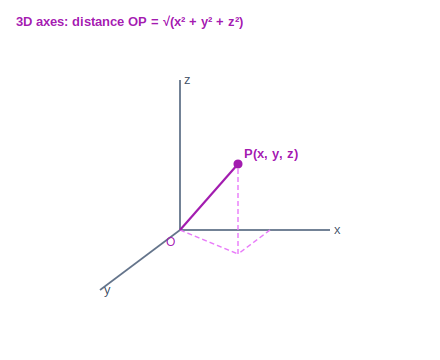
4. The Eight Octants and Their SignsThe three coordinate planes slice space into eight regions called octants, just as the two axes split the plane into four quadrants. The first octant has all three coordinates positive. The other seven are found by changing the signs of one, two or all three coordinates. The table below lists the sign pattern of each octant so you can name the octant of any point at sight.
|
|
Signs of the coordinates in each octant
|
5. Distance Between Two PointsThe straight-line distance between two points P(x₁, y₁, z₁) and Q(x₂, y₂, z₂) is d = √[(x₂ − x₁)² + (y₂ − y₁)² + (z₂ − z₁)²]. It is the same idea as the distance formula on the plane, but with a third squared difference for the z-direction. The formula comes from applying Pythagoras twice, which we prove in the next section.
|
6. Distance From the Origin and From the AxesPutting the origin (0, 0, 0) into the distance formula gives the distance of a point (x, y, z) from the origin as √(x² + y² + z²). With distances alone we can also test geometric facts: three points are collinear when the longest of the three pairwise distances equals the sum of the other two, and a triangle is right-angled when its three squared distances satisfy the Pythagoras relation.
|
| 4 |
Key Results & Proofs |
The central result of this chapter is the distance formula. Everything else, including the distance from the origin and tests for collinearity, follows from it.
Statement. The distance between P(x₁, y₁, z₁) and Q(x₂, y₂, z₂) is d = √[(x₂−x₁)² + (y₂−y₁)² + (z₂−z₁)²]. Proof Apply Pythagoras twice: once on the base of a box, then to the diagonal.
This is exactly the plane distance formula with one extra term for the z-direction. |
|||||||||||||||||||
Statement. The distance of the point (x, y, z) from the origin is √(x² + y² + z²). Proof This is the distance formula with one point taken as the origin.
So the point (3, 4, 12) is at distance √(9 + 16 + 144) = √169 = 13 from the origin. |
|||||||||||||
Statement. Three points are collinear if the largest of their three pairwise distances equals the sum of the other two. Proof On a straight line, the two shorter gaps add up to the whole.
For example AB + BC = AC means B lies on the segment from A to C. |
|||||||||||||||
| 5 |
Worked Examples |
Question: Name the octant in which the point (1, 2, 3) lies. ▶ Show full workingCheck the sign of each coordinate against the octant table.
Answer: Octant I. |
||||||||
Question: Name the octant of the point (−1, 2, −3). ▶ Show full workingFind the sign pattern and match the table.
Answer: Octant VI. |
||||||||
Question: Write the coordinates of a point that lies on the x-axis. ▶ Show full workingA point on the x-axis has no y or z displacement.
Answer: Any point of the form (x, 0, 0), for example (5, 0, 0). |
||||||||
Question: Find the distance of the point (2, 3, 6) from the origin. ▶ Show full workingUse d = √(x² + y² + z²).
Answer: The distance is 7 units. |
Question: Find the distance between (1, −3, 4) and (4, 1, 4). ▶ Show full workingUse the distance formula in space.
Answer: The distance is 5 units. |
Question: Find the distance between (−1, 3, −4) and (1, −3, 4). ▶ Show full workingApply the distance formula carefully with the signs.
Answer: The distance is 2√26 units. |
Question: Show that the points A(0, 7, 10), B(−1, 6, 6) and C(−4, 9, 6) form a right-angled isosceles triangle. ▶ Show full workingFind the three squared distances and check for equal sides and the Pythagoras relation.
Answer: It is a right-angled isosceles triangle, right-angled at B. |
||||||||||||||||||||
Question: Find the coordinates of the point where (2, 3, 4) lands when projected onto the xy-plane. ▶ Show full workingProjection onto the xy-plane sets the z-coordinate to 0.
Answer: (2, 3, 0). |
||||||||
Question: Find the distance of the point (3, 4, 12) from the origin. ▶ Show full workingUse d = √(x² + y² + z²).
Answer: The distance is 13 units. |
Question: Are the points A(1, 2, 3), B(2, 3, 4) and C(3, 4, 5) collinear? ▶ Show full workingFind the three distances and check whether the longest equals the sum of the other two.
Answer: Yes, the three points are collinear. |
|||||||||||||||||
Question: Name the octant of the point (5, −2, −7). ▶ Show full workingFind the sign pattern and match the table.
Answer: Octant VIII. |
||||||||
Question: A point P(x, y, z) is equidistant from A(1, 2, 3) and B(3, 2, 1). Find the relation between its coordinates. ▶ Show full workingSet PA² = PB² and simplify.
Answer: The relation is x = z. |
| 6 |
Where You Meet This in Real Life |
|
Maps and GPS Locating a point on Earth, or an aircraft in the sky, needs three numbers: two for position and one for height or depth. |
|
Architecture and engineering Buildings, bridges and machine parts are designed in three dimensions, with every joint given coordinates in space. |
|
Computer graphics and games Every object in a 3D game or film is built from points with (x, y, z) coordinates that the computer moves and projects onto the screen. |
|
Robotics A robot arm reaches a point in space by setting the three coordinates of its gripper, then computing distances to move. |
|
Medical imaging Scans such as MRI build a three-dimensional picture of the body from points measured throughout space. |
| 7 |
Practice Sets A to D |
|
Practice Set A – Basics |
|
A1. Name the octant of the point (2, 3, 4). ▶ Reveal full workingCheck the signs.
Answer: Octant I. |
|||||||
|
A2. Write the coordinates of the point on the z-axis at height 5. ▶ Reveal full workingOn the z-axis both x and y are 0.
Answer: (0, 0, 5). |
|||||||
|
A3. Find the distance between the origin and (1, 2, 2). ▶ Reveal full workingUse √(x² + y² + z²).
Answer: 3 units. |
|
A4. Which coordinate is zero for a point in the yz-plane? ▶ Reveal full workingRecall which axis is missing from that plane.
Answer: The x-coordinate is 0. |
|||||||
|
Practice Set B – Conceptual |
|
B1. Into how many regions do the three coordinate planes divide space? ▶ Reveal full workingCompare with the four quadrants of the plane.
Answer: Eight octants. |
|||||||
|
B2. What is the condition for a point to lie in the xy-plane? ▶ Reveal full workingThink about the missing direction.
Answer: Its z-coordinate is 0. |
|||||||
|
B3. Name the three coordinate planes. ▶ Reveal full workingEach is formed by a pair of axes.
Answer: The xy-plane, yz-plane and zx-plane. |
||||
|
B4. For a point on the x-axis, which coordinates are zero? ▶ Reveal full workingA point on the x-axis has no spread in the other directions.
Answer: y and z are both 0. |
||||
|
Practice Set C – Application / Numerical |
|
C1. Find the distance between (1, 2, 3) and (4, 5, 6). ▶ Reveal full workingUse the distance formula.
Answer: 3√3 units. |
|
C2. Find the distance between (2, −1, 3) and (2, 3, 3). ▶ Reveal full workingOnly the y-coordinate changes.
Answer: 4 units. |
|
C3. Name the octant of the point (−3, −4, 5). ▶ Reveal full workingFind the sign pattern.
Answer: Octant III. |
|||||||
|
C4. Show that the point (3, 4, 12) is at distance 13 from the origin. ▶ Reveal full workingUse the distance-from-origin formula.
Answer: The distance is 13, as required. |
|
Practice Set D – HOTS / Word Problems |
|
D1. Show that the points A(−2, 3, 5), B(1, 2, 3) and C(7, 0, −1) are collinear. ▶ Reveal full workingFind the three distances and check that the longest equals the sum of the other two.
Answer: They are collinear. |
||||||||||||||||
|
D2. Find the point on the x-axis that is equidistant from A(1, 2, 3) and B(3, 2, 1). ▶ Reveal full workingA point on the x-axis is (x, 0, 0); set PA² = PB².
Answer: The point is the origin (0, 0, 0). |
|
D3. A point P(x, y, z) is equidistant from A(2, 0, 0) and B(0, 2, 0). Find the relation between its coordinates. ▶ Reveal full workingSet PA² = PB² and simplify.
Answer: The relation is x = y. |
|
D4. Find the distance of the point (a, b, c) from the x-axis. ▶ Reveal full workingThe nearest point on the x-axis is (a, 0, 0).
Answer: √(b² + c²). |
||||||||||||
|
Chapter Summary Everything in One Glance
|
||||||||||||||||||
| 8 |
Are You Exam-Ready? |
|
8-Point Exam Quick-Check
|
||||||||||||||||||||||||||||||||
|
School Revise Virtual Lab Practice the concepts in this chapter with interactive simulations and visual tools.
|
|
Class 11 Mathematics Chapter 11: Introduction to Three Dimensional Geometry, Complete Notes and Practice These free Class 11 Maths Chapter 11 Introduction to Three Dimensional Geometry notes follow the latest NCERT 2026-27 syllabus and give complete, exam-ready coverage for board exams and competitive foundations. Includes worked examples, step-by-step proofs and graded practice, free on SchoolRevise.com. |
 Google