Curriculum
Mathematics Grade XI
Grade 11 Mathematics
0/14
-
Chapter 1: Sets
 Preview
 -
Chapter 2: Relations and Functions
Preview
-
Chapter 3: Trigonometric Functions
Preview
-
Chapter 4: Complex Numbers and Quadratic Equations
Preview
-
Chapter 5: Linear Inequalities
Preview
-
Chapter 6: Permutations and Combinations
Preview
-
Chapter 7: Binomial Theorem
Preview
-
Chapter 8: Sequences and Series
Preview
-
Chapter 9: Straight Lines
Preview
-
Chapter 10: Conic Sections
Preview
-
Chapter 11: Introduction to Three Dimensional Geometry
Preview
-
Chapter 12: Limits and Derivatives
Preview
-
Chapter 13: Statistics
Preview
-
Chapter 14: Probability
Preview
Chapter 14: Probability
|
Class 11 • Mathematics • Chapter 14 ProbabilityMeasuring how likely an event is, on a clear scale from impossible to certain.
|
|
Chapter Roadmap Random Experiments • Sample Space • Events • Operations on Events • Axiomatic Probability • Addition Theorem • Key Results • Applications |
| 1 |
Why Probability Matters |
Will it rain tomorrow? What are the chances of winning a game, or of a manufactured part being faulty? Many things in life are uncertain, and probability is the branch of mathematics that measures uncertainty on a clear scale, from 0 for something impossible to 1 for something certain. Everything else sits in between.
In this chapter you will learn to describe an experiment whose result cannot be predicted in advance, to list all its possible outcomes in a sample space, and to talk about events using the language of sets. You will then meet the axiomatic approach, which builds all of probability on a few simple rules, and the addition theorem for finding the chance that one event or another happens.
Probability is always a number between 0 and 1. For an experiment with equally likely outcomes, P(event) = (number of favourable outcomes) / (total number of outcomes). An impossible event has probability 0; a certain event has probability 1.
|
| 2 |
Key Terms You Must Know |
| Term | Meaning | Example |
| Random experiment | An action whose result cannot be predicted with certainty but whose outcomes are known. | Tossing a coin |
| Outcome | A single possible result of an experiment. | Getting a head |
| Sample space | The set S of all possible outcomes. | For a die, S = {1,2,3,4,5,6} |
| Event | A subset of the sample space. | Getting an even number, {2,4,6} |
| Equally likely | Outcomes that each have the same chance. | Each face of a fair die |
| Mutually exclusive | Two events that cannot happen together (A ∩ B is empty). | Getting a 2 or a 5 on one roll |
| Complement | The event ‘A does not happen’, written A′. | P(A′) = 1 − P(A) |
| 3 |
Core Concepts, Step by Step |
1. Random Experiments and OutcomesA random experiment is one whose result cannot be predicted for sure beforehand, even though we know all the results it could give. Tossing a coin, rolling a die, or drawing a card are all random experiments. Each single result is an outcome: a head, a 4, or the king of hearts. The whole study of probability begins by listing, clearly and completely, all the outcomes an experiment can produce.
|
2. The Sample SpaceThe sample space, written S, is the set of all possible outcomes of a random experiment. For one toss of a coin, S = {H, T}; for one roll of a die, S = {1, 2, 3, 4, 5, 6}. For two dice, S has 36 outcomes. The table below shows the sum on two dice for every pair, a sample space of 36 equally likely outcomes that we will use again and again.
|
|
The sum on two dice: 36 equally likely outcomes
|
3. Events and Their TypesAn event is any subset of the sample space, that is, any collection of outcomes we are interested in. Getting an even number on a die is the event {2, 4, 6}. A simple event has just one outcome; a compound event has more than one. The sure event is the whole sample space S (it always happens), and the impossible event is the empty set (it never happens). The complement A′ of an event A is the event that A does not occur.
|
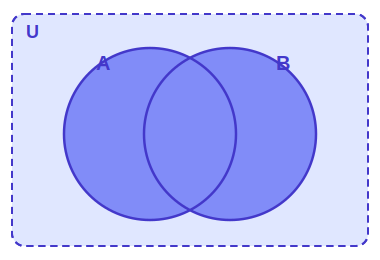
4. Operations on EventsBecause events are sets, we combine them with set operations. The union A ∪ B is the event that A or B (or both) happens. The intersection A ∩ B is the event that both A and B happen. Two events are mutually exclusive when they cannot happen at the same time, so A ∩ B is empty, for example getting a 2 and getting a 5 on a single roll. Events are exhaustive when together they cover the whole sample space.
|
5. The Axiomatic Approach to ProbabilityModern probability rests on three simple rules, or axioms. First, the probability of any event is at least 0. Second, the probability of the sure event S is 1. Third, for mutually exclusive events the probabilities add. From these it follows that every probability lies between 0 and 1. For an experiment whose outcomes are all equally likely, this gives the familiar rule P(A) = (favourable outcomes)/(total outcomes).
|
6. Complement and the Addition TheoremTwo results are used constantly. The complement rule says P(A′) = 1 − P(A), which is often the quickest route, since the chance that something does not happen is easy to find. The addition theorem says P(A ∪ B) = P(A) + P(B) − P(A ∩ B); we subtract the overlap so it is not counted twice. When A and B are mutually exclusive, the overlap is empty and this simplifies to P(A ∪ B) = P(A) + P(B).
|
|
Addition theorem: P(A ∪ B) = P(A) + P(B) − P(A ∩ B)
|
| 4 |
Key Results & Proofs |
Three results follow directly from the axioms and are used in almost every probability question.
Statement. For any event A, P(A′) = 1 − P(A). Proof Use the fact that A and A′ together fill the sample space.
So if the chance of rain is 0.3, the chance of no rain is 1 − 0.3 = 0.7. |
||||||||||||||||
Statement. For any two events, P(A ∪ B) = P(A) + P(B) − P(A ∩ B). Proof Think about which outcomes get counted more than once.
If A and B are mutually exclusive then P(A ∩ B) = 0, giving P(A ∪ B) = P(A) + P(B). |
||||||||||||
Statement. The probability of the impossible event is 0. Proof Apply the complement rule to the sure event.
So every probability lies between these two extremes: 0 for impossible and 1 for certain. |
|||||||||||||
| 5 |
Worked Examples |
Question: Write the sample space when a coin is tossed twice. ▶ Show full workingList every possible pair of results in order.
Answer: S = {HH, HT, TH, TT}, four outcomes. |
||||||||
Question: A fair die is rolled. Find the probability of getting an even number. ▶ Show full workingCount the favourable outcomes over the total.
Answer: 1/2. |
|||||||||||||
Question: A fair die is rolled. Find the probability of getting a number greater than 4. ▶ Show full workingThe favourable outcomes are 5 and 6.
Answer: 1/3. |
|||||||||
Question: A card is drawn from a well-shuffled pack of 52. Find the probability it is a king. ▶ Show full workingThere are 4 kings in a pack.
Answer: 1/13. |
Question: A card is drawn from a pack of 52. Find the probability it is a red card. ▶ Show full workingHalf the pack is red (hearts and diamonds).
Answer: 1/2. |
Question: Two coins are tossed. Find the probability of getting at least one head. ▶ Show full workingUse the sample space {HH, HT, TH, TT}.
Answer: 3/4. |
|||||||||
Question: A die is rolled. Find the probability of not getting a 6. ▶ Show full workingUse the complement rule P(A′) = 1 − P(A).
Answer: 5/6. |
Question: A bag holds 5 red and 3 blue balls. One ball is drawn. Find the probability it is red. ▶ Show full workingCount the red balls over the total number of balls.
Answer: 5/8. |
|||||||||
Question: If P(A) = 0.5, P(B) = 0.3 and P(A ∩ B) = 0.1, find P(A ∪ B). ▶ Show full workingUse the addition theorem.
Answer: 0.7. |
Question: A die is rolled. Find the probability of getting a 2 or a 5. ▶ Show full workingThese events are mutually exclusive, so the probabilities add.
Answer: 1/3. |
|||||||||||||
Question: Two dice are thrown. Find the probability that the sum is 7. ▶ Show full workingCount the pairs from the 36 outcomes that add to 7.
Answer: 1/6. |
|||||||||||||
Question: A card is drawn from 52. Find the probability that it is a king or a queen. ▶ Show full workingA card cannot be both, so the events are mutually exclusive.
Answer: 2/13. |
| 6 |
Where You Meet This in Real Life |
|
Weather forecasts A ‘70% chance of rain’ is a probability, worked out from past records and current conditions. |
|
Games and sport Card games, board games and lotteries are built on probability, and selectors use it to weigh a player’s chances. |
|
Insurance Companies set premiums using the probability of accidents, illness or loss across large groups of people. |
|
Medicine and testing The chance that a test is correct, or that a treatment works, is described and compared using probability. |
|
Quality and reliability Factories estimate the probability that a product is faulty so they can keep quality high and waste low. |
| 7 |
Practice Sets A to D |
|
Practice Set A – Basics |
|
A1. Write the sample space when one die is rolled. ▶ Reveal full workingList every face.
Answer: S = {1, 2, 3, 4, 5, 6}. |
||||
|
A2. A fair coin is tossed once. Find the probability of a head. ▶ Reveal full workingOne favourable outcome out of two.
Answer: 1/2. |
|
A3. A die is rolled. Find the probability of getting a 3. ▶ Reveal full workingOne favourable outcome out of six.
Answer: 1/6. |
|
A4. What is the probability of an impossible event? ▶ Reveal full workingRecall the probability scale.
Answer: 0. |
|||||||
|
Practice Set B – Conceptual |
|
B1. What is a sample space? ▶ Reveal full workingThink about all the things that can happen.
Answer: The set of all possible outcomes. |
||||
|
B2. What does it mean for two events to be mutually exclusive? ▶ Reveal full workingCan they happen together?
Answer: They cannot happen together (A ∩ B is empty). |
|||||||
|
B3. Between what two values does any probability lie? ▶ Reveal full workingRecall the axioms.
Answer: Between 0 and 1 inclusive. |
|||||||
|
B4. What is the probability of a sure event? ▶ Reveal full workingA sure event always happens.
Answer: 1. |
|||||||
|
Practice Set C – Application / Numerical |
|
C1. A die is rolled. Find the probability of an odd number. ▶ Reveal full workingOdd numbers are 1, 3, 5.
Answer: 1/2. |
|
C2. A card is drawn from 52. Find the probability it is a heart. ▶ Reveal full workingThere are 13 hearts.
Answer: 1/4. |
|
C3. If P(A) = 0.4, P(B) = 0.5 and P(A ∩ B) = 0.2, find P(A ∪ B). ▶ Reveal full workingUse the addition theorem.
Answer: 0.7. |
|
C4. A bag has 4 red and 6 green balls. One ball is drawn. Find the probability it is green. ▶ Reveal full workingCount green over total.
Answer: 3/5. |
||||||||
|
Practice Set D – HOTS / Word Problems |
|
D1. Two dice are thrown. Find the probability that the sum is 8. ▶ Reveal full workingCount the pairs from the 36 outcomes that add to 8.
Answer: 5/36. |
||||||||
|
D2. A card is drawn from 52. Find the probability it is a face card (jack, queen or king). ▶ Reveal full workingThere are 12 face cards in all.
Answer: 3/13. |
||||||||
|
D3. A die is rolled. Find the probability of getting a prime number. ▶ Reveal full workingThe primes on a die are 2, 3 and 5.
Answer: 1/2. |
||||||||
|
D4. The probability that a student passes an exam is 0.85. Find the probability that the student does not pass. ▶ Reveal full workingUse the complement rule.
Answer: 0.15. |
|
Chapter Summary Everything in One Glance
|
||||||||||||||||||
| 8 |
Are You Exam-Ready? |
|
8-Point Exam Quick-Check
|
||||||||||||||||||||||||||||||||
|
School Revise Virtual Lab Practice the concepts in this chapter with interactive simulations and visual tools.
|
|
Class 11 Mathematics Chapter 14: Probability, Complete Notes and Practice These free Class 11 Maths Chapter 14 Probability notes follow the latest NCERT 2026-27 syllabus and give complete, exam-ready coverage for board exams and competitive foundations. Includes worked examples, step-by-step proofs and graded practice, free on SchoolRevise.com. |
 Google