Curriculum
Mathematics Grade XI
Grade 11 Mathematics
0/14
-
Chapter 1: Sets
 Preview
 -
Chapter 2: Relations and Functions
Preview
-
Chapter 3: Trigonometric Functions
Preview
-
Chapter 4: Complex Numbers and Quadratic Equations
Preview
-
Chapter 5: Linear Inequalities
Preview
-
Chapter 6: Permutations and Combinations
Preview
-
Chapter 7: Binomial Theorem
Preview
-
Chapter 8: Sequences and Series
Preview
-
Chapter 9: Straight Lines
Preview
-
Chapter 10: Conic Sections
Preview
-
Chapter 11: Introduction to Three Dimensional Geometry
Preview
-
Chapter 12: Limits and Derivatives
Preview
-
Chapter 13: Statistics
Preview
-
Chapter 14: Probability
Preview
Worksheets
0/14

Chapter 4: Complex Numbers and Quadratic Equations
|
Class 11 • Mathematics • Chapter 4 Complex Numbers and Quadratic EquationsExtending the number line so that every quadratic equation has a solution.
|
|
Chapter Roadmap The Imaginary Unit i • Complex Numbers • Algebra of Complex Numbers • Powers of i • Modulus & Conjugate • Argand Plane • Polar Form • Quadratic Equations with Complex Roots |
| 1 |
Why We Needed a New Kind of Number |
For centuries, mathematicians were stuck on one stubborn question: what number, when multiplied by itself, gives a negative result? No real number works, because a positive times a positive is positive and a negative times a negative is also positive. Equations as simple as x² + 1 = 0 had no solution at all. Rather than give up, mathematicians invented a brand-new number to fill the gap.
That number is the imaginary unit i, defined so that i² = −1. Combining it with ordinary real numbers produces complex numbers of the form a + bi, which extend the one-dimensional number line into a two-dimensional plane. Far from being a curiosity, complex numbers are the working language of electrical engineering, signal processing, quantum mechanics and computer graphics. This chapter teaches you to build, combine, measure and picture them, and to solve quadratic equations that real numbers alone cannot.
The imaginary unit i satisfies i² = −1. A complex number is written z = a + bi, where a is the real part Re(z) and b is the imaginary part Im(z). The set of complex numbers is written C and contains every real number (taking b = 0).
|
| 2 |
Key Terms You Must Know |
| Term | Meaning | Example |
| Imaginary unit i | The number defined by i² = −1; it is not on the real number line. | i = √(−1) |
| Complex number z | A number of the form a + bi with a, b real. | 3 + 4i |
| Real part Re(z) | The a in a + bi. | Re(3 + 4i) = 3 |
| Imaginary part Im(z) | The b in a + bi (the coefficient of i, without i). | Im(3 + 4i) = 4 |
| Conjugate z̅ | The reflection a − bi, formed by flipping the sign of the imaginary part. | Conjugate of 3 + 4i is 3 − 4i |
| Modulus |z| | The distance of z from the origin, √(a² + b²). | |3 + 4i| = 5 |
| Argand plane | The plane that pictures a + bi as the point (a, b). | 3 + 4i plots at (3, 4) |
| 3 |
Core Concepts, Step by Step |
1. The Imaginary Unit and Powers of iEverything starts from i² = −1. From this, higher powers cycle through just four values: i¹ = i, i² = −1, i³ = −i, and i⁴ = 1, after which the pattern repeats. To find any power, divide the exponent by 4 and use the remainder, so for instance i¹⁰ has remainder 2, so i¹⁰ = i² = −1. Square roots of negatives are written using i too: √(−9) = 3i, and in general √(−a) = i√a for positive a.
|
2. Complex Numbers and Their EqualityA complex number z = a + bi packs a real part and an imaginary part into one object. Two complex numbers are equal only when both parts match: a + bi = c + di means a = c and b = d. A complex number is purely real when b = 0 and purely imaginary when a = 0 (but b ≠ 0). This single rule for equality is what lets us solve equations by comparing real and imaginary parts separately.
|
3. Algebra of Complex NumbersComplex numbers add and subtract part by part: (a + bi) + (c + di) = (a + c) + (b + d)i. They multiply using the distributive rule together with i² = −1: (a + bi)(c + di) = (ac − bd) + (ad + bc)i. To divide, multiply top and bottom by the conjugate of the denominator, which clears i from below: this turns the denominator into the real number c² + d².
|
4. Modulus and ConjugateThe conjugate of z = a + bi is z̅ = a − bi. Multiplying a complex number by its conjugate always gives a non-negative real number: z · z̅ = a² + b². The modulus |z| = √(a² + b²) measures how far z sits from the origin, so |z|² = z · z̅. Useful properties include |z₁z₂| = |z₁| |z₂|, the conjugate of a sum equals the sum of conjugates, and the conjugate of a product equals the product of conjugates.
|
5. The Argand Plane and Polar FormWe picture z = a + bi as the point (a, b) on a plane called the Argand plane, with the real part along the horizontal axis and the imaginary part along the vertical axis. The figure below shows how the sign of each part decides the quadrant. The distance from the origin is the modulus r = |z|, and the angle the line Oz makes with the positive real axis is the argument θ. This gives the polar form z = r(cos θ + i sin θ).
|
|
The Argand plane: plotting z = a + bi
|
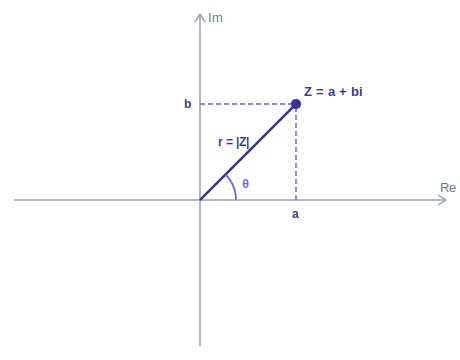
6. Quadratic Equations with Complex RootsA quadratic ax² + bx + c = 0 (with real a, b, c and a ≠ 0) is solved by x = (−b ± √(b² − 4ac)) / 2a. When the discriminant b² − 4ac is negative, the square root is imaginary, and the two roots become complex conjugates of each other, a + bi and a − bi. Every quadratic now has exactly two roots in C, which is the payoff of inventing complex numbers, and it foreshadows the Fundamental Theorem of Algebra.
|
| 4 |
Key Results & Proofs |
Complex numbers rest on a handful of properties that are properly proved from the single fact i² = −1. Here are the key ones, derived line by line.
Statement. For any integer n, iⁿ takes only four values: i⁰ = 1, i¹ = i, i² = −1, i³ = −i. Proof Start from i² = −1 and keep multiplying by i.
Because i⁴ = 1, multiplying by i⁴ changes nothing, so iⁿ equals i raised to the remainder of n divided by 4. |
Statement. For z = a + bi, z · z̅ = a² + b² = |z|². Proof Multiply z by its conjugate z̅ = a − bi.
So z · z̅ is always a non-negative real number, exactly equal to |z|². This is the trick behind dividing complex numbers. |
Statement. For any complex numbers z₁ and z₂, |z₁ z₂| = |z₁| · |z₂|. Proof Square the left side and use |z|² = z · z̅ together with (z₁z₂)̅ = z₁̅ z₂̅.
The square-root step is valid because a modulus is never negative. |
Statement. If ax² + bx + c = 0 has real coefficients (a ≠ 0) and b² − 4ac < 0, then its two roots are complex conjugates of each other. Proof Apply the quadratic formula and pull the i out of the negative square root.
The two roots share the same real part (−b/2a) and have opposite imaginary parts, so x₂ is the conjugate of x₁. Complex roots of a real quadratic always occur in conjugate pairs. |
|||||||||||||||||||||
| 5 |
Worked Examples |
Question: Simplify i³⁹. ▶ Show full workingPowers of i repeat every 4 (i, −1, −i, 1), so use the remainder when the power is divided by 4.
Answer: i³⁹ = −i. |
Question: Write √(−25) in terms of i. ▶ Show full workingSeparate the −1, since √(−1) = i.
Answer: √(−25) = 5i. |
Question: Add (3 + 2i) and (4 − 5i). ▶ Show full workingAdd the real parts together and the imaginary parts together.
Answer: 7 − 3i. |
Question: Multiply (2 + 3i)(1 − 4i). ▶ Show full workingExpand the brackets, then use i² = −1.
Answer: 14 − 5i. |
Question: Express (1 + i)/(1 − i) in the form a + bi. ▶ Show full workingMultiply top and bottom by the conjugate of the denominator, 1 + i, to clear the i.
Answer: (1 + i)/(1 − i) = i, i.e. 0 + 1i. |
Question: Find the conjugate and modulus of z = 5 − 12i. ▶ Show full workingThe conjugate flips the imaginary sign; the modulus is √(real² + imaginary²).
Answer: Conjugate 5 + 12i; modulus 13. |
Question: Find the real numbers x and y if (x + 2) + (y − 3)i = 5 + 4i. ▶ Show full workingEqual complex numbers have equal real parts and equal imaginary parts.
Answer: x = 3, y = 7. |
Question: Verify that z · z̅ = |z|² for z = 3 + 4i. ▶ Show full workingWork out z · z̅ and |z|² separately, then compare.
Answer: z · z̅ = |z|² = 25, verified. |
Question: Plot z = −2 + 3i on the Argand plane and state its quadrant. ▶ Show full workingPlot at (real, imaginary) = (−2, 3).
Answer: Point (−2, 3), second quadrant. |
||||||||
Question: Express z = 1 + i in polar form. ▶ Show full workingFind r = |z| and the angle θ, then write z = r(cos θ + i sin θ).
Answer: z = √2 (cos π/4 + i sin π/4). |
Question: Solve x² + 4 = 0. ▶ Show full workingIsolate x², then take the square root using i.
Answer: x = 2i or x = −2i. |
Question: Solve x² + x + 1 = 0. ▶ Show full workingRead off a, b, c; a negative discriminant gives a conjugate pair of complex roots.
Answer: x = (−1 ± i√3)/2. |
|||||||||||||||||
| 6 |
Where You Meet This in Real Life |
|
Electrical engineering Alternating-current circuits are analysed with complex numbers, where the modulus gives the size of a voltage or current and the argument gives its phase. |
|
Signal processing The Fourier transform behind audio compression, image formats and mobile networks is built entirely on complex numbers. |
|
Quantum mechanics The wave function describing a particle is complex-valued; physics at the smallest scale simply cannot be written without i. |
|
Computer graphics and fractals The famous Mandelbrot set is generated by repeatedly squaring a complex number, producing the intricate patterns you see in fractal art. |
|
Control systems Engineers test whether aircraft, robots and power grids stay stable by examining complex roots of their characteristic equations. |
| 7 |
Practice Sets A-D |
|
Practice Set A – Basics |
|
A1. Simplify i¹². ▶ Reveal full workingUse the cycle of 4: divide the power by 4.
Answer: i¹² = 1. |
|
A2. Write √(−49) using i. ▶ Reveal full workingSplit off √(−1) = i.
Answer: 7i. |
|
A3. State the real and imaginary parts of 6 − 9i. ▶ Reveal full workingReal part = plain number; imaginary part = coefficient of i, with its sign.
Answer: Re = 6, Im = −9. |
|
A4. Write the conjugate of −3 + 7i. ▶ Reveal full workingFlip only the imaginary sign.
Answer: −3 − 7i. |
|
Practice Set B – Conceptual |
|
B1. Why does i² = −1 give every quadratic two roots in C? ▶ Reveal full workingA negative discriminant used to block real solutions.
Answer: Because square roots of negatives now exist. |
|||||||
|
B2. When is a complex number purely imaginary? ▶ Reveal full workingWrite z = a + bi.
Answer: When its real part is 0 and imaginary part is non-zero. |
|||||||
|
B3. Show that the conjugate of a real number is itself. ▶ Reveal full workingA real number is a + 0i.
Answer: A real number equals its own conjugate. |
|
B4. If |z| = 0, what is z? ▶ Reveal full workingUse |z| = √(a² + b²).
Answer: z = 0. |
||||||||
|
Practice Set C – Application / Numerical |
|
C1. Express (3 + 2i)/(2 − i) as a + bi. ▶ Reveal full workingMultiply top and bottom by the conjugate 2 + i.
Answer: 4/5 + (7/5)i. |
|
C2. Find the modulus of z = −6 + 8i. ▶ Reveal full workingUse |z| = √(real² + imaginary²).
Answer: |z| = 10. |
|
C3. Solve 2x² + 3 = 0. ▶ Reveal full workingIsolate x², then take the root with i.
Answer: x = ±(i√6)/2. |
|
C4. Express z = −1 + i√3 in polar form. ▶ Reveal full workingFind r and the argument, then write r(cos θ + i sin θ).
Answer: z = 2(cos 2π/3 + i sin 2π/3). |
|
Practice Set D – HOTS / Multi-step |
|
D1. If z = 2 + 3i, find z + z̅ and z − z̅, and say what kind of number each is. ▶ Reveal full workingWrite the conjugate, then add and subtract.
Answer: z + z̅ = 4 (real); z − z̅ = 6i (purely imaginary). |
|
D2. Find the smallest positive integer n for which (1 + i)ⁿ is purely real. ▶ Reveal full workingRaise 1 + i to powers until the result is real.
Answer: n = 4, giving (1 + i)⁴ = −4. |
||||||||||||
|
D3. Solve x² − 2x + 5 = 0 and verify the roots are conjugates. ▶ Reveal full workingUse the discriminant and the quadratic formula.
Answer: x = 1 ± 2i, a conjugate pair. |
|||||||||||||||||||
|
D4. Show that for any complex z, |z|² = z · z̅, and use it to find |(3 + 4i)(1 − 2i)|. ▶ Reveal full workingProve the rule, then use |z₁z₂| = |z₁| |z₂|.
Answer: |z|² = z · z̅; the product modulus is 5√5. |
|
Chapter Summary Everything in One Glance
|
||||||||||||||||||
| 8 |
Are You Exam-Ready? |
|
8-Point Exam Quick-Check
|
||||||||||||||||||||||||||||||||
|
School Revise Virtual Lab Practice the concepts in this chapter with interactive simulations and visual tools.
|
|
Class 11 Mathematics Chapter 4: Complex Numbers and Quadratic Equations, Complete Notes and Practice These free Class 11 Maths Chapter 4 Complex Numbers and Quadratic Equations notes are aligned with the latest NCERT 2026-27 syllabus and deliver complete, exam-ready coverage for board exams and competitive foundations. Includes worked examples, step-by-step proofs and graded practice, free on SchoolRevise.com. |
 Google