Curriculum
Mathematics Grade XII
Mathematics Grade XII
0/13
-
Chapter 1: Relations and Functions
 Preview
 -
Chapter 2: Inverse Trigonometric Functions
Preview
-
Chapter 3: Matrices
Preview
-
Chapter 4: Determinants
Preview
-
Chapter 5: Continuity and Differentiability
Preview
-
Chapter 6: Application of Derivatives
Preview
-
Chapter 7: Integrals
Preview
-
Chapter 8: Application of Integrals
Preview
-
Chapter 9: Differential Equations
Preview
-
Chapter 10: Vector Algebra
Preview
-
Chapter 11: Three Dimensional Geometry
Preview
-
Chapter 12: Linear Programming
Preview
-
Chapter 13: Probability
Preview
Work Sheets
0/13

Maths Notes
0/13
Chapter 1: Relations and Functions
|
Class 12 • Mathematics • Chapter 1 Relations and FunctionsHow elements of one set connect to another, and what makes a connection a true function.
|
|
Chapter Roadmap Types of Relations • Equivalence Relations • One-One Functions • Onto and Bijective • Composition • Invertible Functions • Key Results • Applications |
| 1 |
Why Relations and Functions Matter |
In Class 11 you learned what a relation and a function are. In Class 12 we look more closely at the kinds of relations and functions, because the differences between them decide what we are allowed to do with them. A relation can be reflexive, symmetric or transitive; a function can be one-one, onto, or both. These properties are the deciding factor for whether a function can be reversed, which matters throughout calculus and algebra.
This chapter sharpens that understanding. You will classify relations, recognise the very important equivalence relations that split a set into neat groups, tell apart one-one and onto functions, combine functions by composition, and find the inverse of a function when one exists. Each idea is small on its own, but together they form the language used in every later chapter.
A relation just links elements; a function links each input to exactly one output. A function can be reversed only when it is both one-one (distinct inputs give distinct outputs) and onto (every output is reached). Such a function is called bijective.
|
| 2 |
Key Terms You Must Know |
| Term | Meaning | Example |
| Relation | A set of ordered pairs linking elements of one set to another. | R = {(1, 2), (2, 3)} |
| Reflexive | Every element is related to itself: (a, a) is in R. | (1, 1), (2, 2), … all present |
| Symmetric | If (a, b) is in R then (b, a) is too. | (1, 2) in R needs (2, 1) in R |
| Transitive | If (a, b) and (b, c) are in R then (a, c) is too. | links chain together |
| Equivalence relation | A relation that is reflexive, symmetric and transitive. | ‘is parallel to’ on lines |
| One-one (injective) | Distinct inputs give distinct outputs. | f(x) = 2x + 3 |
| Onto (surjective) | Every element of the codomain is an output. | f(x) = 2x + 3 on the reals |
| 3 |
Core Concepts, Step by Step |
1. Relations and Their TypesA relation R on a set A is just a collection of ordered pairs of elements of A. Three properties matter most. R is reflexive if every element is related to itself, that is (a, a) is in R for all a. R is symmetric if whenever (a, b) is in R, so is (b, a). R is transitive if whenever (a, b) and (b, c) are in R, then (a, c) is in R as well. The table below lays out the three properties with examples.
|
|
The three key properties of a relation
|
2. Equivalence RelationsA relation that is reflexive, symmetric and transitive all at once is called an equivalence relation. These are special because they sort the whole set into neat, non-overlapping groups called equivalence classes, where everything in a group is related to everything else in it. Everyday examples include ‘is parallel to’ for lines, ‘has the same remainder when divided by 5’ for integers, and ‘is the same age as’ for people.
|
3. One-One (Injective) FunctionsA function f is one-one, or injective, if different inputs always give different outputs. The neat way to test this is to assume f(x₁) = f(x₂) and show that this forces x₁ = x₂. For example f(x) = 2x + 3 is one-one, because 2x₁ + 3 = 2x₂ + 3 leads straight to x₁ = x₂. By contrast f(x) = x² is not one-one, since 2 and −2 both map to 4.
|
|
A one-one function: distinct inputs, distinct outputs
|
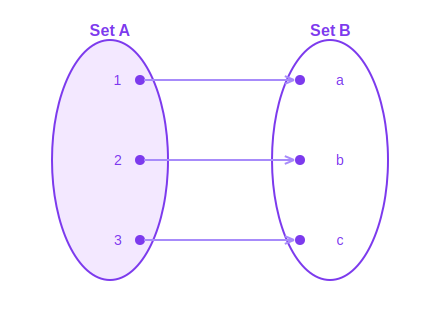
4. Onto (Surjective) and Bijective FunctionsA function f : A → B is onto, or surjective, if every element of the codomain B is the image of at least one element of A, so nothing in B is left out. To test it, take a general y in B and try to find an x with f(x) = y. A function that is both one-one and onto is called bijective. Bijective functions are the well-behaved ones that can be reversed, as the next concepts show.
|
|
Comparing the three kinds of function
|
|
A bijection: f(x) = x³ is one-one and onto on the real numbers
|
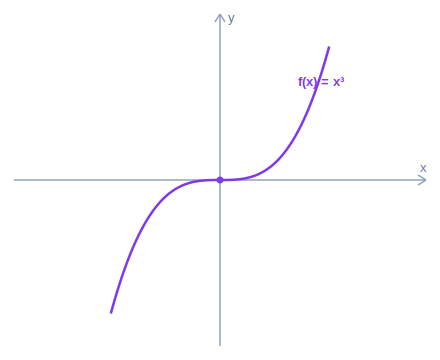
5. Composition of FunctionsTwo functions can be applied one after another. If f : A → B and g : B → C, the composition g ∘ f means ‘do f first, then g’, and is defined by (g ∘ f)(x) = g(f(x)). The order matters: in general g ∘ f and f ∘ g are not the same. For example, with f(x) = 2x + 3 and g(x) = x², we get (g ∘ f)(x) = (2x + 3)² but (f ∘ g)(x) = 2x² + 3, which are clearly different.
|
6. Invertible FunctionsA function f is invertible if it can be undone by another function f⁻¹, so that applying f and then f⁻¹ returns the original input. The central fact is that a function is invertible if and only if it is bijective, that is one-one and onto. To find the inverse, write y = f(x), make x the subject, and then swap the roles of x and y. For instance, f(x) = 2x + 3 has inverse f⁻¹(x) = (x − 3)/2.
|
| 4 |
Key Results & Proofs |
Three results capture the heart of this chapter, and each is proved by careful, plain reasoning.
Statement. On the integers, the relation a R b defined by ‘(a − b) is divisible by n’ is an equivalence relation. Proof Check the three properties one by one for the given relation.
This relation sorts the integers into n classes, one for each possible remainder on division by n. |
||||||||||||||
Statement. If f and g are both one-one, then g ∘ f is one-one. Proof Assume two inputs give the same output, then peel off g and then f.
Equal outputs force equal inputs, so g ∘ f is one-one. |
Statement. A function f : A → B is invertible if and only if it is one-one and onto. Proof If f is bijective, we can build its inverse directly.
Conversely, any function with an inverse must be one-one and onto, so invertible and bijective mean the same thing. |
||||||||||||||
| 5 |
Worked Examples |
Question: Is the relation R = {(1, 1), (2, 2), (3, 3)} on A = {1, 2, 3} reflexive? ▶ Show full workingA relation is reflexive when every element is related to itself.
Answer: Yes, R is reflexive. |
||||||||
Question: Is the relation R = {(1, 2), (2, 1)} on {1, 2} symmetric? ▶ Show full workingSymmetric means each pair has its reverse in R.
Answer: Yes, R is symmetric. |
|||||
Question: On the integers, a R b means (a − b) is divisible by 3. Show that R is reflexive. ▶ Show full workingCheck whether a R a holds for every integer a.
Answer: R is reflexive. |
|||||||||
Question: Show that ‘is parallel to’ on the set of lines in a plane is an equivalence relation. ▶ Show full workingCheck the three properties for parallel lines.
Answer: It is reflexive, symmetric and transitive, so an equivalence relation. |
|||||||||||
Question: Is f : R → R, f(x) = 2x + 3, one-one? ▶ Show full workingAssume f(x₁) = f(x₂) and see whether x₁ must equal x₂.
Answer: Yes, f is one-one. |
Question: Is f : R → R, f(x) = x², one-one? ▶ Show full workingLook for two different inputs with the same output.
Answer: No, f is not one-one. |
|||||||||||||
Question: Is f : R → R, f(x) = 2x + 3, onto? ▶ Show full workingTake any y in the codomain and try to find an x with f(x) = y.
Answer: Yes, f is onto. |
|||||||||||||
Question: Is f : N → N, f(x) = 2x, onto? ▶ Show full workingList the outputs and see whether any codomain value is missed.
Answer: No, f is not onto. |
||||||||
Question: If f(x) = 2x + 3 and g(x) = x², find (g ∘ f)(x) and (f ∘ g)(x). ▶ Show full workingComposition means substitute one function into the other.
Answer: (g ∘ f)(x) = (2x + 3)² and (f ∘ g)(x) = 2x² + 3. |
Question: Find the inverse of f(x) = 2x + 3. ▶ Show full workingWrite y = f(x), make x the subject, then swap x and y.
Answer: f⁻¹(x) = (x − 3)/2. |
Question: Show that f : R → R, f(x) = 3x − 4, is bijective and find its inverse. ▶ Show full workingCheck one-one and onto, then invert.
Answer: f is bijective and f⁻¹(x) = (x + 4)/3. |
||||||||||||
Question: On {1, 2, 3, 4}, a R b means a = b. Identify the type of relation. ▶ Show full workingWrite out R and check the three properties.
Answer: It is an equivalence relation (the identity relation). |
||||||||
| 6 |
Where You Meet This in Real Life |
|
Sorting and grouping Equivalence relations are exactly how we sort things into groups, such as students by house or items by category, where everything in a group shares a property. |
|
Encoding and decoding An invertible function is one that can be undone, which is the basis of every code that must be read back, from passwords to file compression. |
|
Databases Relations in the mathematical sense are the foundation of relational databases, which link records in one table to records in another. |
|
Computer functions A program function takes inputs to outputs; whether it is one-one or onto decides whether its result can be reversed or repeated safely. |
|
Conversions Changing units, currencies or temperatures uses one-one functions, so the conversion can always be reversed exactly. |
| 7 |
Practice Sets A to D |
|
Practice Set A – Basics |
|
A1. Is R = {(1, 1), (2, 2)} on {1, 2} reflexive? ▶ Reveal full workingCheck for (1,1) and (2,2).
Answer: Yes, it is reflexive. |
|||||||
|
A2. Is f : R → R, f(x) = x + 1, one-one? ▶ Reveal full workingAssume equal outputs.
Answer: Yes, it is one-one. |
|
A3. Is f : R → R, f(x) = x², onto? ▶ Reveal full workingCan a negative number be an output?
Answer: No, it is not onto. |
||||
|
A4. Find the inverse of f(x) = x − 5. ▶ Reveal full workingSolve y = x − 5 for x.
Answer: f⁻¹(x) = x + 5. |
|
Practice Set B – Conceptual |
|
B1. Define a reflexive relation. ▶ Reveal full workingThink about an element and itself.
Answer: Every element is related to itself. |
||||
|
B2. Which three properties make a relation an equivalence relation? ▶ Reveal full workingRecall the definition.
Answer: Reflexive, symmetric and transitive. |
||||
|
B3. What is the difference between a one-one and an onto function? ▶ Reveal full workingOne looks at inputs, the other at the codomain.
Answer: One-one is about distinct outputs; onto is about covering the codomain. |
|||||||
|
B4. When is a function invertible? ▶ Reveal full workingRecall the key condition.
Answer: When it is bijective. |
||||
|
Practice Set C – Application / Numerical |
|
C1. On the integers, a R b means (a − b) is divisible by 5. Show that R is symmetric. ▶ Reveal full workingStart from a R b.
Answer: R is symmetric. |
|||||||
|
C2. If f(x) = 3x + 2 and g(x) = x − 1, find (g ∘ f)(x). ▶ Reveal full workingSubstitute f into g.
Answer: (g ∘ f)(x) = 3x + 1. |
|
C3. Is f : R → R, f(x) = x³, bijective? ▶ Reveal full workingCheck one-one and onto.
Answer: Yes, it is bijective. |
|||||||
|
C4. Find the inverse of f(x) = (x + 1)/2. ▶ Reveal full workingSolve y = (x + 1)/2 for x.
Answer: f⁻¹(x) = 2x − 1. |
|
Practice Set D – HOTS / Word Problems |
|
D1. Show that ‘has the same remainder on division by 4’ on the integers is an equivalence relation. ▶ Reveal full workingCheck the three properties.
Answer: It is reflexive, symmetric and transitive. |
|||||||||||||
|
D2. Prove that f : R → R, f(x) = 5x + 7, is one-one. ▶ Reveal full workingAssume equal outputs.
Answer: f is one-one. |
|
D3. With f(x) = 2x and g(x) = x + 3, find (f ∘ g)(x) and (g ∘ f)(x), and show they differ. ▶ Reveal full workingCompose in each order.
Answer: They differ: 2x + 6 versus 2x + 3. |
||||||||||||
|
D4. Find the inverse of f(x) = 4x − 3 and verify that f(f⁻¹(x)) = x. ▶ Reveal full workingInvert, then substitute back.
Answer: f⁻¹(x) = (x + 3)/4, and the check gives x. |
|
Chapter Summary Everything in One Glance
|
||||||||||||||||||
| 8 |
Are You Exam-Ready? |
|
8-Point Exam Quick-Check
|
||||||||||||||||||||||||||||||||
|
School Revise Virtual Lab Practice the concepts in this chapter with interactive simulations and visual tools.
|
|
Class 12 Mathematics Chapter 1: Relations and Functions, Complete Notes and Practice These free Class 12 Maths Chapter 1 Relations and Functions notes follow the latest NCERT 2026-27 syllabus and give complete, exam-ready coverage for board exams and competitive foundations. Includes worked examples, step-by-step proofs and graded practice, free on SchoolRevise.com. |
 Google