Curriculum
Mathematics Grade XII
Mathematics Grade XII
0/13
-
Chapter 1: Relations and Functions
 Preview
 -
Chapter 2: Inverse Trigonometric Functions
Preview
-
Chapter 3: Matrices
Preview
-
Chapter 4: Determinants
Preview
-
Chapter 5: Continuity and Differentiability
Preview
-
Chapter 6: Application of Derivatives
Preview
-
Chapter 7: Integrals
Preview
-
Chapter 8: Application of Integrals
Preview
-
Chapter 9: Differential Equations
Preview
-
Chapter 10: Vector Algebra
Preview
-
Chapter 11: Three Dimensional Geometry
Preview
-
Chapter 12: Linear Programming
Preview
-
Chapter 13: Probability
Preview
Work Sheets
0/13

Maths Notes
0/13
Chapter 9: Differential Equations
|
Class 12 • Mathematics • Chapter 9 Differential EquationsEquations that involve a derivative, and the families of curves that solve them.
|
|
Chapter Roadmap Order and Degree • General and Particular Solutions • Forming a Differential Equation • Variable Separable Method • Homogeneous Equations • Linear Equations and the Integrating Factor |
| 1 |
Equations About Change |
Most laws of nature are stated not as fixed values but as rates: how fast a population grows, how quickly a hot drink cools, how charge flows in a circuit. An equation that links a function to its own derivatives is a differential equation, and solving one means finding the function whose rate of change behaves as the equation demands.
Because adding a constant does not change a derivative, a differential equation usually has a whole family of solutions, one curve for each value of the constant. Pinning down a single member needs an extra condition. This chapter classifies differential equations by order and degree, then solves the three standard types met at this level: variable separable, homogeneous and linear.
The order of a differential equation is the highest derivative present; the degree is the power of that highest derivative once the equation is polynomial in derivatives. A general solution contains arbitrary constants; a particular solution fixes them using given conditions.
|
| 2 |
Key Terms You Must Know |
| Term | Meaning | Example |
| Differential equation | An equation involving derivatives of an unknown function. | dy/dx = 2x |
| Order | The highest derivative that appears. | y″ + y = 0 has order 2 |
| Degree | The power of the highest derivative (when polynomial). | usually 1 at this level |
| General solution | A solution containing arbitrary constants. | y = x² + C |
| Particular solution | One curve found by fixing the constants. | y = x² + 1 when y(0) = 1 |
| Integrating factor | A multiplier that makes a linear equation exact. | IF = e^(∫ P dx) |
| 3 |
Core Concepts, Step by Step |
1. Order and DegreeReading off the order is easy: it is the highest derivative that appears. The degree is the power of that highest derivative, but only after the equation has been cleared of roots and fractions so that it is a polynomial in the derivatives. Most board equations turn out to have degree one. These two numbers classify an equation before any solving begins.
|
2. General and Particular SolutionsSolving a differential equation produces a general solution carrying as many arbitrary constants as the order. Each choice of constants gives one curve in the solution family. An initial or boundary condition, such as a known value at a point, fixes the constants and selects the single particular solution that fits the situation.
|
|
The general solution of dy/dx = 2x is a whole family of parabolas y = x² + C
|
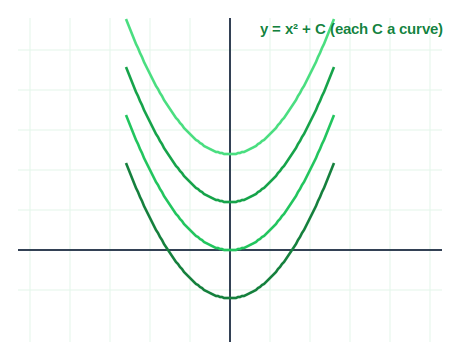
3. Forming a Differential EquationWe can run the process in reverse: starting from a family of curves with arbitrary constants, we differentiate enough times to eliminate the constants. What remains is the differential equation that the family satisfies. For example, the lines through the origin y = mx give, after differentiating, the equation dy/dx = y/x.
|
4. Variable Separable EquationsIf a first-order equation can be rearranged so that all the y terms (with dy) sit on one side and all the x terms (with dx) on the other, it is separable. We then integrate both sides independently and combine the constants into one. This is the simplest and most common solving method.
|
5. Homogeneous EquationsWhen dy/dx can be written purely in terms of the ratio y/x, the equation is homogeneous. The substitution y = vx (so dy/dx = v + x dv/dx) turns it into a separable equation in v and x, which we solve and then change back. This handles many equations that are not directly separable.
|
6. Linear Equations and the Integrating FactorA first-order linear equation has the form dy/dx + P(x) y = Q(x). Multiplying through by the integrating factor IF = e raised to the integral of P makes the left side the exact derivative of (IF × y). Integrating both sides then gives y directly. This single technique solves a large and important class of equations.
|
| 4 |
Key Results with Proofs |
Statement. The order of a differential equation is the order of the highest derivative occurring in it. Proof Order is a direct reading of the equation, not a calculation.
Degree is then the power of that highest derivative once the equation is polynomial in its derivatives. |
||||||||||||||
Statement. If dy/dx = f(x) g(y), then ∫ dy/g(y) = ∫ f(x) dx. Proof Separating the variables lets each side be integrated on its own.
Always combine the two constants of integration into a single C. |
||||||||||||||
Statement. For dy/dx + P y = Q, the integrating factor IF = e^(∫ P dx) makes d/dx(IF · y) = IF · Q. Proof The integrating factor is built so the left side collapses into a single derivative.
This is why IF is chosen as e raised to the integral of the coefficient P. |
||||||||||||||
| 5 |
Worked Examples |
Question: State the order and degree of d²y/dx² + 3(dy/dx)² + y = 0. ▶ Show full workingFind the highest derivative and its power.
Answer: Order 2, degree 1. |
||||||||
Question: State the order and degree of (dy/dx)³ + y = x. ▶ Show full workingOnly a first derivative appears.
Answer: Order 1, degree 3. |
||||||||
Question: Solve dy/dx = 2x. ▶ Show full workingIntegrate both sides.
Answer: y = x² + C. |
||||||||
Question: Solve dy/dx = y. ▶ Show full workingSeparate the variables.
Answer: y = C eₓ. |
||||||||
Question: Solve dy/dx = x/y. ▶ Show full workingVariable separable.
Answer: y² = x² + C. |
||||||||
Question: Solve dy/dx = (1 + y²)/(1 + x²). ▶ Show full workingSeparate and use the arctan integral.
Answer: tan⁻¹y = tan⁻¹x + C. |
||||||||
Question: Solve the linear equation dy/dx + y = eₓ. ▶ Show full workingUse the integrating factor.
Answer: y = eₓ/2 + C e⁻ₓ. |
|||||||||||
Question: Solve dy/dx + (1/x) y = x. ▶ Show full workingLinear with IF.
Answer: y = x²/3 + C/x. |
|||||||||||
Question: Find the particular solution of dy/dx = 2x with y(0) = 1. ▶ Show full workingFind the general solution, then use the condition.
Answer: y = x² + 1. |
||||||||
Question: Solve the homogeneous equation dy/dx = (x + y)/x. ▶ Show full workingSubstitute y = vx.
Answer: y = x(ln|x| + C). |
|||||||||||
Question: Form the differential equation of the family y = mx. ▶ Show full workingDifferentiate to remove m.
Answer: dy/dx = y/x. |
||||||||
Question: Form the differential equation of the family y = A eₓ. ▶ Show full workingDifferentiate to remove A.
Answer: dy/dx = y. |
|||||
| 6 |
Where You Meet This in Real Life |
|
Population biology Growth and decay of populations follow dy/dt proportional to y, giving exponential models. |
|
Physics of cooling Newton’s law of cooling is a differential equation linking temperature change to the temperature gap. |
|
Electrical circuits The current in a circuit with resistance and inductance obeys a first-order linear differential equation. |
|
Pharmacology Drug elimination from the bloodstream is modelled by a decay equation that sets safe dosing intervals. |
|
Finance Continuously compounded interest grows according to dy/dt = ry, a separable differential equation. |
| 7 |
Practice Sets A–D |
|
Practice Set A – Basics |
|
A1. State the order of d³y/dx³ + y = 0. ▶ Reveal full workingHighest derivative.
Answer: 3. |
||||
|
A2. Solve dy/dx = 3x². ▶ Reveal full workingIntegrate.
Answer: y = x³ + C. |
||||
|
A3. Solve dy/dx = 5. ▶ Reveal full workingIntegrate.
Answer: y = 5x + C. |
||||
|
A4. What kind of solution contains arbitrary constants? ▶ Reveal full workingTerm.
Answer: General solution. |
||||
|
Practice Set B – Conceptual |
|
B1. Why does a first-order equation have one arbitrary constant? ▶ Reveal full workingLink to integration.
Answer: Because one integration introduces one constant. |
|||||||
|
B2. How is the degree of a differential equation defined? ▶ Reveal full workingPower of the highest derivative.
Answer: The power of the highest derivative (in polynomial form). |
||||
|
B3. Which method suits dy/dx = f(x) g(y)? ▶ Reveal full workingName it.
Answer: Variable separable. |
||||
|
B4. What is the integrating factor for dy/dx + P y = Q? ▶ Reveal full workingFormula.
Answer: e^(∫ P dx). |
||||
|
Practice Set C – Application / Numerical |
|
C1. Solve dy/dx = eₓ. ▶ Reveal full workingIntegrate.
Answer: y = eₓ + C. |
||||
|
C2. Solve dy/dx = sec² x. ▶ Reveal full workingIntegrate.
Answer: y = tan x + C. |
||||
|
C3. Solve dy/dx = xy by separation. ▶ Reveal full workingSeparate.
Answer: y = C e^(x²/2). |
|||||||
|
C4. Find the particular solution of dy/dx = 3x² with y(1) = 2. ▶ Reveal full workingGeneral then condition.
Answer: y = x³ + 1. |
||||
|
Practice Set D – HOTS / Multi-step |
|
D1. Solve the linear equation dy/dx + 2y = 6 and find the particular solution with y(0) = 0. ▶ Reveal full workingIF then condition.
Answer: y = 3(1 − e^(−2x)). |
||||||||||
|
D2. Solve dy/dx = (1 + y²)/(1 + x²) with y(0) = 1. ▶ Reveal full workingSeparable, then apply the condition.
Answer: tan⁻¹y = tan⁻¹x + π/4. |
||||||||||
|
D3. Form the differential equation of the family y = A x². ▶ Reveal full workingDifferentiate to eliminate A.
Answer: dy/dx = 2y/x. |
|||||||
|
D4. Solve the homogeneous equation dy/dx = (x² + y²)/(xy). ▶ Reveal full workingUse y = vx.
Answer: y² = 2x²(ln|x| + C). |
||||||||||
|
Chapter Summary Everything in One Glance
|
||||||||||||||||||
| 8 |
Are You Exam-Ready? |
|
8-Point Exam Quick-Check
|
||||||||||||||||||||||||||||||||
|
School Revise Virtual Lab Practice the concepts in this chapter with interactive simulations and visual tools.
|
|
Class 12 Mathematics Chapter 9: Differential Equations, Complete Notes and Practice These free Class 12 Maths Differential Equations notes follow the NCERT 2026 to 27 syllabus and cover order and degree, general and particular solutions, forming differential equations, the variable separable method, homogeneous equations and linear equations with the integrating factor, with twelve worked examples and sixteen graded practice questions. Includes worked examples, step-by-step proofs and graded practice, free on SchoolRevise.com. |
 Google