Curriculum
Mathematics Grade XII
Mathematics Grade XII
0/13
-
Chapter 1: Relations and Functions
 Preview
 -
Chapter 2: Inverse Trigonometric Functions
Preview
-
Chapter 3: Matrices
Preview
-
Chapter 4: Determinants
Preview
-
Chapter 5: Continuity and Differentiability
Preview
-
Chapter 6: Application of Derivatives
Preview
-
Chapter 7: Integrals
Preview
-
Chapter 8: Application of Integrals
Preview
-
Chapter 9: Differential Equations
Preview
-
Chapter 10: Vector Algebra
Preview
-
Chapter 11: Three Dimensional Geometry
Preview
-
Chapter 12: Linear Programming
Preview
-
Chapter 13: Probability
Preview
Work Sheets
0/13

Maths Notes
0/13
Chapter 12: Linear Programming
|
Class 12 • Mathematics • Chapter 12 Linear ProgrammingSqueezing the best possible profit or cost out of a set of straight-line constraints.
|
|
Chapter Roadmap What an LPP Is • Constraints and the Feasible Region • Corner Points • The Corner Point Method • Bounded and Unbounded Regions • Formulating Word Problems |
| 1 |
Getting the Most from Limited Resources |
Every business and factory works under limits: only so much material, so many hours, so much money. Linear programming is the mathematics of getting the best outcome, the largest profit or the smallest cost, when both the goal and the limits are straight-line (linear) relationships in the variables.
A linear programming problem, or LPP, has an objective function to maximise or minimise and a set of constraints written as inequalities. At this level we solve two-variable problems graphically: shade the region allowed by the constraints, find its corner points, and test the objective at each corner. The best value always sits at a corner, which makes the search short and certain.
An LPP maximises or minimises a linear objective function Z = ax + by subject to linear constraints. The set of points satisfying all constraints is the feasible region, and the optimum, if it exists, occurs at a corner point of that region.
|
| 2 |
Key Terms You Must Know |
| Term | Meaning | Example |
| Objective function | The quantity Z = ax + by to be optimised. | Z = 3x + 4y |
| Constraint | A linear inequality limiting the variables. | x + y ≤ 4 |
| Feasible region | All points satisfying every constraint. | a shaded polygon |
| Corner point | A vertex of the feasible region. | where two boundaries meet |
| Bounded region | A feasible region of finite size. | a closed polygon |
| Optimal solution | The point giving the best value of Z. | always at a corner |
| 3 |
Core Concepts, Step by Step |
1. What a Linear Programming Problem IsAn LPP has three ingredients: decision variables (often x and y), an objective function Z = ax + by to maximise or minimise, and a list of linear constraints together with the non-negativity conditions x ≥ 0 and y ≥ 0. Everything is linear, which is exactly what makes the graphical method work.
|
2. Constraints and the Feasible RegionEach linear inequality cuts the plane into an allowed half and a forbidden half. The feasible region is the overlap of all the allowed halves, the set of points satisfying every constraint at once. We find it by drawing each boundary line and shading the correct side, then taking the common area.
|
|
The feasible region is the overlap of all constraints; its corners are the candidates
|
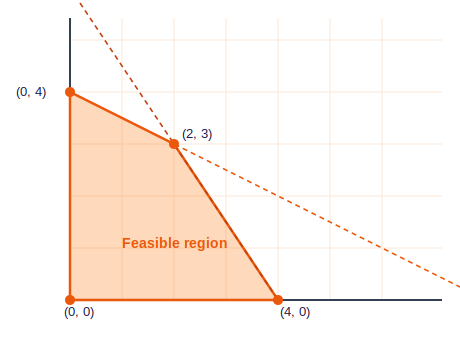
3. Corner PointsThe corners (vertices) of the feasible region are where two boundary lines cross. They are found by solving the relevant pairs of boundary equations together. These corner points are the only places we need to test, which is the whole reason the method is so efficient.
|
4. The Corner Point MethodTo solve an LPP: draw the feasible region, list all its corner points, evaluate the objective Z at each corner, and pick the largest value for a maximisation problem or the smallest for a minimisation problem. Because Z is linear, its best value over the whole region is guaranteed to occur at one of these corners.
|
5. Bounded and Unbounded RegionsA bounded feasible region is enclosed on all sides, so both a maximum and a minimum exist at corners. An unbounded region stretches to infinity in some direction; a maximum (or minimum) may then fail to exist, and we must check whether the objective can grow without limit before declaring an answer.
|
6. Formulating Word ProblemsReal problems must first be turned into an LPP. Identify the decision variables, write the quantity to optimise as Z = ax + by, and translate every limit, on materials, time, demand or budget, into a linear inequality. Adding x ≥ 0 and y ≥ 0 completes the model, ready for the graphical method.
|
| 4 |
Key Results with Proofs |
Statement. If an LPP has an optimal value, it is attained at a corner point of the feasible region. Proof The level lines of a linear objective leave the region last at a vertex.
This is why we only ever test the corners, never the interior. |
||||||||||||||
Statement. On a bounded feasible region, Z attains both a maximum and a minimum, each at a corner. Proof Finitely many corners on a closed region guarantee both extremes exist.
On an unbounded region one of these may be missing. |
||||||||||||||
Statement. If the feasible region is unbounded, the objective may have no maximum (or no minimum). Proof On an open region the objective can sometimes increase forever.
Always confirm whether the region is bounded in the direction Z is being optimised. |
||||||||||||||
| 5 |
Worked Examples |
Question: Maximise Z = 3x + 4y subject to x + y ≤ 4, x ≥ 0, y ≥ 0. ▶ Show full workingCorners then evaluate.
Answer: Maximum Z = 16 at (0, 4). |
|||||||||||
Question: Minimise Z = 2x + 3y subject to x + y ≥ 5, x ≥ 0, y ≥ 0. ▶ Show full workingCorners on the boundary line.
Answer: Minimum Z = 10 at (5, 0). |
|||||||||||
Question: Maximise Z = x + y subject to x + 2y ≤ 8, 3x + 2y ≤ 12, x, y ≥ 0. ▶ Show full workingFind all four corners.
Answer: Maximum Z = 5 at (2, 3). |
|||||||||||
Question: Maximise Z = 5x + 3y subject to x + y ≤ 6, x ≥ 0, y ≥ 0. ▶ Show full workingTriangle corners.
Answer: Maximum Z = 30 at (6, 0). |
|||||||||||
Question: Minimise Z = 4x + 5y subject to 2x + y ≥ 6, x + y ≥ 4, x, y ≥ 0. ▶ Show full workingFind the corners of the unbounded region’s boundary.
Answer: Minimum Z = 16 at (4, 0). |
|||||||||||
Question: Find the corner where x + 2y = 8 meets 3x + 2y = 12. ▶ Show full workingSolve the two equations together.
Answer: (2, 3). |
||||||||
Question: Maximise Z = 2x + y subject to x ≤ 4, y ≤ 3, x, y ≥ 0. ▶ Show full workingRectangle corners.
Answer: Maximum Z = 11 at (4, 3). |
|||||||||||
Question: A toy maker earns 5 on a car and 6 on a doll. Each car needs 2 hours, each doll 3 hours, with 12 hours available. Write the LPP. ▶ Show full workingDefine variables and translate.
Answer: Maximise Z = 5x + 6y subject to 2x + 3y ≤ 12, x, y ≥ 0. |
||||||||
Question: Solve the LPP from Example 8 if only whole corners are checked: corners (0, 0), (6, 0), (0, 4). ▶ Show full workingEvaluate Z at the corners.
Answer: Maximum Z = 30 at (6, 0). |
||||||||
Question: Maximise Z = x + 2y subject to 2x + y ≤ 4, x, y ≥ 0. ▶ Show full workingTriangle corners.
Answer: Maximum Z = 8 at (0, 4). |
|||||||||||
Question: Is the region x ≥ 0, y ≥ 0, x + y ≥ 2 bounded? ▶ Show full workingCheck for a finite enclosure.
Answer: No, it is unbounded. |
||||||||
Question: Minimise Z = x + y subject to x + y ≥ 3, x, y ≥ 0. ▶ Show full workingTest the boundary corners.
Answer: Minimum Z = 3 (along x + y = 3). |
||||||||
| 6 |
Where You Meet This in Real Life |
|
Manufacturing Factories decide how many of each product to make to maximise profit within material and machine limits. |
|
Diet and nutrition Planners minimise the cost of a diet while meeting minimum requirements for each nutrient. |
|
Transport and logistics Shipping companies minimise cost while meeting delivery demands across routes. |
|
Agriculture Farmers allocate land between crops to maximise yield within water and budget limits. |
|
Finance Investors choose a mix of assets to maximise return subject to risk and budget constraints. |
| 7 |
Practice Sets A–D |
|
Practice Set A – Basics |
|
A1. Name the function we optimise in an LPP. ▶ Reveal full workingTerm.
Answer: The objective function. |
||||
|
A2. Evaluate Z = 2x + 3y at (1, 2). ▶ Reveal full workingSubstitute.
Answer: 8. |
||||
|
A3. Where in the feasible region does the optimum occur? ▶ Reveal full workingTheorem.
Answer: At a corner point. |
||||
|
A4. Write the non-negativity constraints. ▶ Reveal full workingStandard.
Answer: x ≥ 0, y ≥ 0. |
||||
|
Practice Set B – Conceptual |
|
B1. Why do we only test corner points? ▶ Reveal full workingCorner point theorem.
Answer: Because the optimum of a linear objective is always at a corner. |
||||
|
B2. What is the feasible region? ▶ Reveal full workingDefinition.
Answer: The overlap of all constraints. |
||||
|
B3. Why might an unbounded region have no maximum? ▶ Reveal full workingObjective can grow.
Answer: Because the objective can increase without bound. |
||||
|
B4. How do you find a corner point? ▶ Reveal full workingSolve boundaries.
Answer: By solving the two intersecting boundary equations. |
||||
|
Practice Set C – Application / Numerical |
|
C1. Maximise Z = 4x + 3y subject to x + y ≤ 5, x, y ≥ 0. ▶ Reveal full workingTriangle corners.
Answer: Maximum Z = 20 at (5, 0). |
|||||||
|
C2. Minimise Z = 3x + 2y subject to x + y ≥ 4, x, y ≥ 0. ▶ Reveal full workingBoundary corners.
Answer: Minimum Z = 8 at (0, 4). |
|||||||
|
C3. Find the corner where 2x + y = 4 meets x + y = 3. ▶ Reveal full workingSolve together.
Answer: (1, 2). |
||||
|
C4. Maximise Z = x + y subject to x ≤ 3, y ≤ 2, x, y ≥ 0. ▶ Reveal full workingRectangle corners.
Answer: Maximum Z = 5 at (3, 2). |
||||
|
Practice Set D – HOTS / Multi-step |
|
D1. Maximise Z = 3x + 2y subject to x + y ≤ 4, x + 3y ≤ 6, x, y ≥ 0. ▶ Reveal full workingFind all corners including the intersection.
Answer: Maximum Z = 12 at (4, 0). |
||||||||||
|
D2. A shopkeeper stocks x radios and y phones. Each radio earns 100, each phone 170. Space allows x + y ≤ 20 and budget allows 600x + 1200y ≤ 12000. Write the LPP. ▶ Reveal full workingTranslate to inequalities.
Answer: Maximise Z = 100x + 170y subject to x + y ≤ 20, 600x + 1200y ≤ 12000, x, y ≥ 0. |
|||||||
|
D3. Maximise Z = 5x + 7y subject to x + y ≤ 4, 3x + 8y ≤ 24, x, y ≥ 0. ▶ Reveal full workingFind the interior corner too.
Answer: Maximum Z = 24.8 at (1.6, 2.4). |
||||||||||
|
D4. Minimise Z = 200x + 500y subject to x + 2y ≥ 10, 3x + 4y ≥ 24, x, y ≥ 0. ▶ Reveal full workingTest the boundary corners.
Answer: Minimum Z = 2000 at (10, 0). |
||||||||||
|
Chapter Summary Everything in One Glance
|
||||||||||||||||||
| 8 |
Are You Exam-Ready? |
|
8-Point Exam Quick-Check
|
||||||||||||||||||||||||||||||||
|
School Revise Virtual Lab Practice the concepts in this chapter with interactive simulations and visual tools.
|
|
Class 12 Mathematics Chapter 12: Linear Programming, Complete Notes and Practice These free Class 12 Maths Linear Programming notes follow the NCERT 2026 to 27 syllabus and cover the objective function, constraints, the feasible region, corner points, the corner point method, bounded and unbounded regions and problem formulation, with twelve worked examples and sixteen graded practice questions. Includes worked examples, step-by-step proofs and graded practice, free on SchoolRevise.com. |
 Google