Curriculum
Mathematics Grade XII
Mathematics Grade XII
0/13
-
Chapter 1: Relations and Functions
 Preview
 -
Chapter 2: Inverse Trigonometric Functions
Preview
-
Chapter 3: Matrices
Preview
-
Chapter 4: Determinants
Preview
-
Chapter 5: Continuity and Differentiability
Preview
-
Chapter 6: Application of Derivatives
Preview
-
Chapter 7: Integrals
Preview
-
Chapter 8: Application of Integrals
Preview
-
Chapter 9: Differential Equations
Preview
-
Chapter 10: Vector Algebra
Preview
-
Chapter 11: Three Dimensional Geometry
Preview
-
Chapter 12: Linear Programming
Preview
-
Chapter 13: Probability
Preview
Work Sheets
0/13

Maths Notes
0/13
Chapter 10: Vector Algebra
|
Class 12 • Mathematics • Chapter 10 Vector AlgebraQuantities with both size and direction, and the two products that unlock geometry in space.
|
|
Chapter Roadmap Scalars and Vectors • Types of Vectors • Addition and Components • Magnitude and Unit Vectors • Dot Product • Cross Product |
| 1 |
Size, and Also Direction |
Some quantities need only a number: mass, time, temperature. These are scalars. Others make no sense without a direction as well: displacement, velocity, force. These are vectors. A vector is drawn as an arrow whose length shows the size, or magnitude, and whose arrowhead shows the direction.
Vector algebra gives precise rules for combining such arrows. You will add and scale vectors, break them into components along the i, j and k directions, and measure them. Two special products then appear: the dot product, which extracts angles and projections, and the cross product, which produces a perpendicular vector whose length is an area. These tools are the language of physics and three-dimensional geometry.
A vector a = a₁i + a₂j + a₃k has magnitude |a| = √(a₁² + a₂² + a₃²). The dot product a·b = |a||b| cosθ gives a scalar; the cross product a×b is a vector with |a×b| = |a||b| sinθ.
|
| 2 |
Key Terms You Must Know |
| Term | Meaning | Example |
| Scalar | A quantity with size only. | mass, time |
| Vector | A quantity with size and direction. | velocity, force |
| Unit vector | A vector of magnitude 1 in a given direction. | â = a/|a| |
| Position vector | The vector from the origin to a point. | point (x, y, z) |
| Dot product | a·b = |a||b| cosθ, a scalar. | measures angle and projection |
| Cross product | a×b, a vector perpendicular to both. | length is the parallelogram area |
| 3 |
Core Concepts, Step by Step |
1. Scalars and VectorsA scalar is fully described by a single number with its unit. A vector needs a magnitude and a direction, so it is drawn as a directed arrow. In components we write a vector along the three axes as a₁i + a₂j + a₃k, where i, j and k are the unit vectors pointing along the x, y and z axes.
|
2. Types of VectorsSeveral special vectors recur: the zero vector has no length; a unit vector has length 1; equal vectors have the same magnitude and direction; collinear vectors are parallel; and the position vector of a point runs from the origin to that point. Recognising these types speeds up almost every problem.
|
3. Addition, Scaling and ComponentsVectors add tip to tail by the triangle law, or as the diagonal of a parallelogram. In components we simply add matching parts: (a₁ + b₁)i + (a₂ + b₂)j + (a₃ + b₃)k. Multiplying by a scalar stretches or shrinks the arrow and reverses it if the scalar is negative.
|
|
The triangle law: placing b at the tip of a gives the resultant a + b
|
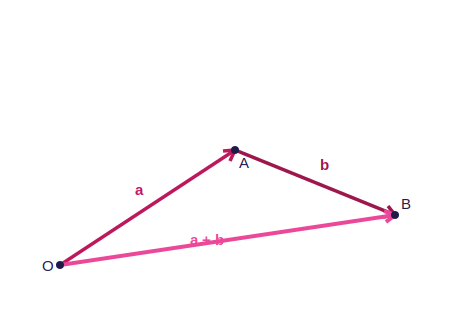
4. Magnitude and Unit VectorsThe magnitude of a = a₁i + a₂j + a₃k is √(a₁² + a₂² + a₃²), found by Pythagoras in three dimensions. To get a unit vector in the direction of a, divide a by its own magnitude. Unit vectors are the standard way to record a pure direction.
|
5. The Dot ProductThe dot product a·b equals |a||b| cosθ and is computed in components as a₁b₁ + a₂b₂ + a₃b₃. It returns a scalar and is the tool for finding the angle between two vectors and the projection of one onto another. Crucially, two non-zero vectors are perpendicular exactly when their dot product is zero.
|
6. The Cross ProductThe cross product a×b is a vector perpendicular to both a and b, found from the determinant of i, j, k over the two component rows. Its magnitude |a||b| sinθ equals the area of the parallelogram with a and b as sides, so it vanishes when the vectors are parallel. The cross product is essential for areas, torques and normals to planes.
|
| 4 |
Key Results with Proofs |
Statement. The angle θ between non-zero vectors satisfies cosθ = (a·b)/(|a||b|). Proof The angle is recovered simply by rearranging the dot-product definition.
This is the standard way to find the angle between two vectors or two lines in space. |
||||||||||||||
Statement. Two non-zero vectors are perpendicular if and only if a·b = 0. Proof A zero dot product can only come from a right angle when the lengths are non-zero.
This single test is used constantly to check perpendicularity. |
||||||||||||||
Statement. The magnitude |a×b| equals the area of the parallelogram with sides a and b. Proof The sine in the cross product is precisely the height factor of the parallelogram.
Half of this, ½|a×b|, is the area of the triangle with sides a and b. |
||||||||||||||
| 5 |
Worked Examples |
Question: Find the magnitude of a = 2i + 3j + 6k. ▶ Show full workingUse the three-dimensional Pythagoras.
Answer: |a| = 7. |
||||||||
Question: Find the unit vector in the direction of 3i + 4j. ▶ Show full workingDivide by the magnitude.
Answer: (3/5)i + (4/5)j. |
||||||||
Question: If a = i + 2j and b = 3i − j, find a + b. ▶ Show full workingAdd matching components.
Answer: 4i + j. |
|||||
Question: Find (i + 2j + 3k)·(2i − j + k). ▶ Show full workingMultiply matching parts and add.
Answer: 3. |
||||||||
Question: Find the angle between i and j. ▶ Show full workingUse the dot product.
Answer: 90°. |
||||||||
Question: Show that 2i + 3j and 3i − 2j are perpendicular. ▶ Show full workingCheck the dot product.
Answer: Yes, they are perpendicular. |
||||||||
Question: Find (i + j + k)×(i − j + k). ▶ Show full workingExpand the determinant of i, j, k.
Answer: 2i − 2k. |
||||||||
Question: Find the area of the parallelogram with adjacent sides a = i + j and b = j + k. ▶ Show full workingArea is |a×b|.
Answer: √3 square units. |
||||||||
Question: Find the projection of a = 2i + j on b = i + 2j + 2k. ▶ Show full workingProjection = (a·b)/|b|.
Answer: 4/3. |
|||||||||||
Question: Find λ so that 2i + λj + k and i − 2j + 3k are perpendicular. ▶ Show full workingSet the dot product to zero.
Answer: λ = 5/2. |
||||||||
Question: Find the position vector of the midpoint of A(1, 2, 3) and B(3, 4, 5). ▶ Show full workingAverage the position vectors.
Answer: 2i + 3j + 4k. |
||||||||
Question: Find a unit vector perpendicular to both i + j and j + k. ▶ Show full workingTake the cross product, then normalise.
Answer: (i − j + k)/√3. |
||||||||
| 6 |
Where You Meet This in Real Life |
|
Physics of forces Forces add as vectors, so engineers use the triangle and parallelogram laws to find the net push on a structure. |
|
Navigation An aircraft’s true path is the vector sum of its heading and the wind, found by vector addition. |
|
Computer graphics Surface normals, computed with cross products, decide how light reflects off three-dimensional models. |
|
Robotics The torque on a robot joint is a cross product of the position and force vectors. |
|
Work in mechanics The work done by a force is the dot product of the force and the displacement vectors. |
| 7 |
Practice Sets A–D |
|
Practice Set A – Basics |
|
A1. Find the magnitude of 3i + 4j. ▶ Reveal full workingPythagoras.
Answer: 5. |
||||
|
A2. Find (i + 2j + k) + (2i − j + 3k). ▶ Reveal full workingAdd components.
Answer: 3i + j + 4k. |
||||
|
A3. Find i·i. ▶ Reveal full workingDot product of a unit vector with itself.
Answer: 1. |
||||
|
A4. Find i×i. ▶ Reveal full workingCross product of parallel vectors.
Answer: 0 (the zero vector). |
||||
|
Practice Set B – Conceptual |
|
B1. Why does a zero dot product mean perpendicular vectors? ▶ Reveal full workingUse the cosine.
Answer: Because it forces cosθ = 0, a right angle. |
|||||||
|
B2. What does |a×b| represent geometrically? ▶ Reveal full workingArea.
Answer: The parallelogram area. |
||||
|
B3. How do you make a unit vector from a? ▶ Reveal full workingNormalise.
Answer: Divide a by |a|. |
||||
|
B4. When is a cross product the zero vector? ▶ Reveal full workingParallel case.
Answer: When the vectors are parallel. |
||||
|
Practice Set C – Application / Numerical |
|
C1. Find (2i + 3j + k)·(i − j + 4k). ▶ Reveal full workingComponent products.
Answer: 3. |
||||
|
C2. Find the angle between i + j and i − j. ▶ Reveal full workingDot then cosine.
Answer: 90°. |
|||||||
|
C3. Find the area of the triangle with sides a = i + j and b = j + k. ▶ Reveal full workingHalf the cross-product length.
Answer: ½√3 square units. |
|||||||
|
C4. Find λ so that i + λj + 2k and 2i + j − k are perpendicular. ▶ Reveal full workingDot product zero.
Answer: λ = 0. |
||||
|
Practice Set D – HOTS / Multi-step |
|
D1. Show that the vectors i + 2j + 3k, 2i + 3j + 4k and 3i + 4j + 5k are coplanar. ▶ Reveal full workingCoplanar when the scalar triple product is 0.
Answer: Yes, the triple product is 0, so they are coplanar. |
||||||||||
|
D2. Find the angle between a = i + j + k and b = i + j − 2k. ▶ Reveal full workingDot product and magnitudes.
Answer: 90°. |
|||||||
|
D3. Find a vector of magnitude 5 in the direction of 3i + 4j. ▶ Reveal full workingUnit vector times 5.
Answer: 3i + 4j. |
|||||||
|
D4. Find the area of the parallelogram whose diagonals are 2i and 2j. ▶ Reveal full workingArea is half the magnitude of the cross product of the diagonals.
Answer: 2 square units. |
||||||||||
|
Chapter Summary Everything in One Glance
|
||||||||||||||||||
| 8 |
Are You Exam-Ready? |
|
8-Point Exam Quick-Check
|
||||||||||||||||||||||||||||||||
|
School Revise Virtual Lab Practice the concepts in this chapter with interactive simulations and visual tools.
|
|
Class 12 Mathematics Chapter 10: Vector Algebra, Complete Notes and Practice These free Class 12 Maths Vector Algebra notes follow the NCERT 2026 to 27 syllabus and cover scalars and vectors, types of vectors, addition and components, magnitude and unit vectors, the dot product and the cross product, with twelve worked examples and sixteen graded practice questions. Includes worked examples, step-by-step proofs and graded practice, free on SchoolRevise.com. |
 Google