Curriculum
Mathematics Grade XII
Mathematics Grade XII
0/13
-
Chapter 1: Relations and Functions
 Preview
 -
Chapter 2: Inverse Trigonometric Functions
Preview
-
Chapter 3: Matrices
Preview
-
Chapter 4: Determinants
Preview
-
Chapter 5: Continuity and Differentiability
Preview
-
Chapter 6: Application of Derivatives
Preview
-
Chapter 7: Integrals
Preview
-
Chapter 8: Application of Integrals
Preview
-
Chapter 9: Differential Equations
Preview
-
Chapter 10: Vector Algebra
Preview
-
Chapter 11: Three Dimensional Geometry
Preview
-
Chapter 12: Linear Programming
Preview
-
Chapter 13: Probability
Preview
Work Sheets
0/13

Maths Notes
0/13
Chapter 4: Determinants
|
Class 12 • Mathematics • Chapter 4 DeterminantsOne number from a square matrix that decides area, invertibility and whether a system can be solved.
|
|
Chapter Roadmap Determinant of a Matrix • Minors and Cofactors • Expansion Along Any Row or Column • Properties of Determinants • Area of a Triangle • Adjoint of a Matrix • Inverse Using the Adjoint • Solving Linear Systems |
| 1 |
Why a Single Number Matters So Much |
A matrix is a whole grid of numbers, yet for every square matrix we can squeeze out just one number that tells us an enormous amount. That number is the determinant. If it is zero, the matrix has no inverse and the linear system behind it either fails or has infinitely many answers. If it is not zero, the matrix can be inverted and the system has exactly one solution.
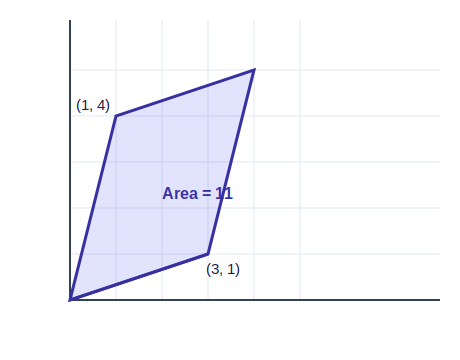
The determinant also carries a clear geometric meaning: for a 2 × 2 matrix it measures the area of the parallelogram built from its columns, and a related formula gives the area of a triangle straight from the coordinates of its corners. In this chapter you will learn to compute determinants of any order, simplify them with properties, and use them to find adjoints, inverses and solutions of equations.
The determinant of a square matrix A is written det(A) or |A|. For a 2 × 2 matrix [a, b; c, d], the value is ad − bc. A matrix with |A| = 0 is called singular; one with |A| ≠ 0 is non-singular and has an inverse.
|
| 2 |
Key Terms You Must Know |
| Term | Meaning | Example |
| Determinant |A| | A single number attached to every square matrix. | |[3, 1; 2, 4]| = 10 |
| Minor Mᵢⱼ | Determinant left after deleting row i and column j. | Delete a row and a column |
| Cofactor Aᵢⱼ | The minor with the sign (−1)^(i+j) attached. | A₁₂ = −M₁₂ |
| Singular matrix | A square matrix whose determinant is 0; it has no inverse. | |[1, 2; 2, 4]| = 0 |
| Adjoint adj A | Transpose of the matrix of cofactors. | Used to build the inverse |
| Inverse A⁻¹ | The matrix with A A⁻¹ = I, equal to (1/|A|) adj A. | Exists only if |A| ≠ 0 |
| 3 |
Core Concepts, Step by Step |
1. What a Determinant IsFor a 1 × 1 matrix [a] the determinant is simply a. For a 2 × 2 matrix [a, b; c, d] it is ad − bc, the product of the main diagonal minus the product of the other diagonal. For a 3 × 3 matrix we expand it into three 2 × 2 determinants. The determinant is defined only for square matrices, and it returns one ordinary number that can be positive, negative or zero.
|
|
A 3 × 3 matrix whose determinant we will expand
|
2. Minors and CofactorsThe minor Mᵢⱼ of an entry is the smaller determinant you get by crossing out that entry’s whole row and column. The cofactor Aᵢⱼ is the same minor with a sign attached, following the chessboard pattern of (−1)^(i+j): plus, minus, plus along the top row. Cofactors are the building blocks for expanding a determinant, for the adjoint and for the inverse.
|
3. Expanding Along Any Row or ColumnTo evaluate a 3 × 3 determinant, pick any one row or column, multiply each entry by its cofactor, and add the results. Choosing a row or column that already contains zeros saves work, because those terms vanish. A key fact is that you get the same value no matter which row or column you expand along, which is a useful self-check.
|
4. Properties That Simplify DeterminantsDeterminants obey neat rules. Swapping two rows (or two columns) flips the sign. If two rows are identical, the determinant is 0. A common factor in any row can be taken outside. Adding a multiple of one row to another leaves the determinant unchanged, which is the property used to create zeros before expanding. The determinant of a triangular matrix is just the product of its diagonal entries, and det(A′) = det(A).
|
5. Area of a Triangle from CoordinatesIf a triangle has corners (x₁, y₁), (x₂, y₂) and (x₃, y₃), its area equals one half of the absolute value of the determinant [x₁, y₁, 1; x₂, y₂, 1; x₃, y₃, 1]. The modulus is taken because area is never negative. A beautiful by-product: if this determinant comes out as 0, the three points lie on one straight line, so they are collinear.
|
|
Area of triangle ABC from the determinant of its coordinates
|
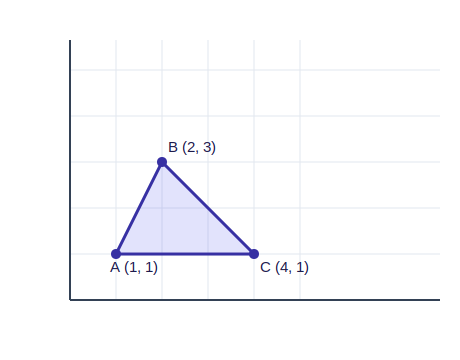
6. Adjoint, Inverse and Solving EquationsThe adjoint of A is the transpose of its cofactor matrix. It satisfies A (adj A) = (adj A) A = |A| I. From this comes the inverse: when |A| ≠ 0, A⁻¹ = (1/|A|) adj A. Inverses let us solve a system written as AX = B by computing X = A⁻¹ B, giving one unique answer whenever |A| ≠ 0. For a 2 × 2 matrix the determinant even measures the area of the parallelogram formed by its two columns.
|
|
For a 2 × 2 matrix, |det| is the area of the parallelogram of its columns
|
| 4 |
Key Results with Proofs |
Statement. For two square matrices of the same order, det(AB) = det(A) det(B). Proof The general proof uses row operations; here is a concrete check that shows the pattern.
A direct consequence: det(A⁻¹) = 1/det(A), since det(A) det(A⁻¹) = det(I) = 1. |
|||||||||||||||
Statement. For any square matrix A, A (adj A) = (adj A) A = |A| I. Proof Each diagonal entry of A (adj A) is an expansion of |A|; each off-diagonal entry is an expansion with a repeated row, which is 0.
This identity is the engine behind the inverse formula in Result 3. |
|||||||||||||||
Statement. If |A| ≠ 0 then A is invertible and A⁻¹ = (1/|A|) adj A. Proof The adjoint identity converts straight into a formula for the inverse.
If |A| = 0 no inverse exists, which is why a singular matrix can never be inverted. |
||||||||||||||
| 5 |
Worked Examples |
Question: Evaluate the determinant of [3, 1; 2, 4]. ▶ Show full workingUse ad − bc for a 2 × 2 matrix.
Answer: |[3, 1; 2, 4]| = 10. |
|||||||||||
Question: Evaluate |[1, 2, 3; 0, 4, 5; 1, 0, 6]| by expanding along the first column. ▶ Show full workingTwo entries in the first column work; the middle 0 drops out.
Answer: The determinant is 22. |
|||||||||||
Question: Find the minor and cofactor of the entry 6 (position 2,3) in [2, 1, 3; 4, 5, 6; 7, 8, 9]. ▶ Show full workingDelete row 2 and column 3, then attach the sign.
Answer: Minor = 9, cofactor = −9. |
|||||||||||
Question: Without full expansion, state |[2, 4, 6; 1, 0, 5; 3, 1, 2]| after taking out the common factor of row 1. ▶ Show full workingRow 1 has a common factor of 2.
Answer: The determinant is 48. |
|||||||||||
Question: Show that swapping two rows changes the sign, using [1, 2; 3, 4]. ▶ Show full workingCompute the determinant, swap rows, recompute.
Answer: A single row swap multiplies the determinant by −1. |
|||||||||||
Question: Find the area of the triangle with vertices A(1, 1), B(2, 3), C(4, 1). ▶ Show full workingUse one half the absolute value of the coordinate determinant.
Answer: Area = 3 square units. |
|||||||||||
Question: Check whether the points (1, 2), (2, 4) and (3, 6) are collinear. ▶ Show full workingThey are collinear exactly when the coordinate determinant is 0.
Answer: Yes, the three points are collinear. |
|||||||||||
Question: Find the adjoint of A = [2, 3; 1, 4]. ▶ Show full workingFor a 2 × 2 matrix, swap the main diagonal and negate the other diagonal.
Answer: adj A = [4, −3; −1, 2]. |
|||||||||||
Question: Find the inverse of A = [2, 5; 1, 3]. ▶ Show full workingUse A⁻¹ = (1/|A|) adj A.
Answer: A⁻¹ = [3, −5; −1, 2]. |
|||||||||||
Question: Solve the system 2x + 3y = 8, x + 4y = 9 by the matrix method. ▶ Show full workingWrite AX = B and use X = A⁻¹ B.
Answer: x = 1, y = 2. |
|||||||||||
Question: Find the determinant of the upper-triangular matrix [3, 7, 2; 0, 5, 4; 0, 0, 2]. ▶ Show full workingFor a triangular matrix the determinant is the product of the diagonal.
Answer: The determinant is 30. |
|||||||||||
Question: Determine whether A = [1, 2; 2, 4] has an inverse. ▶ Show full workingA matrix is invertible only when its determinant is non-zero.
Answer: No, A is singular and has no inverse. |
|||||||||||
| 6 |
Where You Meet This in Real Life |
|
Computer graphics Determinants tell graphics engines whether a transformation flips or squashes a shape, and scale factors for areas and volumes come straight from them. |
|
Engineering and physics Solving networks of equations for currents, forces or stresses relies on determinants to confirm a unique solution exists. |
|
Surveying and GPS Areas of irregular land plots are found from corner coordinates using the same triangle determinant formula. |
|
Economics Input-output models that balance many industries are solved with matrix inverses, which depend on a non-zero determinant. |
|
Cryptography Some classic ciphers encode messages with matrices and can only be decoded when the key matrix has a determinant that is invertible. |
| 7 |
Practice Sets A–D |
|
Practice Set A – Basics |
|
A1. Evaluate |[5, 2; 3, 4]|. ▶ Reveal full workingUse ad − bc.
Answer: 14. |
||||
|
A2. Evaluate |[2, 0; 7, 3]|. ▶ Reveal full workingUse ad − bc.
Answer: 6. |
||||
|
A3. Write the sign attached to the cofactor at position (2, 1). ▶ Reveal full workingUse (−1)^(i+j).
Answer: Negative. |
||||
|
A4. State the determinant of the identity matrix [1, 0; 0, 1]. ▶ Reveal full workingApply ad − bc.
Answer: 1. |
||||
|
Practice Set B – Conceptual |
|
B1. Why does a matrix with two equal rows have determinant 0? ▶ Reveal full workingLink it to the row-swap property.
Answer: Because the determinant must equal its own negative, so it is 0. |
|||||||
|
B2. What does |A| = 0 tell you about solving AX = B? ▶ Reveal full workingConnect to invertibility.
Answer: The system has no unique solution. |
|||||||
|
B3. If det(A) = 4, what is det(A⁻¹)? ▶ Reveal full workingUse det(A) det(A⁻¹) = 1.
Answer: det(A⁻¹) = 1/4. |
||||
|
B4. A 3 × 3 matrix is multiplied throughout by 2. By what factor does its determinant change? ▶ Reveal full workingEach of the three rows contributes one factor.
Answer: It is multiplied by 8. |
|||||||
|
Practice Set C – Application / Numerical |
|
C1. Evaluate |[1, 2, 1; 0, 3, 1; 2, 1, 0]| by expanding along the first column. ▶ Reveal full workingUse the entries 1 and 2 in column 1.
Answer: −3. |
||||||||||
|
C2. Find the area of the triangle with vertices (0, 0), (4, 0) and (0, 3). ▶ Reveal full workingUse the coordinate determinant formula.
Answer: 6 square units. |
|||||||
|
C3. Find the inverse of [4, 7; 2, 6]. ▶ Reveal full workingUse (1/|A|) adj A.
Answer: A⁻¹ = (1/10)[6, −7; −2, 4]. |
||||||||||
|
C4. Solve x + 2y = 4, 3x + y = 7 using determinants. ▶ Reveal full workingUse ratios of determinants (Cramer’s style).
Answer: x = 2, y = 1. |
||||||||||
|
Practice Set D – HOTS / Multi-step |
|
D1. If A = [2, 0; 1, 3] and B = [1, 4; 0, 2], verify det(AB) = det(A) det(B). ▶ Reveal full workingCompute both sides.
Answer: Both equal 12, so the rule holds. |
||||||||||
|
D2. Find the value of k for which the points (1, 2), (3, k) and (5, 8) are collinear. ▶ Reveal full workingSet the coordinate determinant to 0.
Answer: k = 5. |
||||||||||
|
D3. For A = [2, 3; 1, 4], verify A (adj A) = |A| I. ▶ Reveal full workingMultiply A by its adjoint.
Answer: A (adj A) = 5 I = |A| I, verified. |
||||||||||
|
D4. Solve 2x + y = 5 and 4x + 2y = 11 using determinants, and explain the result. ▶ Reveal full workingCheck the main determinant first.
Answer: D = 0, so the system has no unique solution; in fact it is inconsistent. |
||||||||||
|
Chapter Summary Everything in One Glance
|
||||||||||||||||||
| 8 |
Are You Exam-Ready? |
|
8-Point Exam Quick-Check
|
||||||||||||||||||||||||||||||||
|
School Revise Virtual Lab Practice the concepts in this chapter with interactive simulations and visual tools.
|
|
Class 12 Mathematics Chapter 4: Determinants, Complete Notes and Practice These free Class 12 Maths Determinants notes follow the NCERT 2026 to 27 syllabus and cover determinant evaluation, minors and cofactors, properties, area of a triangle, adjoint, inverse and solving linear systems with twelve worked examples and sixteen graded practice questions. Includes worked examples, step-by-step proofs and graded practice, free on SchoolRevise.com. |
 Google