Curriculum
Mathematics Grade XII
Mathematics Grade XII
0/13
-
Chapter 1: Relations and Functions
 Preview
 -
Chapter 2: Inverse Trigonometric Functions
Preview
-
Chapter 3: Matrices
Preview
-
Chapter 4: Determinants
Preview
-
Chapter 5: Continuity and Differentiability
Preview
-
Chapter 6: Application of Derivatives
Preview
-
Chapter 7: Integrals
Preview
-
Chapter 8: Application of Integrals
Preview
-
Chapter 9: Differential Equations
Preview
-
Chapter 10: Vector Algebra
Preview
-
Chapter 11: Three Dimensional Geometry
Preview
-
Chapter 12: Linear Programming
Preview
-
Chapter 13: Probability
Preview
Work Sheets
0/13

Maths Notes
0/13
Chapter 7: Integrals
|
Class 12 • Mathematics • Chapter 7 IntegralsUndoing differentiation, and adding up infinitely many slivers to measure an area.
|
|
Chapter Roadmap Integration as Anti-Differentiation • Standard Integrals • Integration by Substitution • Integration by Parts • Partial Fractions • Definite Integrals • Fundamental Theorem of Calculus • Properties of Definite Integrals |
| 1 |
Reversing the Derivative |
Differentiation breaks a quantity down into its rate of change. Integration runs the process backwards: given a rate, it rebuilds the original quantity. Because many derivatives can lead to the same shape once a constant is dropped, every indefinite integral carries an arbitrary constant C. Integration is therefore the reverse of differentiation, which is why it is also called anti-differentiation.
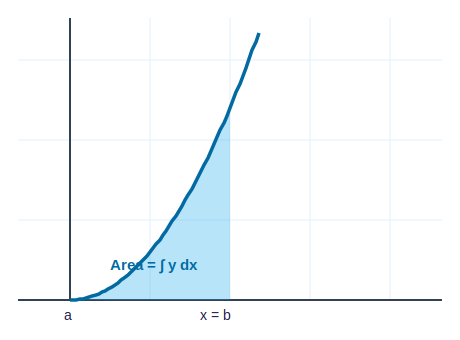
Integration has a second, equally powerful meaning. The definite integral adds up infinitely many thin slices under a curve to give the exact area of a region. The Fundamental Theorem of Calculus ties these two ideas together, turning area calculations into simple antiderivative evaluations. This chapter builds the standard integrals and the main techniques, substitution, parts and partial fractions, then applies them to definite integrals.
If d/dx[F(x)] = f(x), then the indefinite integral ∫ f(x) dx = F(x) + C. The definite integral from a to b is F(b) − F(a), and it measures the signed area between the curve and the x-axis.
|
| 2 |
Key Terms You Must Know |
| Term | Meaning | Example |
| Antiderivative | A function whose derivative is the given function. | F(x) with F′ = f |
| Indefinite integral | The family F(x) + C of all antiderivatives. | ∫ x dx = x²/2 + C |
| Definite integral | A number giving signed area between limits a and b. | ∫ from 0 to 1 of x² dx = 1/3 |
| Substitution | Swapping in a new variable to simplify an integral. | let u = inner function |
| Integration by parts | A rule from the product rule for products of functions. | ∫ u dv = uv − ∫ v du |
| Partial fractions | Splitting a rational function into simpler pieces. | 1/[x(x+1)] = 1/x − 1/(x+1) |
| 3 |
Core Concepts, Step by Step |
1. Integration as Anti-DifferentiationTo integrate is to ask: which function has this as its derivative? Since adding a constant does not change a derivative, the answer is a whole family F(x) + C. Reversing the power rule gives the most-used result: the integral of xⁿ is xⁿ⁺¹/(n + 1) + C, valid for every n except −1, where the integral is ln|x| + C instead.
|
2. Standard IntegralsA short table of standard integrals covers most needs: powers, 1/x giving ln|x|, eₓ giving eₓ, sin and cos, sec² giving tan, and the inverse-trig forms such as 1/(1 + x²) giving tan⁻¹x. Integration is linear, so constants pull out and sums integrate term by term. Knowing these by heart turns most integrals into quick recognition.
|
3. Integration by SubstitutionWhen an integral contains a function and (a multiple of) its derivative, we substitute a new variable u for the inner function. This converts the integral into a simpler one in u, which we integrate and then change back. Substitution is the integral version of the chain rule and is the first technique to try on a composite expression.
|
4. Integration by PartsFor a product of two functions we use ∫ u dv = uv − ∫ v du. The art is choosing u so that differentiating it simplifies the problem; the common guide is the order logarithmic, inverse-trig, algebraic, trig, exponential. Integration by parts is the integral form of the product rule and handles cases such as x eₓ and ln x.
|
5. Integration by Partial FractionsA proper rational function with a factorable denominator can be split into simpler fractions, each easy to integrate. For example 1/[x(x + 1)] becomes 1/x − 1/(x + 1), and integrating gives a difference of logarithms. This technique reduces complicated rational integrals to standard log and power forms.
|
6. Definite Integrals and Their PropertiesA definite integral is evaluated as F(b) − F(a) by the Fundamental Theorem of Calculus, and it equals the signed area under the curve. Helpful properties let us reverse limits (which flips the sign), split the interval, and exploit symmetry: for example ∫ from 0 to a of f(x) dx equals ∫ from 0 to a of f(a − x) dx, a trick that cracks many otherwise hard integrals.
|
|
A definite integral measures the exact area under the curve between two limits
|
| 4 |
Key Results with Proofs |
Statement. If F is an antiderivative of a continuous f, then ∫ from a to b of f(x) dx = F(b) − F(a). Proof The area built up to x grows at the rate f(x), which makes the area function an antiderivative.
This is why evaluating a definite integral reduces to plugging the limits into any antiderivative. |
||||||||||||||
Statement. ∫ u dv = uv − ∫ v du. Proof The formula is just the product rule, integrated and rearranged.
Choosing u by the logarithmic, inverse-trig, algebraic, trig, exponential order usually simplifies the new integral. |
||||||||||||||
Statement. ∫ from 0 to a of f(x) dx = ∫ from 0 to a of f(a − x) dx. Proof A single substitution t = a − x maps the interval onto itself.
Adding the integral to its mirror often collapses tough definite integrals, as in ∫ sin x/(sin x + cos x). |
||||||||||||||
| 5 |
Worked Examples |
Question: Find ∫ x³ dx. ▶ Show full workingReverse the power rule.
Answer: x⁴/4 + C. |
||||||||
Question: Find ∫ (3x² + 2x) dx. ▶ Show full workingIntegrate term by term.
Answer: x³ + x² + C. |
||||||||
Question: Find ∫ (1/x) dx. ▶ Show full workingThis is the exceptional power.
Answer: ln|x| + C. |
|||||
Question: Find ∫ eₓ dx. ▶ Show full workingStandard integral.
Answer: eₓ + C. |
|||||
Question: Find ∫ cos x dx. ▶ Show full workingStandard integral.
Answer: sin x + C. |
|||||
Question: Find ∫ x e^(x²) dx. ▶ Show full workingUse substitution.
Answer: (1/2) e^(x²) + C. |
|||||||||||
Question: Find ∫ x cos x dx. ▶ Show full workingUse integration by parts.
Answer: x sin x + cos x + C. |
|||||||||||
Question: Find ∫ ln x dx. ▶ Show full workingUse parts with the whole thing as u.
Answer: x ln x − x + C. |
|||||||||||
Question: Find ∫ 1/[x(x + 1)] dx. ▶ Show full workingUse partial fractions.
Answer: ln|x/(x + 1)| + C. |
|||||||||||
Question: Evaluate ∫ from 0 to 1 of x² dx. ▶ Show full workingUse the Fundamental Theorem of Calculus.
Answer: 1/3. |
||||||||
Question: Evaluate ∫ from 0 to π/2 of sin x dx. ▶ Show full workingAntiderivative then limits.
Answer: 1. |
||||||||
Question: Evaluate I = ∫ from 0 to π/2 of sin x/(sin x + cos x) dx. ▶ Show full workingUse the symmetry property.
Answer: π/4. |
|||||||||||
| 6 |
Where You Meet This in Real Life |
|
Physics Distance is the integral of speed and work is the integral of force, so integration recovers totals from rates. |
|
Engineering Areas, volumes, centres of mass and the load on a beam are all computed with definite integrals. |
|
Economics Total cost and consumer surplus are found by integrating marginal quantities over a range. |
|
Probability and statistics For continuous data, probabilities are areas under a density curve, which are definite integrals. |
|
Medicine The total exposure of the body to a drug over time is the area under its concentration curve. |
| 7 |
Practice Sets A–D |
|
Practice Set A – Basics |
|
A1. Find ∫ x⁴ dx. ▶ Reveal full workingPower rule.
Answer: x⁵/5 + C. |
||||
|
A2. Find ∫ sin x dx. ▶ Reveal full workingStandard.
Answer: −cos x + C. |
||||
|
A3. Find ∫ 5 dx. ▶ Reveal full workingConstant.
Answer: 5x + C. |
||||
|
A4. Find ∫ sec² x dx. ▶ Reveal full workingStandard.
Answer: tan x + C. |
||||
|
Practice Set B – Conceptual |
|
B1. Why does an indefinite integral always include + C? ▶ Reveal full workingThink about derivatives of constants.
Answer: Because constants vanish on differentiation, giving a family of antiderivatives. |
|||||||
|
B2. Which standard power has a logarithmic integral instead of a power? ▶ Reveal full workingRecall the exception.
Answer: 1/x integrates to ln|x|. |
||||
|
B3. Which technique reverses the chain rule? ▶ Reveal full workingName it.
Answer: Substitution. |
||||
|
B4. Which technique reverses the product rule? ▶ Reveal full workingName it.
Answer: Integration by parts. |
||||
|
Practice Set C – Application / Numerical |
|
C1. Find ∫ (2x + 1)⁴ dx. ▶ Reveal full workingSubstitute u = 2x + 1.
Answer: (2x + 1)⁵/10 + C. |
|||||||
|
C2. Evaluate ∫ from 1 to 2 of (1/x) dx. ▶ Reveal full workingAntiderivative then limits.
Answer: ln 2. |
||||
|
C3. Find ∫ x eₓ dx. ▶ Reveal full workingParts.
Answer: eₓ(x − 1) + C. |
|||||||
|
C4. Evaluate ∫ from 0 to 1 of eₓ dx. ▶ Reveal full workingFTC.
Answer: e − 1. |
||||
|
Practice Set D – HOTS / Multi-step |
|
D1. Evaluate ∫ from 0 to 1 of x eₓ dx. ▶ Reveal full workingParts, then limits.
Answer: 1. |
||||||||||
|
D2. Find ∫ (2x)/(x² + 1) dx. ▶ Reveal full workingSpot the derivative on top.
Answer: ln(x² + 1) + C. |
|||||||
|
D3. Use partial fractions to find ∫ 1/(x² − 1) dx. ▶ Reveal full workingFactor first.
Answer: ½ ln|(x − 1)/(x + 1)| + C. |
|||||||
|
D4. Evaluate I = ∫ from 0 to π/2 of cos x/(sin x + cos x) dx using symmetry. ▶ Reveal full workingPair it with the sine version.
Answer: π/4. |
|||||||
|
Chapter Summary Everything in One Glance
|
||||||||||||||||||
| 8 |
Are You Exam-Ready? |
|
8-Point Exam Quick-Check
|
||||||||||||||||||||||||||||||||
|
School Revise Virtual Lab Practice the concepts in this chapter with interactive simulations and visual tools.
|
|
Class 12 Mathematics Chapter 7: Integrals, Complete Notes and Practice These free Class 12 Maths Integrals notes follow the NCERT 2026 to 27 syllabus and cover indefinite and definite integrals, standard integrals, substitution, integration by parts, partial fractions, the Fundamental Theorem of Calculus and properties of definite integrals, with twelve worked examples and sixteen graded practice questions. Includes worked examples, step-by-step proofs and graded practice, free on SchoolRevise.com. |
 Google