Curriculum
Mathematics Grade XII
Mathematics Grade XII
0/13
-
Chapter 1: Relations and Functions
 Preview
 -
Chapter 2: Inverse Trigonometric Functions
Preview
-
Chapter 3: Matrices
Preview
-
Chapter 4: Determinants
Preview
-
Chapter 5: Continuity and Differentiability
Preview
-
Chapter 6: Application of Derivatives
Preview
-
Chapter 7: Integrals
Preview
-
Chapter 8: Application of Integrals
Preview
-
Chapter 9: Differential Equations
Preview
-
Chapter 10: Vector Algebra
Preview
-
Chapter 11: Three Dimensional Geometry
Preview
-
Chapter 12: Linear Programming
Preview
-
Chapter 13: Probability
Preview
Work Sheets
0/13

Maths Notes
0/13
Chapter 5: Continuity and Differentiability
|
Class 12 • Mathematics • Chapter 5 Continuity and DifferentiabilityWhen a graph flows without a break, and when it is smooth enough to have a slope at every point.
|
|
Chapter Roadmap Continuity at a Point • Algebra of Continuous Functions • Differentiability • Chain Rule for Composites • Implicit and Logarithmic Differentiation • Derivatives of Standard Functions • Parametric Form • Second Order Derivatives |
| 1 |
From Unbroken Graphs to Smooth Slopes |
Some graphs you can draw without lifting your pen; others jump suddenly. The first kind are continuous. Continuity is the precise way of saying a function has no gaps, jumps or holes, and it is the foundation on which all of calculus is built. Once a function is continuous, the next question is whether it is smooth enough to have a definite slope at each point. That property is differentiability, and the slope itself is the derivative.
This chapter sharpens both ideas. You will test continuity using limits, learn which functions are automatically continuous, and find derivatives of composite, implicit, exponential, logarithmic and parametric functions, right up to second order derivatives. These tools power everything from physics and economics to machine learning, where rates of change are everywhere.
A function f is continuous at x = a when three things agree: f(a) exists, the limit of f(x) as x → a exists, and that limit equals f(a). A function is differentiable at a when the limit defining f′(a) exists; differentiability is the stronger condition.
|
| 2 |
Key Terms You Must Know |
| Term | Meaning | Example |
| Continuous at a | f(a) exists, the limit exists, and they are equal. | x² is continuous everywhere |
| Discontinuity | A point where the graph breaks, jumps or has a hole. | A step function jumps |
| Derivative f′(x) | The limit giving the slope of the tangent at each point. | f(x)=x² → f′(x)=2x |
| Chain rule | Rule for differentiating a function inside another. | d/dx sin(x²) = 2x cos(x²) |
| Implicit function | y tied to x by an equation, not solved for y. | x² + y² = 25 |
| Second derivative | The derivative of the derivative. | y=x³ → y″ = 6x |
| 3 |
Core Concepts, Step by Step |
1. Continuity at a PointTo test continuity at x = a, check the three-part rule: the value f(a) must exist, the limit as x approaches a must exist (the left side and right side must agree), and the limit must equal the value. If any part fails, the function is discontinuous there. Polynomials are continuous everywhere; rational functions are continuous wherever the denominator is non-zero.
|
|
A continuous curve has no gaps, so it passes the three-part test at every point
|
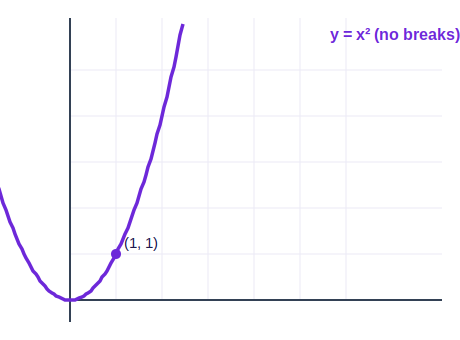
2. Algebra of Continuous FunctionsIf two functions are continuous at a point, then so are their sum, difference, product and (where the denominator is non-zero) their quotient. The composition of continuous functions is also continuous. This means most functions you build from polynomials, roots, trigonometric, exponential and logarithmic pieces are continuous on their natural domains, so you rarely test every point by hand.
|
3. Differentiability and the Tangent SlopeThe derivative f′(a) is the limit of the average rate of change as the interval shrinks to zero. Geometrically it is the slope of the tangent line to the curve at that point. A key relationship holds: every differentiable function is continuous, but not every continuous function is differentiable. A graph with a sharp corner, such as |x| at 0, is continuous yet has no single tangent slope there.
|
|
The derivative at a point is the slope of the tangent line there
|
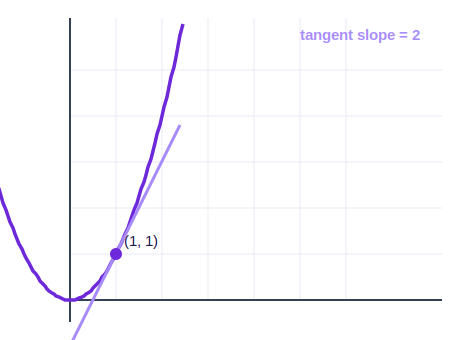
4. The Chain Rule for Composite FunctionsWhen one function sits inside another, such as sin(x²), we differentiate the outer function and multiply by the derivative of the inner function. Symbolically, if y = f(g(x)) then dy/dx = f′(g(x)) · g′(x). The chain rule is the workhorse of differentiation and is used constantly alongside the product and quotient rules.
|
5. Implicit and Logarithmic DifferentiationWhen y is not written explicitly, as in x² + y² = 25, we differentiate both sides treating y as a function of x and then solve for dy/dx. Logarithmic differentiation tames awkward expressions such as x raised to the power x: take natural logs of both sides first, which turns powers into products, then differentiate. Both techniques widen the range of functions you can handle.
|
6. Parametric Form and Second Order DerivativesSometimes x and y are each given in terms of a third variable t. Then dy/dx = (dy/dt) ÷ (dx/dt). The second derivative is found by differentiating the first derivative again; it measures how the slope itself is changing and tells us about concavity. Standard derivatives of trigonometric, inverse trigonometric, exponential and logarithmic functions should be at your fingertips for all of this.
|
| 4 |
Key Results with Proofs |
Statement. If f is differentiable at x = a, then f is continuous at x = a. Proof We turn the difference f(x) − f(a) into a product whose limit is clearly zero.
The converse fails: |x| is continuous at 0 but has a corner there, so it is not differentiable. |
||||||||||||||
Statement. For any positive integer n, the derivative of xⁿ is n xⁿ⁻¹. Proof The binomial theorem makes the first-principles limit collapse neatly.
So d/dx of x³ is 3x², and the rule extends to all real powers. |
||||||||||||||
Statement. If f is continuous on [a, b], differentiable on (a, b), and f(a) = f(b), then there is a point c in (a, b) with f′(c) = 0. Proof Equal end values force the curve to turn somewhere inside, where the slope is zero.
The Mean Value Theorem generalises this to f′(c) = [f(b) − f(a)]/(b − a). |
||||||||||||||
| 5 |
Worked Examples |
Question: Is f(x) = x² + 1 continuous at x = 2? ▶ Show full workingCheck value and limit, then compare.
Answer: Yes, f is continuous at x = 2. |
|||||||||||
Question: Find k so that f(x) = kx + 1 for x ≤ 2 and 3x − 1 for x > 2 is continuous at x = 2. ▶ Show full workingMatch the two pieces at x = 2.
Answer: k = 2. |
|||||||||||
Question: Differentiate f(x) = x² from first principles. ▶ Show full workingUse the limit definition.
Answer: f′(x) = 2x. |
|||||||||||
Question: Differentiate y = sin(x²). ▶ Show full workingUse the chain rule.
Answer: dy/dx = 2x cos(x²). |
||||||||
Question: Differentiate y = x² sin x. ▶ Show full workingUse the product rule.
Answer: dy/dx = 2x sin x + x² cos x. |
||||||||
Question: Differentiate y = (sin x)/x. ▶ Show full workingUse the quotient rule.
Answer: dy/dx = (x cos x − sin x)/x². |
||||||||
Question: Find dy/dx for x² + y² = 25. ▶ Show full workingDifferentiate implicitly.
Answer: dy/dx = −x/y. |
||||||||
Question: Differentiate y = xₓ (x to the power x). ▶ Show full workingUse logarithmic differentiation.
Answer: dy/dx = xₓ(1 + ln x). |
|||||||||||
Question: If x = t² and y = t³, find dy/dx. ▶ Show full workingUse the parametric rule.
Answer: dy/dx = (3/2)t. |
||||||||
Question: Find the second derivative of y = x³. ▶ Show full workingDifferentiate twice.
Answer: y″ = 6x. |
||||||||
Question: Differentiate y = tan⁻¹(x). ▶ Show full workingUse the standard inverse-trig derivative.
Answer: dy/dx = 1/(1 + x²). |
|||||
Question: Differentiate y = ln(x² + 1). ▶ Show full workingUse the chain rule with the log derivative.
Answer: dy/dx = 2x/(x² + 1). |
||||||||
| 6 |
Where You Meet This in Real Life |
|
Physics Velocity is the derivative of position and acceleration is the derivative of velocity, so motion is described entirely by derivatives. |
|
Economics Marginal cost and marginal revenue are derivatives that tell a business how profit changes with one more unit produced. |
|
Medicine Rates at which a drug concentration rises and falls in the blood are modelled with derivatives to set safe doses. |
|
Engineering Smoothness conditions, which are continuity and differentiability, decide whether a designed curve such as a road or a cam runs without jolts. |
|
Machine learning Training a neural network relies on the chain rule, applied millions of times, to adjust the model and reduce error. |
| 7 |
Practice Sets A–D |
|
Practice Set A – Basics |
|
A1. Differentiate y = x⁵. ▶ Reveal full workingUse the power rule.
Answer: 5x⁴. |
||||
|
A2. Differentiate y = cos x. ▶ Reveal full workingStandard derivative.
Answer: −sin x. |
||||
|
A3. Differentiate y = eₓ. ▶ Reveal full workingStandard derivative.
Answer: eₓ. |
||||
|
A4. Is f(x) = 3x − 4 continuous at x = 1? ▶ Reveal full workingPolynomials are continuous everywhere.
Answer: Yes. |
||||
|
Practice Set B – Conceptual |
|
B1. Give a function that is continuous but not differentiable at a point. ▶ Reveal full workingThink of a sharp corner.
Answer: f(x) = |x| at x = 0. |
|||||||
|
B2. Why does differentiable always imply continuous? ▶ Reveal full workingLink the difference to a product whose limit is 0.
Answer: Because the change in f shrinks to 0 as x approaches a. |
|||||||
|
B3. State the chain rule in words. ▶ Reveal full workingOuter then inner.
Answer: Outer derivative times inner derivative. |
||||
|
B4. What does the second derivative tell you about a curve? ▶ Reveal full workingThink about how the slope changes.
Answer: It describes the concavity of the curve. |
||||
|
Practice Set C – Application / Numerical |
|
C1. Differentiate y = cos(3x). ▶ Reveal full workingChain rule.
Answer: −3 sin(3x). |
|||||||
|
C2. Differentiate y = x² eₓ. ▶ Reveal full workingProduct rule.
Answer: eₓ(x² + 2x). |
|||||||
|
C3. Find dy/dx if x = 2t and y = t². ▶ Reveal full workingParametric rule.
Answer: dy/dx = t. |
|||||||
|
C4. Find the second derivative of y = sin x. ▶ Reveal full workingDifferentiate twice.
Answer: y″ = −sin x. |
|||||||
|
Practice Set D – HOTS / Multi-step |
|
D1. Find dy/dx for y = (1 + x²)⁵. ▶ Reveal full workingChain rule on a power.
Answer: 10x(1 + x²)⁴. |
|||||||
|
D2. Differentiate y = xₓ for x > 0 and evaluate dy/dx at x = 1. ▶ Reveal full workingUse logarithmic differentiation, then substitute.
Answer: dy/dx = xₓ(1 + ln x); at x = 1 it equals 1. |
|||||||
|
D3. For x² + y² = 25 find the slope of the tangent at the point (3, 4). ▶ Reveal full workingUse the implicit derivative.
Answer: Slope = −3/4. |
|||||||
|
D4. Verify Rolle’s Theorem for f(x) = x² − 4x on [0, 4] and find c. ▶ Reveal full workingCheck the conditions, then solve f′(c) = 0.
Answer: c = 2. |
||||||||||
|
Chapter Summary Everything in One Glance
|
||||||||||||||||||
| 8 |
Are You Exam-Ready? |
|
8-Point Exam Quick-Check
|
||||||||||||||||||||||||||||||||
|
School Revise Virtual Lab Practice the concepts in this chapter with interactive simulations and visual tools.
|
|
Class 12 Mathematics Chapter 5: Continuity and Differentiability, Complete Notes and Practice These free Class 12 Maths Continuity and Differentiability notes follow the NCERT 2026 to 27 syllabus and cover continuity at a point, the algebra of continuous functions, differentiability, the chain rule, implicit and logarithmic differentiation, parametric and second order derivatives, with twelve worked examples and sixteen graded practice questions. Includes worked examples, step-by-step proofs and graded practice, free on SchoolRevise.com. |
 Google