Curriculum
Mathematics Grade XII
Mathematics Grade XII
0/13
-
Chapter 1: Relations and Functions
 Preview
 -
Chapter 2: Inverse Trigonometric Functions
Preview
-
Chapter 3: Matrices
Preview
-
Chapter 4: Determinants
Preview
-
Chapter 5: Continuity and Differentiability
Preview
-
Chapter 6: Application of Derivatives
Preview
-
Chapter 7: Integrals
Preview
-
Chapter 8: Application of Integrals
Preview
-
Chapter 9: Differential Equations
Preview
-
Chapter 10: Vector Algebra
Preview
-
Chapter 11: Three Dimensional Geometry
Preview
-
Chapter 12: Linear Programming
Preview
-
Chapter 13: Probability
Preview
Work Sheets
0/13

Maths Notes
0/13
Chapter 6: Application of Derivatives
|
Class 12 • Mathematics • Chapter 6 Application of DerivativesUsing the slope of a curve to find rates, peaks, valleys and the best possible answer.
|
|
Chapter Roadmap Derivative as a Rate of Change • Increasing and Decreasing Functions • Tangents and Normals • Maxima and Minima • First and Second Derivative Tests • Absolute Extrema on an Interval |
| 1 |
Turning Slopes into Decisions |
Once you can find a derivative, a whole world of practical questions opens up. How fast is something changing right now? Where is a quantity rising and where is it falling? What is the largest profit or the smallest cost possible? Each of these is answered by reading the derivative, because the derivative is the instantaneous rate of change and the slope of the tangent line.
In this chapter the derivative becomes a decision-making tool. You will compute rates of change, decide where functions increase or decrease, write the equations of tangents and normals, and locate maximum and minimum values using the first and second derivative tests. The same ideas drive optimisation in business, engineering and science.
The sign of f′(x) tells you the behaviour: f′(x) > 0 means f is increasing, f′(x) < 0 means f is decreasing, and f′(x) = 0 marks a stationary point that may be a maximum, a minimum or neither.
|
| 2 |
Key Terms You Must Know |
| Term | Meaning | Example |
| Rate of change | How fast one quantity changes with respect to another, given by a derivative. | dV/dt for volume over time |
| Increasing function | Values rise as x rises; here f′(x) > 0. | f(x) = x³ rises throughout |
| Tangent | The line touching a curve with the curve’s slope at that point. | slope = f′ at the point |
| Normal | The line at a point perpendicular to the tangent. | slope = −1/f′ |
| Stationary point | A point where f′(x) = 0. | peaks and valleys |
| Local maximum/minimum | A highest or lowest value in a small neighbourhood. | top of a hill or bottom of a dip |
| 3 |
Core Concepts, Step by Step |
1. The Derivative as a Rate of ChangeIf a quantity y depends on x, then dy/dx is the rate at which y changes per unit change in x. When the variable is time, derivatives become speeds and growth rates: dV/dt is how fast a volume grows, dA/dt how fast an area spreads. Related-rate problems link several changing quantities through one equation and then differentiate it with respect to time.
|
2. Increasing and Decreasing FunctionsWhere the derivative is positive the function climbs; where it is negative the function falls. To find these intervals, set f′(x) = 0 to locate the turning points, then test the sign of f′ on each side. This converts a question about the whole graph into simple sign checks at a few points.
|
3. Tangents and NormalsThe tangent at a point has slope f′ evaluated there, and its equation follows from the point-slope form. The normal is perpendicular to the tangent, so its slope is the negative reciprocal, −1/f′. Tangents and normals describe how a curve behaves locally and appear in optics, design and physics.
|
|
The tangent shares the curve’s slope; the normal is perpendicular to it
|
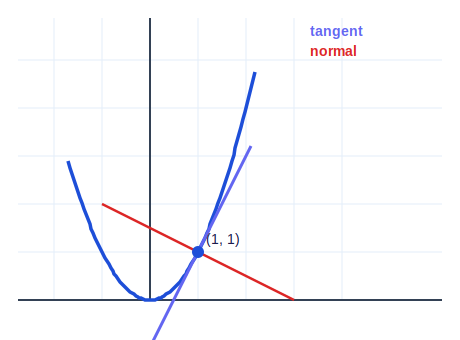
4. Maxima and MinimaPeaks and valleys of a smooth curve occur where the tangent is horizontal, that is where f′(x) = 0. These stationary points are the candidates for local maxima and minima. Not every stationary point is an extremum, so each candidate must be tested, which is what the next two tests do.
|
|
A cubic with a local maximum and a local minimum, each with a horizontal tangent
|
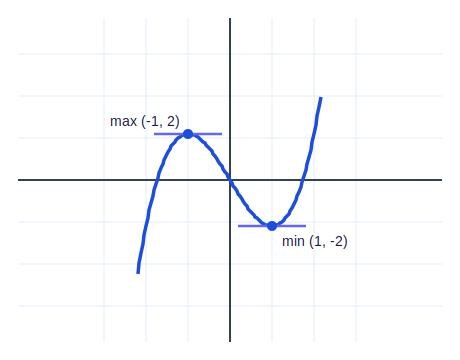
5. First and Second Derivative TestsThe first derivative test checks how the sign of f′ changes across a stationary point: from positive to negative gives a local maximum, from negative to positive gives a local minimum. The second derivative test is often quicker: at a stationary point, f″ > 0 means a minimum and f″ < 0 means a maximum; if f″ = 0 the test is inconclusive and you fall back to the first test.
|
6. Absolute Extrema and OptimisationOn a closed interval the largest and smallest values of a continuous function occur either at a stationary point inside or at an end of the interval. So we list the function’s values at all stationary points and at both endpoints and pick the biggest and smallest. This is the heart of optimisation: shaping a real problem into a function and finding its best value.
|
| 4 |
Key Results with Proofs |
Statement. If f has a local maximum or minimum at an interior point c and f is differentiable there, then f′(c) = 0. Proof At a smooth peak the tangent cannot tilt either way, so it must be flat.
This is why we always begin by solving f′(x) = 0 to find candidates. |
||||||||||||||
Statement. At a stationary point c, if f′ changes from positive to negative then c is a local maximum; if from negative to positive then a local minimum. Proof The behaviour of the function follows directly from the sign of its slope on each side.
If f′ does not change sign, the point is neither a maximum nor a minimum. |
||||||||||||||
Statement. At a stationary point c where f′(c) = 0: if f″(c) > 0 then c is a local minimum, and if f″(c) < 0 then c is a local maximum. Proof The sign of the second derivative reveals which way the curve bends at the stationary point.
For f(x) = x³ the point x = 0 has f″ = 0 and is not an extremum, showing why the test can be inconclusive. |
||||||||||||||
| 5 |
Worked Examples |
Question: The side of a square increases at 2 cm/s. How fast is its area growing when the side is 10 cm? ▶ Show full workingDifferentiate A = s² with respect to time.
Answer: The area grows at 40 cm²/s. |
|||||||||||
Question: Find where f(x) = x² − 4x is increasing and where it is decreasing. ▶ Show full workingUse the sign of f′.
Answer: Increasing on x > 2, decreasing on x < 2. |
||||||||
Question: Find the equation of the tangent to y = x² at the point (2, 4). ▶ Show full workingSlope is f′ at the point.
Answer: y = 4x − 4. |
||||||||
Question: Find the equation of the normal to y = x² at the point (2, 4). ▶ Show full workingNormal slope is the negative reciprocal.
Answer: y − 4 = −(1/4)(x − 2). |
||||||||
Question: Find the local maximum and minimum of f(x) = x³ − 3x. ▶ Show full workingSolve f′ = 0, then use the second derivative test.
Answer: Local maximum 2 at x = −1; local minimum −2 at x = 1. |
|||||||||||
Question: Use the second derivative test on f(x) = x² − 4x + 3. ▶ Show full workingFind the stationary point and check f″.
Answer: Minimum value −1 at x = 2. |
|||||||||||
Question: Find the absolute maximum and minimum of f(x) = x³ − 3x on [0, 2]. ▶ Show full workingCheck stationary points inside and both endpoints.
Answer: Absolute maximum 2 at x = 2; absolute minimum −2 at x = 1. |
|||||||||||
Question: A rectangle has perimeter 20 m. What dimensions give the greatest area? ▶ Show full workingExpress area as a function of one side.
Answer: A 5 m by 5 m square, area 25 m². |
|||||||||||
Question: A sphere’s volume is V = (4/3)πr³. Find dV/dr at r = 2. ▶ Show full workingDifferentiate with respect to r.
Answer: dV/dr = 16π. |
||||||||
Question: A cost function is C(x) = x² + 5x + 10. Find the marginal cost at x = 10. ▶ Show full workingMarginal cost is C′(x).
Answer: Marginal cost = 25. |
||||||||
Question: Show that f(x) = x³ + x is increasing for all real x. ▶ Show full workingCheck the sign of f′ everywhere.
Answer: f is increasing everywhere. |
||||||||
Question: Where does the curve y = x² − 6x + 5 have a horizontal tangent? ▶ Show full workingHorizontal tangent means f′ = 0.
Answer: At (3, −4). |
||||||||
| 6 |
Where You Meet This in Real Life |
|
Business Companies maximise profit and minimise cost by setting the derivative of the relevant function to zero. |
|
Engineering design The strongest beam, the least material packaging and the smoothest cam profile are all optimisation problems solved with derivatives. |
|
Physics of motion Speed and acceleration are derivatives, and the highest point of a thrown ball is where the velocity is momentarily zero. |
|
Medicine and biology Models find the dose or time at which a drug concentration peaks by locating where its rate of change is zero. |
|
Logistics Delivery routes and inventory levels are tuned to minimise total cost using the same maximum and minimum methods. |
| 7 |
Practice Sets A–D |
|
Practice Set A – Basics |
|
A1. Find f′(x) for f(x) = x² − 6x. ▶ Reveal full workingPower rule.
Answer: 2x − 6. |
||||
|
A2. What does f′(x) > 0 tell you about f? ▶ Reveal full workingSign meaning.
Answer: It is increasing. |
||||
|
A3. Find the slope of the tangent to y = x² at x = 3. ▶ Reveal full workingUse f′.
Answer: 6. |
||||
|
A4. At a stationary point, what is the value of f′? ▶ Reveal full workingDefinition.
Answer: Zero. |
||||
|
Practice Set B – Conceptual |
|
B1. Why does a smooth local maximum have f′ = 0? ▶ Reveal full workingThink about the tangent.
Answer: Because the tangent is horizontal at a smooth peak. |
||||
|
B2. How does the second derivative test distinguish a maximum from a minimum? ▶ Reveal full workingSign of f″.
Answer: By the sign of f″ at the stationary point. |
||||
|
B3. Why must we also check endpoints for absolute extrema on a closed interval? ▶ Reveal full workingExtremes can hide at the ends.
Answer: Because extreme values can occur at the endpoints. |
||||
|
B4. What is the slope of the normal if the tangent slope is 2? ▶ Reveal full workingNegative reciprocal.
Answer: −1/2. |
||||
|
Practice Set C – Application / Numerical |
|
C1. Find the interval on which f(x) = 6 + 12x + 3x² − 2x³ is increasing. ▶ Reveal full workingSolve f′ > 0.
Answer: Increasing on (−1, 2). |
|||||||
|
C2. Find the local extrema of f(x) = 2x³ − 6x. ▶ Reveal full workingSolve f′ = 0 and use f″.
Answer: Max 4 at x = −1, min −4 at x = 1. |
|||||||
|
C3. A balloon’s volume V = (4/3)πr³ grows so r increases at 0.5 cm/s. Find dV/dt at r = 3. ▶ Reveal full workingChain rule in time.
Answer: 18π cm³/s. |
|||||||
|
C4. Find the absolute maximum of f(x) = x² on [−3, 2]. ▶ Reveal full workingCheck the endpoints and any stationary point.
Answer: Absolute maximum 9 at x = −3. |
|||||||
|
Practice Set D – HOTS / Multi-step |
|
D1. A rectangular box with a square base and no top must hold 32 m³. Minimise the material (surface area). ▶ Reveal full workingExpress surface area in one variable.
Answer: Base 4 m, height 2 m. |
||||||||||
|
D2. Find the point on y = x² closest to the point (0, 3) by minimising the squared distance. ▶ Reveal full workingMinimise D(x) = x² + (x² − 3)².
Answer: The points (±√(5/2), 5/2). |
||||||||||
|
D3. Show that of all rectangles with a fixed perimeter, the square has the greatest area. ▶ Reveal full workingSet perimeter 2(x + y) = constant and maximise area.
Answer: The square gives the maximum area. |
||||||||||
|
D4. Verify the second derivative test is inconclusive for f(x) = x⁴ at x = 0, and find the nature of the point. ▶ Reveal full workingCompute f′, f″ at 0, then reason.
Answer: x = 0 is a local minimum (test inconclusive, first test confirms). |
||||||||||
|
Chapter Summary Everything in One Glance
|
||||||||||||||||||
| 8 |
Are You Exam-Ready? |
|
8-Point Exam Quick-Check
|
||||||||||||||||||||||||||||||||
|
School Revise Virtual Lab Practice the concepts in this chapter with interactive simulations and visual tools.
|
|
Class 12 Mathematics Chapter 6: Application of Derivatives, Complete Notes and Practice These free Class 12 Maths Application of Derivatives notes follow the NCERT 2026 to 27 syllabus and cover rates of change, increasing and decreasing functions, tangents and normals, maxima and minima, the first and second derivative tests and optimisation, with twelve worked examples and sixteen graded practice questions. Includes worked examples, step-by-step proofs and graded practice, free on SchoolRevise.com. |
 Google