Curriculum
Mathematics Grade XII
Mathematics Grade XII
0/13
-
Chapter 1: Relations and Functions
 Preview
 -
Chapter 2: Inverse Trigonometric Functions
Preview
-
Chapter 3: Matrices
Preview
-
Chapter 4: Determinants
Preview
-
Chapter 5: Continuity and Differentiability
Preview
-
Chapter 6: Application of Derivatives
Preview
-
Chapter 7: Integrals
Preview
-
Chapter 8: Application of Integrals
Preview
-
Chapter 9: Differential Equations
Preview
-
Chapter 10: Vector Algebra
Preview
-
Chapter 11: Three Dimensional Geometry
Preview
-
Chapter 12: Linear Programming
Preview
-
Chapter 13: Probability
Preview
Work Sheets
0/13

Maths Notes
0/13
Chapter 13: Probability
|
Class 12 • Mathematics • Chapter 13 ProbabilityUpdating chances with new information, from conditional probability through to Bayes’ theorem.
|
|
Chapter Roadmap Conditional Probability • Multiplication Theorem • Independent Events • Total Probability • Bayes’ Theorem • Random Variables and Mean |
| 1 |
Reasoning with Uncertainty |
Probability measures how likely an event is, on a scale from 0 to 1. The real power comes when new information arrives: once we know that one event has happened, the chances of related events shift. Conditional probability captures this updating, and it leads to some of the most useful results in all of mathematics.
This chapter builds from conditional probability to the multiplication theorem, independence, the total probability theorem and finally Bayes’ theorem, which reverses conditional reasoning and underlies medical testing, spam filters and machine learning. We finish with random variables and their mean, the expected value that summarises a whole distribution in one number.
The conditional probability of A given B is P(A|B) = P(A ∩ B)/P(B), provided P(B) > 0. Two events are independent when P(A ∩ B) = P(A) P(B), so knowing one tells you nothing about the other.
|
| 2 |
Key Terms You Must Know |
| Term | Meaning | Example |
| Conditional probability | Chance of A given that B has occurred. | P(A|B) = P(A ∩ B)/P(B) |
| Independent events | Events where one does not affect the other. | P(A ∩ B) = P(A)P(B) |
| Total probability | Combining cases that partition the sample space. | sum of P(case) P(event|case) |
| Bayes’ theorem | Reversing a conditional probability. | find P(cause|effect) |
| Random variable | A number assigned to each outcome. | number of heads in two tosses |
| Mean (expectation) | The long-run average value of a random variable. | Σ x P(x) |
| 3 |
Core Concepts, Step by Step |
1. Conditional ProbabilityWhen we learn that event B has happened, the sample space shrinks to just B, and probabilities are recalculated within it. The conditional probability is P(A|B) = P(A ∩ B)/P(B). It answers the question: given B, how likely is A? This single idea is the foundation for everything that follows.
|
|
A two-stage probability tree: branch probabilities multiply along each path
|
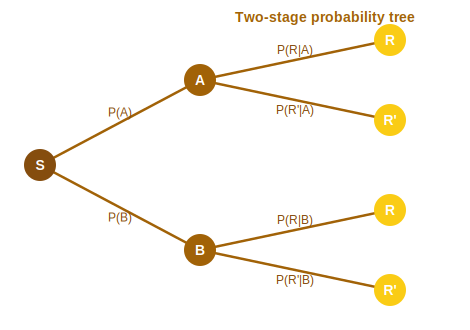
2. The Multiplication TheoremRearranging the definition of conditional probability gives the multiplication theorem: P(A ∩ B) = P(A) P(B|A) = P(B) P(A|B). This lets us find the chance of two events both happening by multiplying along the branches of a probability tree, the standard way to handle multi-stage experiments.
|
3. Independent EventsTwo events are independent when the occurrence of one leaves the probability of the other unchanged, that is P(A|B) = P(A). Equivalently, P(A ∩ B) = P(A) P(B). Independence must be checked, not assumed; many real events that seem unrelated are in fact dependent.
|
4. The Total Probability TheoremSometimes an event can happen through several mutually exclusive routes that together cover all possibilities, a partition. The total probability theorem adds the contributions: P(E) = Σ P(route) P(E|route). It is the natural tool when an outcome depends on which of several cases occurred first.
|
5. Bayes’ TheoremBayes’ theorem reverses the direction of conditioning. Given that an effect E occurred, it finds the probability it came from a particular cause: P(cause|E) = P(cause) P(E|cause) divided by the total probability P(E). It is the mathematics of updating belief in light of evidence, used everywhere from diagnostics to spam detection.
|
6. Random Variables and Their MeanA random variable assigns a number to each outcome of an experiment, and its probability distribution lists each value with its probability. The mean or expected value, E(X) = Σ x P(x), is the long-run average. It condenses an entire distribution into a single representative number.
|
| 4 |
Key Results with Proofs |
Statement. P(A ∩ B) = P(A) P(B|A). Proof The theorem is the definition of conditional probability, rearranged.
This is exactly the rule for multiplying probabilities along a tree branch. |
||||||||||||||
Statement. Events A and B are independent if and only if P(A ∩ B) = P(A) P(B). Proof Independence and the product rule each imply the other.
Always verify the product equation rather than assuming independence. |
||||||||||||||
Statement. P(Aᵢ|E) = P(Aᵢ) P(E|Aᵢ) / Σ P(Aⱼ) P(E|Aⱼ). Proof Bayes’ theorem is built from the multiplication and total probability theorems.
It converts a forward probability P(E|cause) into the reverse P(cause|E). |
||||||||||||||
| 5 |
Worked Examples |
Question: If P(A ∩ B) = 0.2 and P(B) = 0.5, find P(A|B). ▶ Show full workingUse the definition.
Answer: 0.4. |
||||||||
Question: A fair die is rolled. Find the probability it shows a number greater than 4 given that it is even. ▶ Show full workingCondition on the even outcomes.
Answer: 1/3. |
|||||||||||
Question: Two cards are drawn without replacement from 52. Find P(both kings). ▶ Show full workingMultiply along the branches.
Answer: 1/221. |
||||||||
Question: If P(A) = 0.6, P(B) = 0.5 and A, B are independent, find P(A ∩ B). ▶ Show full workingUse the product rule.
Answer: 0.3. |
||||||||
Question: Check whether tossing two fair coins gives independent events ‘first head’ and ‘second head’. ▶ Show full workingCompare P(A ∩ B) with P(A)P(B).
Answer: Yes, they are independent. |
||||||||
Question: Bag I has 3 red and 2 white; Bag II has 1 red and 4 white. A bag is chosen at random and a ball drawn. Find P(red). ▶ Show full workingUse the total probability theorem.
Answer: 2/5. |
|||||||||||
Question: In Example 6, given the ball drawn is red, find the probability it came from Bag I (Bayes). ▶ Show full workingUse Bayes’ theorem.
Answer: 3/4. |
||||||||
Question: A test is 90% accurate. A disease affects 1% of people. If someone tests positive, find P(disease) using Bayes (assume 90% true positive, 10% false positive). ▶ Show full workingSet up Bayes with the small base rate.
Answer: 1/12, about 0.083. |
|||||||||||
Question: A coin is tossed twice. Let X be the number of heads. Write the probability distribution. ▶ Show full workingList values and probabilities.
Answer: P(0)=1/4, P(1)=1/2, P(2)=1/4. |
||||||||
Question: Find the mean of X from Example 9. ▶ Show full workingUse E(X) = Σ x P(x).
Answer: E(X) = 1. |
||||||||
Question: A die is rolled. Let X be the number shown. Find E(X). ▶ Show full workingAverage of equally likely values.
Answer: E(X) = 3.5. |
||||||||
Question: If P(A) = 0.7, P(B) = 0.4 and P(A ∩ B) = 0.28, are A and B independent? ▶ Show full workingCompare with the product.
Answer: Yes, independent. |
||||||||
| 6 |
Where You Meet This in Real Life |
|
Medical testing Bayes’ theorem converts a test’s accuracy into the real chance a positive result means disease, accounting for how rare the disease is. |
|
Spam filtering Email filters use Bayes’ theorem on word frequencies to estimate the probability a message is spam. |
|
Weather forecasting Forecasts update the chance of rain as new data arrives, a conditional-probability process. |
|
Insurance Premiums are set from expected values of claims, the mean of a payout random variable. |
|
Quality control Factories use conditional probability to decide how likely a batch is faulty given a sampled defect. |
| 7 |
Practice Sets A–D |
|
Practice Set A – Basics |
|
A1. If P(A ∩ B) = 0.3 and P(B) = 0.6, find P(A|B). ▶ Reveal full workingDefinition.
Answer: 0.5. |
||||
|
A2. State the condition for A and B to be independent. ▶ Reveal full workingProduct rule.
Answer: P(A ∩ B) = P(A)P(B). |
||||
|
A3. Find P(A ∩ B) if P(A) = 0.5, P(B) = 0.4 and they are independent. ▶ Reveal full workingMultiply.
Answer: 0.2. |
||||
|
A4. What does E(X) measure? ▶ Reveal full workingExpectation.
Answer: The mean / expected value. |
||||
|
Practice Set B – Conceptual |
|
B1. Why does conditioning on B change probabilities? ▶ Reveal full workingSample space shrinks.
Answer: Because the sample space shrinks to B. |
||||
|
B2. How is the multiplication theorem related to conditional probability? ▶ Reveal full workingRearrangement.
Answer: It is the definition rearranged. |
||||
|
B3. What does Bayes’ theorem let you do? ▶ Reveal full workingReverse conditioning.
Answer: Reverse a conditional probability. |
||||
|
B4. When are two events independent? ▶ Reveal full workingDefinition.
Answer: When one does not affect the other’s probability. |
||||
|
Practice Set C – Application / Numerical |
|
C1. A die is rolled. Find P(prime given odd). ▶ Reveal full workingCondition on odd.
Answer: 2/3. |
|||||||
|
C2. Two cards drawn without replacement; find P(both aces). ▶ Reveal full workingMultiply branches.
Answer: 1/221. |
||||
|
C3. Bag has 4 red, 6 blue. Two drawn without replacement. Find P(both red). ▶ Reveal full workingMultiply.
Answer: 2/15. |
||||
|
C4. X is the number of heads in two tosses. Find E(X). ▶ Reveal full workingWeighted sum.
Answer: E(X) = 1. |
||||
|
Practice Set D – HOTS / Multi-step |
|
D1. Bag I: 2 red, 3 black; Bag II: 4 red, 1 black. A bag is chosen at random and a red ball drawn. Find P(it came from Bag II). ▶ Reveal full workingTotal probability then Bayes.
Answer: 2/3. |
||||||||||
|
D2. A coin is biased with P(head) = 0.6. It is tossed twice. Find P(exactly one head). ▶ Reveal full workingTwo disjoint orderings.
Answer: 0.48. |
|||||||
|
D3. A random variable X has P(1) = 0.2, P(2) = 0.5, P(3) = 0.3. Find E(X). ▶ Reveal full workingWeighted sum.
Answer: E(X) = 2.1. |
|||||||
|
D4. A factory has machines A and B making 60% and 40% of items, with defect rates 2% and 5%. An item is defective. Find P(it came from machine B). ▶ Reveal full workingTotal probability then Bayes.
Answer: 5/8, i.e. 0.625. |
||||||||||
|
Chapter Summary Everything in One Glance
|
||||||||||||||||||
| 8 |
Are You Exam-Ready? |
|
8-Point Exam Quick-Check
|
||||||||||||||||||||||||||||||||
|
School Revise Virtual Lab Practice the concepts in this chapter with interactive simulations and visual tools.
|
|
Class 12 Mathematics Chapter 13: Probability, Complete Notes and Practice These free Class 12 Maths Probability notes follow the NCERT 2026 to 27 syllabus and cover conditional probability, the multiplication theorem, independent events, the total probability theorem, Bayes’ theorem and random variables with their mean, with twelve worked examples and sixteen graded practice questions. Includes worked examples, step-by-step proofs and graded practice, free on SchoolRevise.com. |
 Google