Curriculum
Mathematics Grade XII
Mathematics Grade XII
0/13
-
Chapter 1: Relations and Functions
 Preview
 -
Chapter 2: Inverse Trigonometric Functions
Preview
-
Chapter 3: Matrices
Preview
-
Chapter 4: Determinants
Preview
-
Chapter 5: Continuity and Differentiability
Preview
-
Chapter 6: Application of Derivatives
Preview
-
Chapter 7: Integrals
Preview
-
Chapter 8: Application of Integrals
Preview
-
Chapter 9: Differential Equations
Preview
-
Chapter 10: Vector Algebra
Preview
-
Chapter 11: Three Dimensional Geometry
Preview
-
Chapter 12: Linear Programming
Preview
-
Chapter 13: Probability
Preview
Work Sheets
0/13

Maths Notes
0/13
Chapter 11: Three Dimensional Geometry
|
Class 12 • Mathematics • Chapter 11 Three Dimensional GeometryDescribing points, lines and planes in space using direction cosines, vectors and equations.
|
|
Chapter Roadmap Direction Cosines and Ratios • Equation of a Line • Angle Between Two Lines • Equation of a Plane • Angle Between Planes • Distance of a Point from a Plane |
| 1 |
Geometry in All Three Dimensions |
On a flat page we locate a point with two numbers. In the real world we need three, because space has length, width and height. Three dimensional geometry extends coordinate geometry into space, giving exact descriptions of points, the lines joining them and the planes they lie in.
The key new idea is direction. A line in space is fixed by a point on it and the direction it heads, captured by direction cosines or direction ratios. Planes are fixed by a point and a normal direction. With these, we measure angles between lines and planes and find the distance from a point to a plane, the everyday questions of architecture, engineering and graphics.
If a line makes angles α, β, γ with the axes, its direction cosines are l = cosα, m = cosβ, n = cosγ and satisfy l² + m² + n² = 1. Any proportional triple (a, b, c) gives the direction ratios of the same line.
|
| 2 |
Key Terms You Must Know |
| Term | Meaning | Example |
| Direction cosines | Cosines of the angles a line makes with the axes; l, m, n. | l² + m² + n² = 1 |
| Direction ratios | Any numbers proportional to the direction cosines. | (2, 3, 6) |
| Equation of a line | Point plus direction, in vector or cartesian form. | (x−1)/2 = (y−2)/3 = z/1 |
| Normal to a plane | A direction perpendicular to the whole plane. | coefficients in ax+by+cz=d |
| Angle between planes | The angle between their normals. | cosθ from normals |
| Distance from a plane | Perpendicular distance of a point to a plane. | |ax₀+by₀+cz₀−d|/√(a²+b²+c²) |
| 3 |
Core Concepts, Step by Step |
1. Direction Cosines and Direction RatiosThe direction of a line is recorded by the cosines of the angles it makes with the x, y and z axes, written l, m and n. These always satisfy l² + m² + n² = 1. Often it is easier to use any proportional triple of direction ratios (a, b, c); dividing by √(a² + b² + c²) converts them back to direction cosines.
|
|
A point, a line and a plane sketched against the three coordinate axes
|
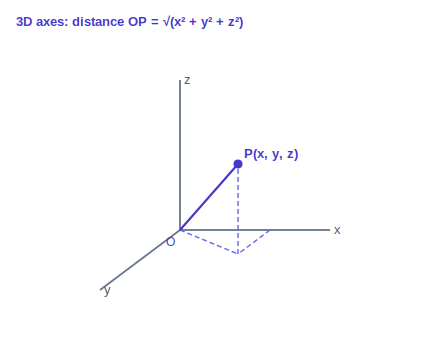
2. Equation of a Line in SpaceA line is fixed by one point on it and its direction. In vector form it is r = a + λb, where a is the position vector of a point and b the direction. In cartesian form it becomes (x − x₁)/a = (y − y₁)/b = (z − z₁)/c, with (a, b, c) the direction ratios.
|
3. Angle Between Two LinesThe angle between two lines depends only on their directions. Using direction ratios (a₁, b₁, c₁) and (a₂, b₂, c₂), the cosine of the angle is the dot product over the product of magnitudes: |a₁a₂ + b₁b₂ + c₁c₂| divided by the two magnitudes. The lines are perpendicular when this dot product is zero and parallel when the ratios are proportional.
|
4. Equation of a PlaneA plane is fixed by a point and a normal direction perpendicular to it. Its general cartesian equation is ax + by + cz = d, where (a, b, c) is the normal. The intercept form x/p + y/q + z/r = 1 reads off where the plane crosses each axis, which is handy for sketching.
|
5. Angle Between Planes and a LineTwo planes meet at an angle equal to the angle between their normals, found by the dot-product formula. For a line and a plane, the relevant angle is between the line’s direction and the plane’s normal; the angle the line makes with the plane itself is its complement, so we use sine rather than cosine.
|
6. Distance of a Point from a PlaneThe perpendicular distance from a point (x₀, y₀, z₀) to the plane ax + by + cz = d is |ax₀ + by₀ + cz₀ − d| divided by √(a² + b² + c²). The absolute value keeps the distance positive, and the denominator scales by the length of the normal. This single formula answers a huge range of spatial problems.
|
| 4 |
Key Results with Proofs |
Statement. For any line, l² + m² + n² = 1. Proof Direction cosines are a unit vector’s components, so their squares sum to one.
This is why only two of the three direction cosines are independent. |
||||||||||||||
Statement. cosθ = |a₁a₂ + b₁b₂ + c₁c₂| / (√(a₁²+b₁²+c₁²) √(a₂²+b₂²+c₂²)). Proof The angle between lines is just the angle between their direction vectors.
Perpendicular lines have a₁a₂ + b₁b₂ + c₁c₂ = 0. |
||||||||||||||
Statement. The distance from (x₀, y₀, z₀) to ax + by + cz = d is |ax₀ + by₀ + cz₀ − d| / √(a² + b² + c²). Proof The distance is the projection of the point-to-plane gap onto the unit normal.
If the point lies on the plane the numerator is 0, as expected. |
||||||||||||||
| 5 |
Worked Examples |
Question: Find the direction ratios and direction cosines of the line through (1, 2, 3) and (4, 6, 3). ▶ Show full workingSubtract coordinates, then normalise.
Answer: Ratios (3, 4, 0); cosines (3/5, 4/5, 0). |
|||||||||||
Question: Find the direction cosines of the x-axis. ▶ Show full workingIt points purely along x.
Answer: (1, 0, 0). |
||||||||
Question: Verify that (1/√3, 1/√3, 1/√3) are valid direction cosines. ▶ Show full workingCheck the sum of squares.
Answer: Yes, the squares sum to 1. |
||||||||
Question: Find the angle between lines with direction ratios (1, 1, 0) and (1, 0, 1). ▶ Show full workingUse the dot-product formula.
Answer: 60°. |
|||||||||||
Question: Find the distance from (1, 2, 3) to the plane x + 2y + 2z = 9. ▶ Show full workingUse the distance formula.
Answer: 2/3. |
|||||||||||
Question: Find the equation of the plane through (1, 0, 0), (0, 1, 0) and (0, 0, 1). ▶ Show full workingUse the intercept form.
Answer: x + y + z = 1. |
|||||||||||
Question: Find the angle between the planes x + y + z = 1 and x − y + z = 2. ▶ Show full workingUse the normals.
Answer: cosθ = 1/3. |
|||||||||||
Question: Are the lines with direction ratios (2, −1, 2) and (1, 2, 0) perpendicular? ▶ Show full workingCheck the dot product.
Answer: Yes, they are perpendicular. |
||||||||
Question: Find λ so the planes 2x + λy + 3z = 1 and x − 2y + z = 4 are perpendicular. ▶ Show full workingPerpendicular planes have perpendicular normals.
Answer: λ = 5/2. |
|||||||||||
Question: Write the cartesian equation of the line through (2, −1, 3) with direction ratios (1, 4, 2). ▶ Show full workingPoint plus direction.
Answer: (x − 2)/1 = (y + 1)/4 = (z − 3)/2. |
||||||||
Question: Find the distance from the origin to the plane 2x + 3y + 6z = 14. ▶ Show full workingUse the distance formula at (0, 0, 0).
Answer: 2. |
|||||||||||
Question: Find the angle between the line with direction ratios (2, 2, 1) and the plane with normal (1, 2, 2). ▶ Show full workingUse sine with the normal.
Answer: θ = sin⁻¹(8/9). |
|||||||||||
| 6 |
Where You Meet This in Real Life |
|
Architecture Roof planes, ramps and supports are defined by their normals and the angles between them. |
|
Computer graphics Every 3D scene uses planes and normals to decide visibility and lighting of surfaces. |
|
Aviation An aircraft’s heading in space is a direction in three dimensions, described by direction cosines. |
|
Robotics Positioning a robot arm requires lines and planes in space and the angles between them. |
|
Geology and mining The orientation of rock layers is recorded as a plane with a measured normal direction. |
| 7 |
Practice Sets A–D |
|
Practice Set A – Basics |
|
A1. Find the direction ratios of the line through (0, 0, 0) and (2, 3, 6). ▶ Reveal full workingSubtract.
Answer: (2, 3, 6). |
||||
|
A2. Find the direction cosines of the y-axis. ▶ Reveal full workingPure y direction.
Answer: (0, 1, 0). |
||||
|
A3. State the normal to the plane 3x − y + 2z = 5. ▶ Reveal full workingRead coefficients.
Answer: (3, −1, 2). |
||||
|
A4. Do (1, 0, 0) satisfy l² + m² + n² = 1? ▶ Reveal full workingCheck.
Answer: Yes. |
||||
|
Practice Set B – Conceptual |
|
B1. Why do direction cosines satisfy l² + m² + n² = 1? ▶ Reveal full workingThey form a unit vector.
Answer: Because they are the components of a unit direction vector. |
|||||||
|
B2. How do you find the angle between two planes? ▶ Reveal full workingUse normals.
Answer: From the angle between their normals. |
||||
|
B3. When are two lines parallel in space? ▶ Reveal full workingProportional ratios.
Answer: When their direction ratios are proportional. |
||||
|
B4. Why is the line-plane angle found using sine? ▶ Reveal full workingComplement of the normal angle.
Answer: Because it is the complement of the angle with the normal. |
||||
|
Practice Set C – Application / Numerical |
|
C1. Find the distance from (2, 1, 0) to the plane 2x + y + 2z = 3. ▶ Reveal full workingDistance formula.
Answer: 2/3. |
|||||||
|
C2. Find the angle between lines (1, 2, 2) and (2, 2, 1). ▶ Reveal full workingDot-product angle.
Answer: cosθ = 8/9. |
|||||||
|
C3. Find where the plane x + y + z = 6 meets the x-axis. ▶ Reveal full workingSet y = z = 0.
Answer: (6, 0, 0). |
||||
|
C4. Find the direction cosines of (6, 8, 0). ▶ Reveal full workingNormalise.
Answer: (3/5, 4/5, 0). |
||||
|
Practice Set D – HOTS / Multi-step |
|
D1. Find the distance between the parallel planes x + 2y + 2z = 6 and x + 2y + 2z = 12. ▶ Reveal full workingTake a point on one and use the distance to the other.
Answer: 2. |
||||||||||
|
D2. Show that the line through (1, 2, 3) with ratios (1, 1, 1) is parallel to the plane x + y − 2z = 5. ▶ Reveal full workingLine is parallel to a plane when its direction is perpendicular to the normal.
Answer: Yes, the direction is perpendicular to the normal, so the line is parallel to the plane. |
||||||||||
|
D3. Find the angle between the planes 2x − y + 2z = 3 and x + 2y − 2z = 1. ▶ Reveal full workingUse the normals.
Answer: cosθ = 4/9. |
|||||||
|
D4. Find the foot of the perpendicular distance check: is (1, 1, 1) closer to plane x + y + z = 3 or x + y + z = 6? ▶ Reveal full workingCompute both distances.
Answer: It lies on x + y + z = 3 and is √3 from x + y + z = 6. |
||||||||||
|
Chapter Summary Everything in One Glance
|
||||||||||||||||||
| 8 |
Are You Exam-Ready? |
|
8-Point Exam Quick-Check
|
||||||||||||||||||||||||||||||||
|
School Revise Virtual Lab Practice the concepts in this chapter with interactive simulations and visual tools.
|
|
Class 12 Mathematics Chapter 11: Three Dimensional Geometry, Complete Notes and Practice These free Class 12 Maths Three Dimensional Geometry notes follow the NCERT 2026 to 27 syllabus and cover direction cosines and ratios, the equation of a line, the angle between two lines, the equation of a plane, angles between planes and a line, and the distance of a point from a plane, with twelve worked examples and sixteen graded practice questions. Includes worked examples, step-by-step proofs and graded practice, free on SchoolRevise.com. |
 Google