Curriculum
Mathematics Grade XII
Mathematics Grade XII
0/13
-
Chapter 1: Relations and Functions
 Preview
 -
Chapter 2: Inverse Trigonometric Functions
Preview
-
Chapter 3: Matrices
Preview
-
Chapter 4: Determinants
Preview
-
Chapter 5: Continuity and Differentiability
Preview
-
Chapter 6: Application of Derivatives
Preview
-
Chapter 7: Integrals
Preview
-
Chapter 8: Application of Integrals
Preview
-
Chapter 9: Differential Equations
Preview
-
Chapter 10: Vector Algebra
Preview
-
Chapter 11: Three Dimensional Geometry
Preview
-
Chapter 12: Linear Programming
Preview
-
Chapter 13: Probability
Preview
Work Sheets
0/13

Maths Notes
0/13
Chapter 2: Inverse Trigonometric Functions
|
Class 12 • Mathematics • Chapter 2 Inverse Trigonometric FunctionsGoing backwards from a ratio to the angle, with one agreed answer every time.
|
|
Chapter Roadmap Why Restrict the Domain • sin and cos Inverses • tan and cot Inverses • sec and cosec Inverses • Finding Principal Values • Elementary Properties • Key Results • Applications |
| 1 |
Why Inverse Trigonometric Functions Matter |
Ordinary trigonometry takes an angle and gives a ratio: sin 30° = 1/2. Very often we need to go the other way, starting from the ratio 1/2 and asking which angle produced it. That reverse journey is what inverse trigonometric functions do, and they appear whenever an angle has to be recovered from a measurement, such as the angle of a ramp from its height and length.
There is a catch. Because sin, cos and tan repeat, infinitely many angles share the same ratio, so the reverse is not automatically a function. To fix this we agree on a single stretch of angles, the principal value branch, for each inverse. This chapter sets out those branches, shows how to read off the one correct answer (the principal value), and develops a small set of properties that simplify expressions quickly.
A trigonometric function is not one-one over all angles, so we restrict its domain to make it invertible. The agreed output range of each inverse is its principal value branch, and the single answer it gives is the principal value.
|
| 2 |
Key Terms You Must Know |
| Term | Meaning | Example |
| Inverse trig function | Gives the angle whose trig ratio is a given value. | sin⁻¹(1/2) = π/6 |
| Principal value branch | The agreed output range that makes the inverse a function. | sin⁻¹ has range [−π/2, π/2] |
| Principal value | The single value the inverse returns, inside its branch. | cos⁻¹(0) = π/2 |
| Domain | The set of inputs the inverse will accept. | sin⁻¹ accepts [−1, 1] |
| Range | The set of outputs (angles) the inverse can give. | tan⁻¹ gives (−π/2, π/2) |
| Odd function | A function with f(−x) = −f(x). | sin⁻¹(−x) = −sin⁻¹x |
| Complementary pair | Two inverses adding to π/2 for valid x. | sin⁻¹x + cos⁻¹x = π/2 |
| 3 |
Core Concepts, Step by Step |
1. Why We Restrict the DomainA function can be reversed only when it is one-one, that is when each output comes from just one input. But sin x takes the value 1/2 at 30°, at 150°, and at countless other angles, so over all angles it is far from one-one. To build an inverse we therefore restrict sin to a stretch of angles on which it is one-one and still reaches every value from −1 to 1. The agreed stretch becomes the range of the inverse, called its principal value branch.
|
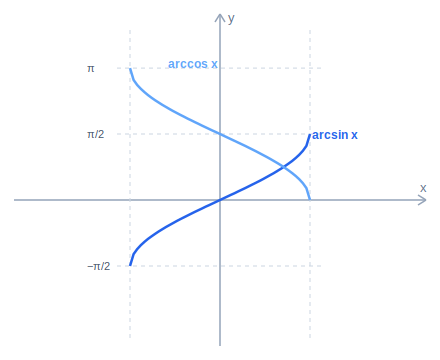
2. The Inverses of sin and cosFor sin⁻¹ we restrict sin to angles from −π/2 to π/2. So sin⁻¹ has domain [−1, 1] and range [−π/2, π/2]. For cos⁻¹ we restrict cos to angles from 0 to π, giving domain [−1, 1] and range [0, π]. Reading them is straightforward: sin⁻¹(1/2) asks ‘which angle in [−π/2, π/2] has sine 1/2?’, and the answer is π/6.
|
|
Graphs of sin⁻¹x and cos⁻¹x on the domain [−1, 1]
|
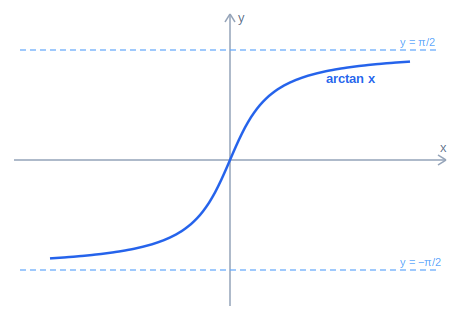
3. The Inverses of tan and cottan⁻¹ accepts every real number (since tan reaches all values) and returns an angle in the open interval (−π/2, π/2). cot⁻¹ also accepts every real number and returns an angle in (0, π). These two are very common in calculus, because tan⁻¹ turns up whenever we integrate expressions of the form 1/(1 + x²), which you will meet later in the year.
|
|
Graph of tan⁻¹x with horizontal asymptotes y = ±π/2
|
4. The Inverses of sec and cosecsec⁻¹ accepts values with |x| ≥ 1 and returns an angle in [0, π] other than π/2. cosec⁻¹ accepts |x| ≥ 1 and returns an angle in [−π/2, π/2] other than 0. They are used less often than the first four, but they complete the family. The table below collects the domain and principal value branch of all six, which is the single most important thing to know in this chapter.
|
|
Domains and principal value branches of the six inverses
|
5. Finding Principal ValuesTo find a principal value, ask which angle inside the correct branch gives the required ratio. For example, to find cos⁻¹(−1/2), look for an angle in [0, π] whose cosine is −1/2; that angle is 2π/3. A common slip is to give an angle outside the branch, so always check that your answer lies within the range from the table. Negative inputs often push the answer into the second quadrant for cos⁻¹, or below zero for sin⁻¹ and tan⁻¹.
|
6. Elementary PropertiesA handful of properties simplify almost every expression. The inverses of sin, tan and cosec are odd, so sin⁻¹(−x) = −sin⁻¹x and tan⁻¹(−x) = −tan⁻¹x. Each function pairs with its co-function to give π/2: sin⁻¹x + cos⁻¹x = π/2, tan⁻¹x + cot⁻¹x = π/2, and sec⁻¹x + cosec⁻¹x = π/2. Reciprocal inputs swap function and co-function, for example sin⁻¹(1/x) = cosec⁻¹x for |x| ≥ 1.
|
| 4 |
Key Results & Proofs |
Three short results do most of the simplifying in this chapter, and each follows from the definition of the inverse.
Statement. For every x in [−1, 1], sin⁻¹x + cos⁻¹x = π/2. Proof Set sin⁻¹x equal to an angle, then use the complement relation.
The same idea gives tan⁻¹x + cot⁻¹x = π/2 and sec⁻¹x + cosec⁻¹x = π/2. |
||||||||||||||||||||
Statement. For every x in [−1, 1], sin⁻¹(−x) = −sin⁻¹x. Proof Use the fact that sine itself is an odd function.
tan⁻¹ and cosec⁻¹ are odd in the same way; cos⁻¹ and sec⁻¹ are not. |
||||||||||||||||
Statement. For every real x, tan⁻¹x + cot⁻¹x = π/2. Proof The same complement trick used for sine and cosine works here.
So tan⁻¹(1) + cot⁻¹(1) = π/4 + π/4 = π/2, as expected. |
||||||||||||||||||||
| 5 |
Worked Examples |
Question: Find the principal value of sin⁻¹(1/2). ▶ Show full workingAsk which angle in [−π/2, π/2] has sine 1/2.
Answer: sin⁻¹(1/2) = π/6. |
|||||
Question: Find the principal value of cos⁻¹(−1/2). ▶ Show full workingAsk which angle in [0, π] has cosine −1/2.
Answer: cos⁻¹(−1/2) = 2π/3. |
|||||
Question: Find the principal value of tan⁻¹(1). ▶ Show full workingAsk which angle in (−π/2, π/2) has tangent 1.
Answer: tan⁻¹(1) = π/4. |
|||||
Question: Find the principal value of sin⁻¹(−1/√2). ▶ Show full workingUse the branch [−π/2, π/2]; a negative input gives a negative angle.
Answer: sin⁻¹(−1/√2) = −π/4. |
|||||
Question: Find the principal value of cos⁻¹(1). ▶ Show full workingAsk which angle in [0, π] has cosine 1.
Answer: cos⁻¹(1) = 0. |
|||||
Question: Find the principal value of tan⁻¹(−√3). ▶ Show full workingUse the branch (−π/2, π/2).
Answer: tan⁻¹(−√3) = −π/3. |
||||||||
Question: Evaluate sin⁻¹(1/2) + cos⁻¹(1/2). ▶ Show full workingUse the complementary property, or add the two principal values.
Answer: The value is π/2, agreeing with sin⁻¹x + cos⁻¹x = π/2. |
|||||||||
Question: Evaluate sin⁻¹(sin(2π/3)). ▶ Show full workingSince 2π/3 is outside the branch [−π/2, π/2], simplify the inside first.
Answer: The value is π/3, not 2π/3. |
||||||||
Question: Evaluate cos⁻¹(cos(7π/6)). ▶ Show full workingSince 7π/6 is outside [0, π], simplify the inside first.
Answer: The value is 5π/6, not 7π/6. |
||||||||
Question: Find the principal value of sec⁻¹(2). ▶ Show full workingAsk which angle in [0, π] (not π/2) has secant 2.
Answer: sec⁻¹(2) = π/3. |
||||||||
Question: Find the principal value of cosec⁻¹(2). ▶ Show full workingAsk which angle in [−π/2, π/2] (not 0) has cosecant 2.
Answer: cosec⁻¹(2) = π/6. |
||||||||
Question: Show that tan⁻¹(1) + cot⁻¹(1) = π/2. ▶ Show full workingFind each principal value and add.
Answer: The sum is π/2, agreeing with tan⁻¹x + cot⁻¹x = π/2. |
||||||||||||
| 6 |
Where You Meet This in Real Life |
|
Angles from measurements To find the angle of a ramp, roof or staircase from its height and base, you take an inverse tangent of the ratio. |
|
Navigation and surveying Bearings and elevation angles are recovered from horizontal and vertical distances using inverse trigonometric functions. |
|
Physics The launch angle of a projectile, or the angle of refraction of light, is often found by inverting a trigonometric ratio. |
|
Computer graphics Rotating and positioning objects on screen needs angles computed from coordinates, which is exactly what these inverses provide. |
|
Calculus ahead The inverse tangent appears when integrating 1/(1 + x²), so this chapter feeds directly into the integration you study later. |
| 7 |
Practice Sets A to D |
|
Practice Set A – Basics |
|
A1. Find the principal value of sin⁻¹(0). ▶ Reveal full workingWhich angle in the branch has sine 0?
Answer: 0. |
||||
|
A2. Find the principal value of cos⁻¹(0). ▶ Reveal full workingWhich angle in [0, π] has cosine 0?
Answer: π/2. |
||||
|
A3. Find the principal value of tan⁻¹(0). ▶ Reveal full workingWhich angle in the branch has tangent 0?
Answer: 0. |
||||
|
A4. Find the principal value of sin⁻¹(1). ▶ Reveal full workingWhich angle in the branch has sine 1?
Answer: π/2. |
||||
|
Practice Set B – Conceptual |
|
B1. Why must we restrict the domain of sine before defining sin⁻¹? ▶ Reveal full workingThink about one-one functions.
Answer: Because sine is not one-one over all angles; restricting makes it invertible. |
|||||||
|
B2. State the principal value branch (range) of cos⁻¹. ▶ Reveal full workingRecall the table.
Answer: [0, π]. |
||||
|
B3. State the principal value branch of tan⁻¹. ▶ Reveal full workingRecall the table.
Answer: (−π/2, π/2). |
||||
|
B4. Is sin⁻¹(sin x) always equal to x? ▶ Reveal full workingThink about the branch.
Answer: No, only when x is in [−π/2, π/2]. |
|||||||
|
Practice Set C – Application / Numerical |
|
C1. Find the principal value of cos⁻¹(−1/√2). ▶ Reveal full workingWhich angle in [0, π] has cosine −1/√2?
Answer: 3π/4. |
||||
|
C2. Find the principal value of tan⁻¹(−1). ▶ Reveal full workingUse the branch (−π/2, π/2).
Answer: −π/4. |
||||
|
C3. Find the principal value of sin⁻¹(−1/2). ▶ Reveal full workingUse the odd property of sin⁻¹.
Answer: −π/6. |
||||
|
C4. Find the principal value of sec⁻¹(√2). ▶ Reveal full workingRewrite with cosine.
Answer: π/4. |
|||||||
|
Practice Set D – HOTS / Multi-step |
|
D1. Evaluate sin⁻¹(sin(3π/4)). ▶ Reveal full workingSimplify the inside first, since 3π/4 is outside the branch.
Answer: π/4. |
|||||||
|
D2. Evaluate cos⁻¹(cos(4π/3)). ▶ Reveal full workingSimplify the inside, since 4π/3 is outside [0, π].
Answer: 2π/3. |
|||||||
|
D3. Prove that tan⁻¹x + cot⁻¹x = π/2. ▶ Reveal full workingLet tan⁻¹x = θ and use the complement relation.
Answer: Proved. |
|||||||||||||||
|
D4. Evaluate sin⁻¹(1/2) + cos⁻¹(1/2) + tan⁻¹(1). ▶ Reveal full workingFind each principal value and add.
Answer: 3π/4. |
||||||||||||
|
Chapter Summary Everything in One Glance
|
||||||||||||||||||
| 8 |
Are You Exam-Ready? |
|
8-Point Exam Quick-Check
|
||||||||||||||||||||||||||||||||
|
School Revise Virtual Lab Practice the concepts in this chapter with interactive simulations and visual tools.
|
|
Class 12 Mathematics Chapter 2: Inverse Trigonometric Functions, Complete Notes and Practice These free Class 12 Maths Chapter 2 Inverse Trigonometric Functions notes follow the latest NCERT 2026-27 syllabus and give complete, exam-ready coverage for board exam s and competitive foundations. Includes worked examples, step-by-step proofs and graded practice, free on SchoolRevise.com. |
 Google