Chapter 1: Orienting Yourself: The Use of Coordinates
School Revise · Grade 9 Maths · Chapter 1
Orienting Yourself: The Use of Coordinates
Ganita Manjari, Class 9. Learn how to describe any position with a pair of numbers, then find the distance and the middle point between any two places, with every step shown, every rule named, and why each idea matters in real life.
5
Core ideas
2
Formulas derived
3
Worked examples
2
Practice sets
What this chapter is about
Imagine telling a friend exactly where you are sitting in a cinema hall. You would give the row and the seat number. Two numbers pin down one place. That is the whole idea of coordinates. In this chapter we place points on a flat grid using an ordered pair, then we learn two very useful tools, the distance between two points and the point that sits exactly in the middle. Each formula is built up from a rule you already know, so you can see where it comes from and why it works.
1. The coordinate plane
Two number lines cross at a right angle. The flat line is the x axis, the standing line is the y axis, and the point where they meet is the origin, written O with coordinates (0, 0). The two axes cut the plane into four parts called quadrants, numbered one to four going anticlockwise from the top right.
Try this: Look at the four quadrants. In quadrant one both numbers are positive. Work out the sign of x and y in each of the other three quadrants.
2. Plotting and reading a point
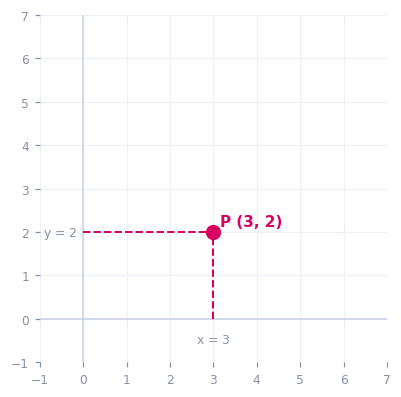
A point is written as an ordered pair (x, y). The first number tells you how far to move along the x axis, the second tells you how far to move up the y axis. The order matters, so (3, 2) is not the same place as (2, 3). To plot P (3, 2), start at the origin, move 3 to the right, then 2 up.
Try this: Plot the points (4, 1), (0, 5) and (2, 0) on paper. Notice that any point on the x axis has y equal to 0, and any point on the y axis has x equal to 0.
3. The distance between two points
What it is: a way to measure the straight line length between two points when you know their coordinates. Why we need it: without it you would have to draw and measure with a ruler every time. Here is how the formula is built, step by step, from the Pythagoras theorem.
Where the distance formula comes from
1
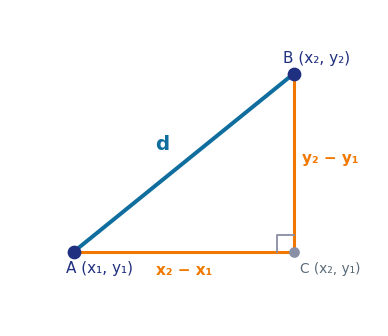
Mark a corner point. Take the two points A (x₁, y₁) and B (x₂, y₂). From A draw a horizontal line and from B draw a vertical line. They meet at a third point C (x₂, y₁).
2
The corner is a right angle. The x axis and the y axis are perpendicular, so the horizontal line AC and the vertical line CB meet at a right angle. Triangle ABC is therefore right angled at C.
3
Length of the two shorter sides. AC lies flat, so its length is the difference in the x values, AC = x₂ − x₁. CB stands up, so its length is the difference in the y values, CB = y₂ − y₁.
4
Apply the Pythagoras theorem. In a right triangle the square on the longest side equals the sum of the squares on the other two sides. Here AB is the longest side, so AB² = AC² + CB².
5
Substitute the side lengths. AB² = (x₂ − x₁)² + (y₂ − y₁)².
6
Take the positive square root. A length can never be negative, so we keep only the positive root. AB = √[(x₂ − x₁)² + (y₂ − y₁)²]. This is the distance formula.
Distance formula
d = √[(x₂ − x₁)² + (y₂ − y₁)²]
Here (x₁, y₁) and (x₂, y₂) are the two points. It is the Pythagoras theorem written in coordinates. You subtract the x values and square the result, do the same for the y values, add the two squares, then take the positive square root.
In real life: Your phone uses this every time a maps app shows how far apart two places are. Delivery and taxi apps use it to find the nearest driver, and video games use it to check how close a player is to a target.
Worked example 1
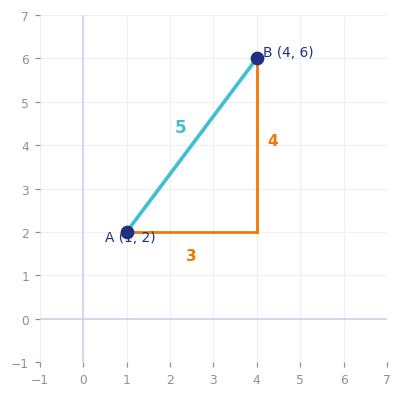
Question. Find the distance between A (1, 2) and B (4, 6).
1
Find the two shorter sides. Horizontal side = x₂ − x₁ = 4 − 1 = 3. Vertical side = y₂ − y₁ = 6 − 2 = 4.
2
Apply the Pythagoras theorem. The distance is the longest side, so d² = 3² + 4².
3
Square each number. d² = 9 + 16 = 25.
4
Take the positive square root. Distance is never negative, so d = √25 = 5.
Answer: d = 5 units.
4. The midpoint of a line segment
What it is: the point that sits exactly halfway between two points. Why we need it: to find a centre or a fair middle position quickly. Here is why the formula is simply an average.
Where the midpoint formula comes from
The midpoint splits the segment into two equal halves, that is, it divides it in the ratio 1 to 1. The value that sits exactly halfway between two numbers is their average, and the average of two numbers is their sum divided by two. So the middle x is the average of the two x values, and the middle y is the average of the two y values.
Midpoint formula
M = ( (x₁ + x₂) / 2 , (y₁ + y₂) / 2 )
You add the two x values and halve them to get the middle x, then add the two y values and halve them to get the middle y. The midpoint always lies on the straight line joining the two points, exactly halfway along.
In real life: It finds the fair meeting point exactly halfway between two homes, places the centre of a button or an image on a screen, and marks the middle of a bridge or a playing field.
Worked example 2
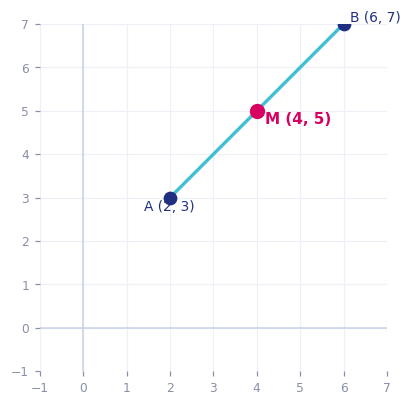
Question. Find the midpoint of A (2, 3) and B (6, 7).
1
Average the x values. By the midpoint rule the middle x is the mean of the two x values, (x₁ + x₂)/2 = (2 + 6)/2 = 8/2 = 4.
2
Average the y values. In the same way the middle y is (3 + 7)/2 = 10/2 = 5.
3
Write the midpoint. Pair the two averages together to get M = (4, 5).
Answer: M = (4, 5).
Worked example 3
Question. A drone flies in a straight line from the origin O (0, 0) to the point (5, 12). How far has it travelled?
1
Find the two shorter sides. From the origin, horizontal side = 5 − 0 = 5, vertical side = 12 − 0 = 12.
2
Apply the Pythagoras theorem. d² = 5² + 12².
3
Square each number. d² = 25 + 144 = 169.
4
Take the positive square root. d = √169 = 13.
Answer: d = 13 units.
5. Coordinates in real life
Coordinates are everywhere. A map uses grid references to name a village. A phone uses latitude and longitude to show your location. A designer uses coordinates to place every shape on a screen. The same two number idea that plots P (3, 2) also guides an aeroplane and draws this very web page.
Practise with the interactive
Move the points, read off their coordinates, and watch the distance and the midpoint update as you drag. The interactive opens right here in the lesson.
Interactive practicedrag
What this is
A point on a grid is pinned down by two numbers, how far across and how far up. The first number is the x coordinate and the second is the y coordinate, written as a pair (x, y). The two axes split the plane into four regions called quadrants. Move the sliders and watch the point land, and see which quadrant it sits in.
a point is written (x, y): x is across, y is up
The x axis runs left to right, the y axis runs up and down, and they cross at the origin (0, 0). Signs tell you the quadrant: both plus is the first quadrant, and it goes anticlockwise from there.
Notice: set x or y to zero and the point sits on an axis, not in any quadrant, and (0, 0) is the origin where the axes meet.
What this is
To find how far apart two points are, drop a step across and a step up between them. Those two steps meet at a right angle, so the straight line joining the points is the longest side of a right triangle, and the Baudhayana relation (the same idea as Pythagoras) gives its length. The midpoint is simply the average of the two points. Move the points and watch both.
distance = √( (x₂ − x₁)2 + (y₂ − y₁)2 )
(x₁, y₁) and (x₂, y₂) are the two points. Square the step across and the step up, add them, and take the square root. The midpoint is ( (x₁+x₂)/2 , (y₁+y₂)/2 ).
Notice: the two dashed steps are the short sides of the right triangle, and the distance you want is always the sloping side across from the right angle.
Practice set A, multiple choice
1. The point where the two axes meet is called the …
The origin, written O (0, 0). It is the starting point for every plot, where x = 0 and y = 0 together.
2. The point (−3, 4) lies in which quadrant?
Quadrant two. There x is negative and y is positive, which is the top left region of the plane.
3. The distance between (0, 0) and (3, 4) is …
1
Two shorter sides. 3 and 4.
2
Pythagoras theorem. d² = 3² + 4² = 25.
3
Positive root. d = √25 = 5 units.
4. The midpoint of (0, 0) and (4, 8) is …
1
Average the x. (0 + 4)/2 = 2.
2
Average the y. (0 + 8)/2 = 4.
3
Midpoint. (2, 4).
Practice set B, short answer
1. Find the distance between P (1, 1) and Q (4, 5).
1
Find the two shorter sides. Horizontal = 4 − 1 = 3, vertical = 5 − 1 = 4.
Average the x values. (−2 + 4)/2 = 2/2 = 1, by the midpoint rule.
2
Average the y values. (3 + 7)/2 = 10/2 = 5.
3
Write the midpoint. M = (1, 5).
3. Show that O (0, 0), A (3, 0) and B (0, 4) form a right triangle.
1
Length of the two legs. OA lies along the x axis, OA = 3. OB lies along the y axis, OB = 4. The x axis and y axis meet at a right angle, so the angle at O is 90 degrees.
2
Length of the sloping side. By the Pythagoras theorem AB² = 3² + 4² = 25, so AB = 5.
3
Conclude. The sides are 3, 4 and 5 with a right angle at O, so O, A and B form a right triangle.
Quick summary
Idea
What to remember, and why
Ordered pair
(x, y), first across then up. Order matters.
Origin
O (0, 0), where the axes meet.
Distance
d = √[(x₂ − x₁)² + (y₂ − y₁)²], from the Pythagoras theorem.
Midpoint
M = ( (x₁ + x₂)/2 , (y₁ + y₂)/2 ), the average of each coordinate.
These free Grade 9 Maths notes explain the coordinate plane, plotting points, the distance formula and the midpoint formula with clear worked examples and step by step practice for students following the Ganita Manjari book at schoolrevise.com.

 Preview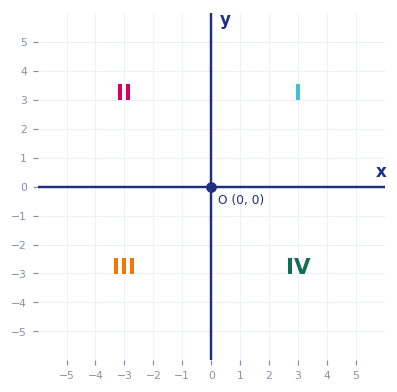
 Google