Curriculum
Mathematics Grade IX
Mathematics Grade 9
0/8
-
Chapter 1: Orienting Yourself: The Use of Coordinates
 Preview
 -
Chapter 2: Introduction to Linear Polynomials
Preview
-
Chapter 3: The World of Numbers
Preview
-
Chapter 4: Exploring Algebraic Identities
Preview
-
Chapter 5: I’m Up and Down, and Round and Round
Preview
-
Chapter 6: Measuring Space: Perimeter and Area
Preview
-
Chapter 7: The Mathematics of Maybe: Introduction to Probability
Preview
-
Chapter 8: Predicting What Comes Next: Exploring Sequences and Progressions
Preview
Advanced Maths
0/6
Chapter 5: I’m Up and Down, and Round and Round
School Revise · Grade 9 Maths · Chapter 5
I’m Up and Down, and Round and Round
Ganita Manjari, Class 9. A circle is the set of all points the same distance from a fixed centre. From that one idea flow the ideas of chords, arcs and angles, and two beautiful results that we prove step by step.
|
|
||
|
|
What this chapter is about
Look at a full moon, a ripple in water, or a bicycle wheel. Each is a circle, a shape where every edge point is exactly the same distance from a middle point. That distance is the radius and the middle point is the centre. In this chapter we name the parts of a circle, then prove two important facts, one about chords and one about angles.
|
What a circle is a circle is the set of all points at a fixed distance, the radius, from a fixed point, the centre Every point on the circle is the same distance from the centre. A straight line joining two points on the circle is a chord, and a chord through the centre is a diameter, the longest chord. In real life: A potter shaping a wheel, a compass drawing an arc, and a satellite circling the Earth all rely on this one fixed distance from a centre. |
1. The parts of a circle
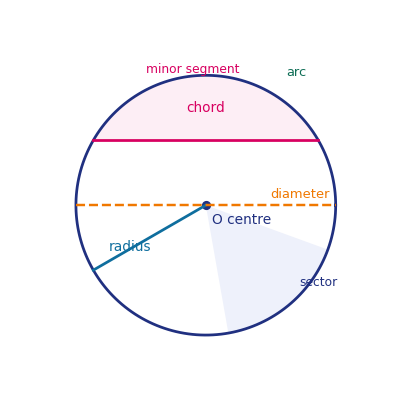
The centre O is the fixed middle point. The radius joins the centre to any point on the circle. The diameter is a chord through the centre, and it is twice the radius. A chord joins any two points on the circle. An arc is a part of the curved edge. A sector is the pie slice between two radii, and a segment is the region cut off by a chord.
Try this: On a drawing of a circle, mark one radius, one diameter and one chord that is not a diameter. Check that the diameter is the longest of the three.
2. The perpendicular from the centre bisects a chord

What it says: if you drop a perpendicular from the centre onto a chord, it cuts the chord into two equal halves. Why it is useful: it lets you find the middle of a chord and locate the centre of a circle.
Proof
| 1 | Set up the picture. Let AB be a chord of a circle with centre O, and let OM be the perpendicular dropped from O to AB, meeting it at M. Join OA and OB. |
| 2 | Compare two triangles. In triangles OMA and OMB: OA = OB because both are radii of the same circle. |
| 3 | A shared side. OM is common to both triangles. |
| 4 | Two right angles. Angle OMA and angle OMB are both 90°, since OM is perpendicular to AB. |
| 5 | Apply RHS congruence. A right angle, the hypotenuse OA = OB, and a side OM equal, so by the RHS rule the two triangles are congruent. |
| 6 | Read off the result. Congruent triangles have equal matching sides, so AM = MB. The perpendicular from the centre bisects the chord. |
|
Worked example 1 Question. A chord of length 16 cm is drawn in a circle. The perpendicular from the centre meets it at M. How long is each half?
Answer: AM = MB = 8 cm. |
3. The angle an arc makes
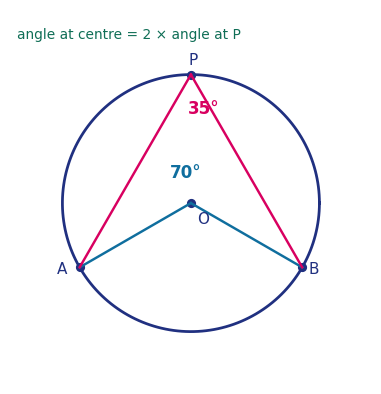
What it says: the angle an arc makes at the centre is exactly twice the angle the same arc makes at any point on the rest of the circle. This is one of the most used facts in circle geometry.
Proof
| 1 | Set up the picture. Let arc AB subtend angle AOB at the centre O, and angle APB at a point P on the rest of the circle. Join P to O and continue the line to a point Q. |
| 2 | Spot two isosceles triangles. OA = OP and OB = OP, since all are radii. So triangle OAP and triangle OBP are each isosceles. |
| 3 | Base angles are equal. In an isosceles triangle the base angles are equal, so angle OAP = angle OPA, and angle OBP = angle OPB. |
| 4 | Use the exterior angle rule. The exterior angle of a triangle equals the sum of the two opposite interior angles. So angle AOQ = angle OAP + angle OPA = 2 × angle OPA. In the same way angle BOQ = 2 × angle OPB. |
| 5 | Add the two parts. Adding, angle AOB = angle AOQ + angle BOQ = 2 × (angle OPA + angle OPB) = 2 × angle APB. |
| 6 | Conclude. So the angle an arc makes at the centre is twice the angle it makes at any point on the remaining circle. |
|
Angle at the centre angle at the centre = 2 × angle at the circumference (same arc) For the same arc, the angle formed at the centre is double the angle formed at any point on the remaining part of the circle. A useful special case: an angle in a semicircle, standing on a diameter, is always 90°. In real life: Designers of stadiums and theatres use it so that every seat around a curve gets a fair view of the same stage arc. |
|
Worked example 2 Question. An arc AB makes an angle of 35° at a point P on the circle. What angle does it make at the centre O?
Answer: angle AOB = 70°. |
|
Worked example 3 Question. Points A and B lie on a circle, and PQ is a diameter through A and B is on the circle. Angle in a semicircle: what is angle APB if AB is a diameter?
Answer: angle APB = 90°, the angle in a semicircle is a right angle. |
Practise with the interactive
Drag the point P around the circle and watch the angle at P stay exactly half the angle at the centre. The interactive opens right here in the lesson.
Practice set A, multiple choice
1. The longest chord of a circle is the …
Diameter. It passes through the centre and equals twice the radius, longer than any other chord.
2. The perpendicular from the centre to a chord …
Bisects the chord, cutting it into two equal parts, as proved by RHS congruence of the two triangles it makes.
3. An arc makes 100° at the centre. The angle at a point on the circle is …
| 1 | Use the theorem. Angle at the circumference is half the angle at the centre. |
| 2 | Halve it. 100° ÷ 2 = 50°. |
4. The angle in a semicircle is …
90°. A diameter makes 180° at the centre, so the angle at the circumference is half, a right angle.
Practice set B, short answer
1. A chord is 24 cm long. How far is each end from the foot of the perpendicular from the centre?
| 1 | Use the theorem. The perpendicular from the centre bisects the chord. |
| 2 | Halve. 24 ÷ 2 = 12 cm from the foot to each end. |
2. An arc subtends 46° at a point on the circle. Find the angle it subtends at the centre.
| 1 | Use the theorem. Angle at the centre is twice the angle at the circumference. |
| 2 | Double. 2 × 46° = 92°. |
3. Two angles stand on the same arc, at two different points on the circle. What can you say about them?
| 1 | Compare each with the centre. Each equals half the angle the arc makes at the centre. |
| 2 | Conclude. Since both are half of the same central angle, the two angles are equal. Angles in the same segment are equal. |
Quick summary
| Idea | The idea |
| Circle | All points a fixed radius from the centre. |
| Diameter | A chord through the centre, twice the radius, the longest chord. |
| Perpendicular from centre | Bisects the chord it meets. |
| Angle of an arc | At the centre it is twice the angle at the circumference. |
| Semicircle | The angle in a semicircle is 90°. |
| Open the Virtual Lab |
These free Grade 9 Maths notes explain the circle, its chords and arcs, the perpendicular from the centre to a chord and the angle subtended by an arc, with proofs for students using the Ganita Manjari book.
© 2026 School Revise. All rights reserved. This lesson is original content written by School Revise, aligned to the CBSE and NCERT Class 9 Maths syllabus. Unauthorised copying, reproduction or redistribution is not permitted. Curriculum names are used only to indicate alignment.
 Google