Curriculum
Mathematics Grade IX
Mathematics Grade 9
0/8
-
Chapter 1: Orienting Yourself: The Use of Coordinates
 Preview
 -
Chapter 2: Introduction to Linear Polynomials
Preview
-
Chapter 3: The World of Numbers
Preview
-
Chapter 4: Exploring Algebraic Identities
Preview
-
Chapter 5: I’m Up and Down, and Round and Round
Preview
-
Chapter 6: Measuring Space: Perimeter and Area
Preview
-
Chapter 7: The Mathematics of Maybe: Introduction to Probability
Preview
-
Chapter 8: Predicting What Comes Next: Exploring Sequences and Progressions
Preview
Advanced Maths
0/6
Chapter 8: Predicting What Comes Next: Exploring Sequences and Progressions
School Revise · Grade 9 Maths · Chapter 8
Predicting What Comes Next?: Exploring Sequences and Progressions
Ganita Manjari, Class 9. A sequence is an ordered list that follows a rule. Here we learn to describe sequences, meet arithmetic progressions that add a fixed step and geometric progressions that multiply by a fixed ratio, and derive their term formulas.
|
|
||
|
|
What this chapter is about
Numbers often come in patterns. The seats in each row of a cinema grow by a fixed number, a bank balance can double each period, and the days of the month simply count up. A sequence is an ordered list of numbers that follows a rule. In this chapter we find rules that predict any term without listing all the ones before it.
|
Sequence and term a sequence is an ordered list of numbers; each number in it is a term The first term is written a₁, the second a₂, and the nth term aₙ. A rule that gives the nth term directly is called an explicit rule. In real life: Seat numbers, salary steps that rise by a fixed raise each year, and interest that grows each period are all sequences. |
1. Arithmetic progressions
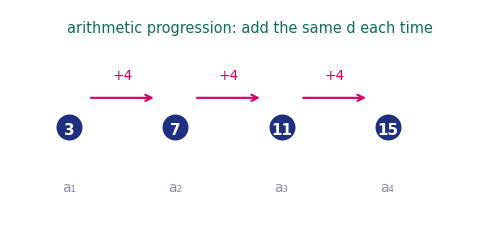
An arithmetic progression, or AP, is a sequence where each term is the one before plus a fixed number called the common difference d. In 3, 7, 11, 15 the common difference is 4.
Where the nth term rule comes from
| 1 | Start at the first term. Call the first term a and the common difference d. So the first term is a. |
| 2 | Build each term. The second term is a + d, the third is a + 2d, the fourth is a + 3d, and so on. |
| 3 | Spot the pattern. Each term adds one more d than its position number minus one. The nth term has added d exactly (n − 1) times. |
| 4 | Write the rule. So the nth term is a + (n − 1)d. |
|
nth term of an AP aₙ = a + (n − 1)d Here a is the first term, d is the common difference, and n is the term number you want. You add d one fewer time than the term number, which is why it is (n − 1). In real life: If a taxi charges a fixed start plus a fixed amount per kilometre, the cost after n kilometres is an AP, and this finds it in one step. |
|
Worked example 1 Question. Find the 10th term of the AP 3, 7, 11, 15, …
Answer: The 10th term is 39. |
2. The sum of the first n natural numbers
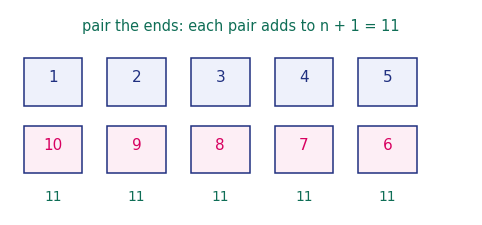
A young Carl Gauss is said to have added 1 to 100 in seconds by pairing the ends. Here is the idea, which gives a formula for the sum of the first n counting numbers.
The pairing method
| 1 | Write the sum forwards and backwards. S = 1 + 2 + … + n, and also S = n + (n − 1) + … + 1. |
| 2 | Add the two lines. Adding term by term, every pair adds to n + 1, and there are n such pairs, so 2S = n(n + 1). |
| 3 | Halve to get S. S = n(n + 1) / 2. |
|
Sum of first n natural numbers S = n(n + 1) / 2 Add the first n counting numbers by pairing the smallest with the largest. Each of the n pairs adds to n + 1, and halving the doubled sum gives the result. In real life: It quickly totals things that stack up one more each step, like rows of a triangular pile of oranges or handshakes in a group. |
|
Worked example 2 Question. Find the sum 1 + 2 + 3 + … + 100.
Answer: The sum is 5050. |
3. Geometric progressions
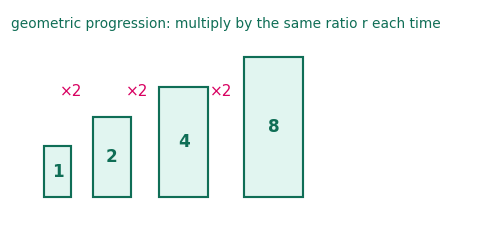
A geometric progression, or GP, is a sequence where each term is the one before multiplied by a fixed number called the common ratio r. In 2, 6, 18, 54 the common ratio is 3.
Where the nth term rule comes from
| 1 | Start at the first term. Call the first term a and the common ratio r. So the first term is a. |
| 2 | Build each term. The second term is ar, the third is ar², the fourth is ar³, each one r times the last. |
| 3 | Spot the pattern. The nth term has multiplied by r exactly (n − 1) times. |
| 4 | Write the rule. So the nth term is a × r^(n − 1). |
|
nth term of a GP aₙ = a × r^(n − 1) Here a is the first term, r is the common ratio, and n is the term number. You multiply by r one fewer time than the term number. In real life: Money growing at a fixed percentage each year, or a rumour that doubles its listeners each hour, follows a GP. |
|
Worked example 3 Question. Find the 5th term of the GP 2, 6, 18, …
Answer: The 5th term is 162. |
Practise with the interactive
Change the first term, the common difference or the ratio and watch the sequence grow, then jump to any term with the rule. The interactive opens right here in the lesson.
Practice set A, multiple choice
1. In an arithmetic progression, each term differs from the last by …
A fixed amount called the common difference d. You add the same d to get from one term to the next.
2. The nth term of an AP is …
a + (n − 1)d, where a is the first term and d the common difference.
3. The 6th term of the AP 5, 8, 11, … is …
| 1 | Read a and d. a = 5, d = 3. |
| 2 | Apply the rule. a₆ = 5 + (6 − 1) × 3 = 5 + 15 = 20. |
4. In the GP 3, 12, 48, … the common ratio is …
| 1 | Divide a term by the one before. 12 ÷ 3 = 4, and 48 ÷ 12 = 4. |
| 2 | Read off r. The common ratio is 4. |
Practice set B, short answer
1. Find the 12th term of the AP 7, 10, 13, …
| 1 | Read a and d. a = 7, d = 3. |
| 2 | Apply the rule. aₙ = 7 + (12 − 1) × 3 = 7 + 33 = 40. |
2. Find the sum 1 + 2 + … + 50.
| 1 | Use the formula. S = n(n + 1)/2 with n = 50. |
| 2 | Substitute and simplify. = 50 × 51 / 2 = 2550 / 2 = 1275. |
3. Find the 4th term of the GP 5, 10, 20, …
| 1 | Read a and r. a = 5, r = 10 ÷ 5 = 2. |
| 2 | Apply the rule. a₄ = 5 × 2^(4 − 1) = 5 × 2^3 = 5 × 8 = 40. |
Quick summary
| Idea | The rule |
| Sequence | An ordered list following a rule; each number is a term. |
| Arithmetic progression | Add a fixed d each time. |
| nth term of an AP | aₙ = a + (n − 1)d. |
| Sum 1 to n | n(n + 1) / 2. |
| Geometric progression | Multiply by a fixed r each time. |
| nth term of a GP | aₙ = a × r^(n − 1). |
| Open the Virtual Lab |
These free Grade 9 Maths notes explain sequences, arithmetic and geometric progressions, the nth term rules and the sum of the first n natural numbers, with clear worked examples for students using the new Ganita Manjari book.
© 2026 School Revise. All rights reserved. This lesson is original content written by School Revise, aligned to the CBSE and NCERT Class 9 Maths syllabus. Unauthorised copying, reproduction or redistribution is not permitted. Curriculum names are used only to indicate alignment.
 Google