Curriculum
Mathematics Grade IX
Mathematics Grade 9
0/8

Ch-4 Coordinate Geometry
School Revise · Grade 9 · Advanced Maths (Optional) · Chapter 4
Coordinate Geometry
Mathematics at Advanced Level, Class 9. This optional chapter deepens coordinate geometry: the four quadrants, reflecting points across the axes, and the slope of a line, which measures how steeply it rises.
|
|
||
|
|
What this chapter is about
Coordinates turn geometry into algebra. In this chapter we read off which quadrant a point lies in, reflect points across the axes and the origin, and measure the slope of a line, then use slope to tell whether two lines are parallel or at right angles.
1. The plane, quadrants and reflections
|
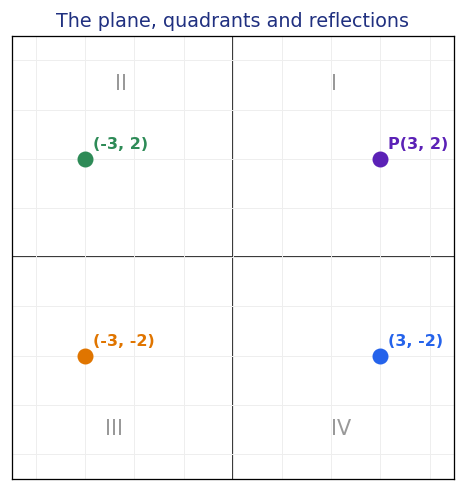
Quadrants and reflections the axes split the plane into four quadrants; reflecting a point flips the sign of one or both coordinates Reflecting P(x, y) in the x axis gives (x, −y), in the y axis gives (−x, y), and in the origin gives (−x, −y). Quadrant I has both coordinates positive, and the signs change as you move round. In real life: A designer mirroring one half of a logo across an axis is using exactly these reflections to make the other half. |
|
Worked example 1 Question. Reflect the point P(3, 2) in the x axis.
Answer: The reflection is (3, −2). |
2. The slope of a line
|
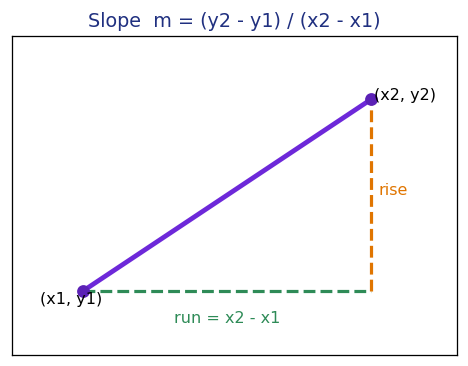
Slope the slope m of a line through (x₁, y₁) and (x₂, y₂) is m = (y₂ − y₁) / (x₂ − x₁) Slope is rise over run, how far the line climbs for each step across. A positive slope rises, a negative slope falls. Parallel lines have equal slopes, and two lines are perpendicular when the product of their slopes is −1. In real life: The gradient sign on a hill road, like 1 in 10, is exactly this slope, the rise divided by the horizontal run. |
|
Worked example 2 Question. Find the slope of the line through (1, 1) and (5, 4).
Answer: The slope is 3/4. |
|
Worked example 3 Question. A line has slope 3/4. What is the slope of any line perpendicular to it?
Answer: The perpendicular slope is −4/3. |
Practise with the interactive
Try this chapter hands on: change the values and watch the answer update live and animate. The interactive opens right here in the lesson.
Practice set A, multiple choice
1. Reflecting (4, 5) in the y axis gives …
(−4, 5). Reflecting in the y axis flips the sign of the x coordinate only.
2. A point with both coordinates negative lies in quadrant …
III, the third quadrant, where x is negative and y is negative.
3. The slope of the line through (2, 3) and (6, 11) is …
| 1 | Use (y₂ − y₁)/(x₂ − x₁). (11 − 3)/(6 − 2) = 8/4. |
| 2 | So. = 2. |
4. Two lines are perpendicular when the product of their slopes is …
−1. Parallel lines instead have equal slopes.
Practice set B, short answer
1. Reflect (−2, 7) in the origin.
| 1 | Reflecting in the origin flips both signs. (x, y) becomes (−x, −y). |
| 2 | Apply it. (−2, 7) becomes (2, −7). |
2. Find the slope of the line through (0, 0) and (3, 6).
| 1 | Use (y₂ − y₁)/(x₂ − x₁). (6 − 0)/(3 − 0). |
| 2 | So. = 2. |
3. A line has slope 2. What is the slope of a line parallel to it, and of one perpendicular to it?
| 1 | Parallel means equal slope. slope = 2. |
| 2 | Perpendicular means product −1. slope = −1/2. |
Quick summary
| Idea | The idea |
| Quadrants | Four regions set by the axes. |
| Reflect in x axis | (x, y) → (x, −y). |
| Reflect in y axis | (x, y) → (−x, y). |
| Slope | (y₂ − y₁)/(x₂ − x₁). |
| Parallel | Equal slopes. |
| Perpendicular | Slopes multiply to −1. |
| Open the Virtual Lab |
These free Grade 9 Advanced Maths notes explain the Cartesian plane, reflections, slope, and equations of straight lines, with clear step by step worked examples and labelled diagrams for every student using the optional Advanced Level book.
© 2026 School Revise. All rights reserved. This lesson is original content written by School Revise, aligned to the CBSE Class 9 Mathematics at Advanced Level (Optional) syllabus. Unauthorised copying, reproduction or redistribution is not permitted. Curriculum names are used only to indicate alignment.
 Google