Ganita Manjari, Class 9. Numbers grew step by step through history, from counting cattle with pebbles to the invention of zero in India. Here we meet the whole family of numbers, place them on the number line, and prove that some numbers can never be written as a fraction.
6
Number families
2
Rules explained
3
Worked examples
2
Practice sets
What this chapter is about
Long ago a herder matched one pebble to one cow to keep count. That simple idea gave us the natural numbers. Over centuries people needed more, a symbol for nothing, a way to show a loss, a way to share one thing among many. Each need added a new kind of number. In this chapter we build the full family and see how they fill the number line.
1. The families of numbers
Each family sits inside the next larger one, like boxes inside boxes.
Natural numbers N are the counting numbers 1, 2, 3 and so on. Whole numbers W add zero to them, giving 0, 1, 2, 3. Integers Z add the negatives, so −3, −2, −1, 0, 1, 2, 3. Rational numbers Q are all numbers that can be written as a fraction p/q with whole numbers p and q and q not 0, which includes every integer and every ending or repeating decimal. Irrational numbers cannot be written as such a fraction. Together the rationals and irrationals make the real numbers R, which fill the number line with no gaps.
What makes a number rational
a rational number can be written as p/q, where p and q are integers and q is not 0
The letter Q stands for quotient, which means the result of a division. If a number can be written as one integer divided by another, it is rational. If it cannot, it is irrational.
In real life: Money uses rationals all the time, since 75 paise is 3/4 of a rupee and a half kilo is 1/2. Sharing a bill equally among friends is division that lands on a rational number.
Try this: Sort these into the smallest family each belongs to: 5, 0, −2, 3/4, and √2.
2. Rational numbers on the number line
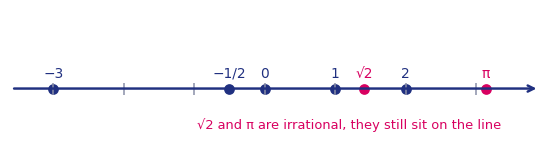
Every rational number has a home on the number line. To place 3/4, split the gap between 0 and 1 into four equal parts and count three. A surprising fact is that between any two rational numbers there is always another rational number, in fact infinitely many. Mathematicians call this the density of the rationals.
Worked example 1
Question. Find a rational number between 1/2 and 3/4.
1
Take the average. A quick way to find a number between two numbers is their average, the sum divided by two.
2
Add the two fractions. 1/2 + 3/4. Make the denominators the same: 1/2 = 2/4, so 2/4 + 3/4 = 5/4.
3
Halve the result. 5/4 ÷ 2 = 5/8.
4
Check it lies between. 1/2 = 4/8 and 3/4 = 6/8, and 4/8 < 5/8 < 6/8. So 5/8 sits between them.
Answer: 5/8, which is 0.625, lies between 1/2 and 3/4.
3. Irrational numbers
What they are: numbers that cannot be written as a fraction p/q. Their decimals go on forever with no repeating block. Famous examples are √2, √3 and π. Why they matter: without them the number line would have tiny gaps, and lengths like the diagonal of a square could not be named.
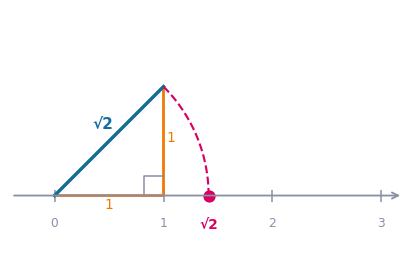
The picture shows how √2 appears in real geometry. Draw a square of side 1. By the Pythagoras theorem its diagonal has length √(1² + 1²) = √2. Swinging that diagonal down onto the number line marks the exact point √2, a real length that is not a fraction.
Why root two is irrational, a full proof
This is one of the oldest and most beautiful proofs in mathematics. We show it can never be a fraction.
1
Suppose the opposite. This is a proof by contradiction. Assume √2 is rational. Then we can write √2 = p/q as a fraction in its lowest terms, so p and q are whole numbers, q is not 0, and p and q share no common factor.
2
Square both sides. Squaring gives 2 = p²/q², so p² = 2q².
3
So p is even. p² is 2 times a whole number, so p² is even. By the rule that a whole number whose square is even must itself be even, p is even. Write p = 2m.
4
Substitute back. Then (2m)² = 2q², so 4m² = 2q², which gives q² = 2m². So q² is even, and by the same rule q is even.
5
Reach the contradiction. Now p and q are both even, so they share the factor 2. But we said p/q had no common factor. This is a contradiction.
6
Conclude. The only faulty step was our assumption, so √2 cannot be written as a fraction. Therefore √2 is irrational.
4. Decimal expansions, terminating or repeating
Every rational number, when you divide it out, gives a decimal that either stops (terminates) or falls into a repeating block. Which one happens depends only on the denominator once the fraction is in lowest terms.
The terminating rule
a fraction in lowest terms terminates only if its denominator’s prime factors are just 2 and 5
Why this is true: a terminating decimal is a whole number over a power of 10, and 10 = 2 × 5, so powers of 10 contain only the primes 2 and 5. A fraction can be turned into such a form exactly when its denominator already has only 2s and 5s. Any other prime, like 3 or 7, forces the decimal to repeat forever.
Worked example 2
Question. Show that 3/8 gives a terminating decimal and find it.
1
Write the fraction in lowest terms. Take 3/8. The 3 and 8 share no common factor, so it is already lowest terms.
2
Look at the denominator’s prime factors. 8 = 2 × 2 × 2, so the only prime factor is 2.
3
Apply the terminating rule. A fraction in lowest terms terminates exactly when its denominator has no prime factors other than 2 and 5. Here it is only 2s, so the decimal terminates.
4
Do the division. 3 ÷ 8 = 0.375.
Answer: 3/8 = 0.375, a terminating decimal.
Worked example 3
Question. Show that 7/12 gives a repeating decimal and find it.
1
Lowest terms. 7/12, no common factor.
2
Prime factors of the denominator. 12 = 2 × 2 × 3. It has a 3, which is not 2 or 5.
3
Apply the rule. Because the denominator has a prime factor other than 2 and 5, the decimal does not terminate, it repeats.
4
Do the division. 7 ÷ 12 = 0.58333…, written 0.58̅3, with the 3 repeating.
Answer: 7/12 = 0.58̅3, a repeating decimal.
5. Real numbers
Put the rationals and the irrationals together and you get the real numbers. They fill the number line completely, with no gaps at all. Every point on the line is exactly one real number, and every real number is exactly one point. This is the number world you will use for the rest of school mathematics.
Practice with the interactive
Slide a point along the number line, switch a number between fraction and decimal form, and see which family it belongs to. The interactive opens right here in the lesson.
Interactive practicedrag
What this is
Numbers fit inside families that sit one within another. The counting numbers live inside the whole numbers, which live inside the integers, which live inside the rational numbers. Alongside the rationals are the irrationals, and together they fill the real numbers. Tap a number and watch which families light up.
natural ⊂ whole ⊂ integers ⊂ rational, and rational with irrational fills the reals
A rational number can be written as a fraction of two integers. An irrational number cannot. Every real number, rational or irrational, sits somewhere on the number line.
Notice: every counting number is also whole, an integer, rational and real, but a number like √2 is real yet not rational.
What this is
Turn a fraction into a decimal and something neat happens. It either stops after a few digits, or a block of digits repeats forever. Either way it is rational. Irrational numbers are different again, they run on forever with no repeating block. Tap a fraction to see its decimal.
rational: terminating or recurring; irrational: non-terminating and non-recurring
A bar over digits means that block repeats without end. A fraction terminates only when its lowest-terms denominator is made only of 2s and 5s.
for contrast, √2 = 1.4142135... never stops and never repeats, so it is irrational
Notice: 1/4 and 3/8 stop, while 1/3, 2/3 and 1/7 repeat a block forever, yet all five are rational because they come from fractions.
Practice set A, multiple choice
1. Which of these is an irrational number? (a) 0.75 (b) 2/7 (c) √3
1
Test each. 0.75 is a terminating decimal, so it is rational. 2/7 is already a fraction, so it is rational.
2
Identify. √3 cannot be written as a fraction and its decimal never repeats, so √3 is irrational.
2. The smallest family that contains −5 is …
The integers Z. It is negative, so it is not a natural or whole number, but it is a whole negative number, which is an integer.
3. 1/4 as a decimal is …
1
Prime factors of the denominator. 4 = 2 × 2, only 2s, so it terminates.
2
Divide. 1 ÷ 4 = 0.25.
4. Between 0.2 and 0.3 there are …
Infinitely many rational numbers, for example 0.25. Between any two rationals there is always another, this is density.
Practice set B, short answer
1. Find a rational number between 1/3 and 1/2.
1
Average them. (1/3 + 1/2) ÷ 2.
2
Common denominator. 1/3 = 2/6 and 1/2 = 3/6, so the sum is 5/6.
These free Grade 9 Maths notes explain natural numbers, integers, rational and irrational numbers, the number line, decimal expansions and the proof that root two is irrational, for students following the new Ganita Manjari book at schoolrevise.com.

 Preview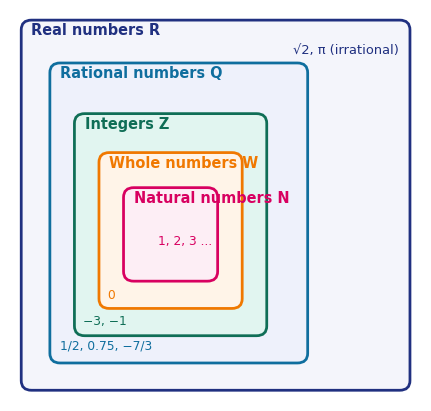
 Google