Curriculum
Mathematics Grade IX
Mathematics Grade 9
0/8

Ch-3 Relations And Functions
School Revise · Grade 9 · Advanced Maths (Optional) · Chapter 3
Relations and Functions
Mathematics at Advanced Level, Class 9. This optional chapter builds from ordered pairs to the Cartesian product, then to relations and functions, the single most important idea in higher mathematics, with their graphs.
|
|
||
|
|
What this chapter is about
Mathematics is full of links between one quantity and another. In this chapter we pair things up as ordered pairs, form every pairing as the Cartesian product, pick out meaningful pairings as relations, and meet the special relations called functions.
1. Ordered pairs and the Cartesian product
|
Cartesian product the Cartesian product A × B is the set of all ordered pairs (a, b) with a from A and b from B In an ordered pair order matters, so (1, 2) is not (2, 1). If A has m elements and B has n, then A × B has m × n pairs. In real life: A cafe menu offering 3 breads and 2 fillings has a Cartesian product of 3 × 2 = 6 possible sandwiches. |
|
Worked example 1 Question. If A = {1, 2} and B = {3, 4}, list A × B.
Answer: A × B = {(1, 3), (1, 4), (2, 3), (2, 4)}. |
2. Relations and functions
|
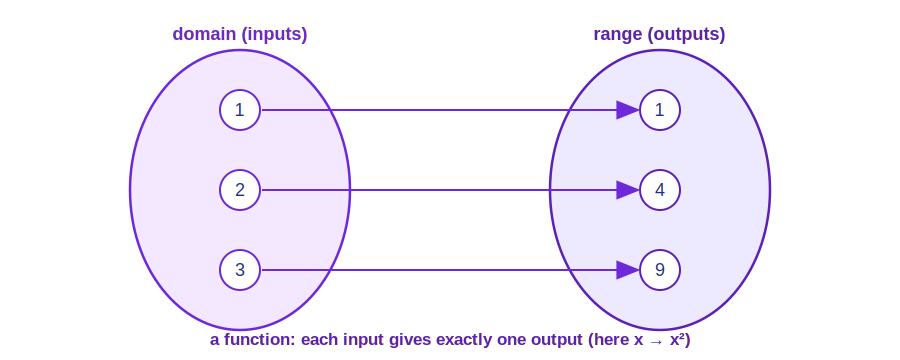
Relation and function a relation is any set of ordered pairs; a function is a relation in which each input gives exactly one output The set of inputs is the domain and the set of outputs the range. The test for a function is simple: no input may point to two different outputs. In real life: A vending machine is a function: each button, the input, always gives one product, the output; a button giving two random items would not be a function. |
|
Worked example 2 Question. Is {(1, 2), (1, 3), (2, 4)} a function?
Answer: No, it is not a function, because the input 1 has two outputs. |
3. Graphs of functions
|
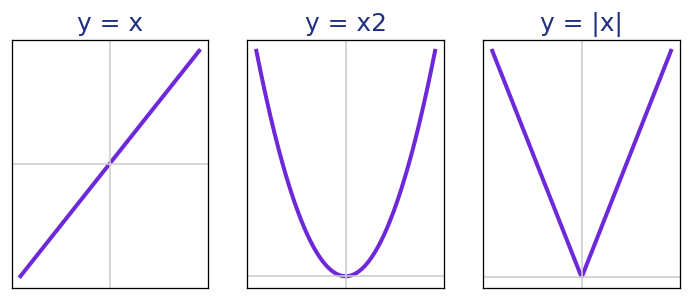
Reading a function’s graph the graph of y = f(x) plots each input on the x axis against its one output on the y axis The straight line y = x is the identity, the U shaped curve y = x² is the square function, and the V shaped y = |x| is the modulus. Each passes the vertical line test, meeting any vertical line just once. In real life: A distance time graph is a function’s graph: at each moment, the input, the object has exactly one position, the output. |
|
Worked example 3 Question. For the function y = x², find the output when x = 3, and when x = −3.
Answer: Both give y = 9, so the input decides one output, though two inputs can share it. |
Practise with the interactive
Try this chapter hands on: change the values and watch the answer update live and animate. The interactive opens right here in the lesson.
Practice set A, multiple choice
1. In an ordered pair, (1, 2) and (2, 1) are …
Different, because order matters in an ordered pair.
2. If A has 3 elements and B has 4, then A × B has …
| 1 | Multiply the counts. 3 × 4. |
| 2 | So. = 12 pairs. |
3. A relation is a function when every input has …
Exactly one output; no input may point to two different outputs.
4. The graph of y = |x| is shaped like a …
V, meeting at the origin, since the modulus makes every output non negative.
Practice set B, short answer
1. If A = {a, b} and B = {1, 2, 3}, how many pairs are in A × B?
| 1 | Multiply the counts. 2 × 3. |
| 2 | So. = 6 pairs. |
2. Is {(1, 5), (2, 5), (3, 5)} a function?
Yes. Each input, 1, 2 and 3, has exactly one output. Different inputs sharing the same output is allowed; one input with two outputs is not.
3. Give the domain and range of {(1, 2), (2, 4), (3, 6)}.
| 1 | Domain is the set of inputs. {1, 2, 3}. |
| 2 | Range is the set of outputs. {2, 4, 6}. |
Quick summary
| Idea | The idea |
| Ordered pair | (a, b); order matters. |
| Cartesian product | All pairs; m × n of them. |
| Relation | Any set of ordered pairs. |
| Function | Each input, one output. |
| Domain / range | Inputs / outputs. |
| Vertical line test | A function’s graph meets it once. |
| Open the Virtual Lab |
These free Grade 9 Advanced Maths notes explain ordered pairs, Cartesian products, relations, functions and their standard graphs, with clear step by step worked examples and labelled diagrams for every student using the optional Advanced Level book.
© 2026 School Revise. All rights reserved. This lesson is original content written by School Revise, aligned to the CBSE Class 9 Mathematics at Advanced Level (Optional) syllabus. Unauthorised copying, reproduction or redistribution is not permitted. Curriculum names are used only to indicate alignment.
 Google