Curriculum
Mathematics Grade IX
Mathematics Grade 9
0/8
-
Chapter 1: Orienting Yourself: The Use of Coordinates
 Preview
 -
Chapter 2: Introduction to Linear Polynomials
Preview
-
Chapter 3: The World of Numbers
Preview
-
Chapter 4: Exploring Algebraic Identities
Preview
-
Chapter 5: I’m Up and Down, and Round and Round
Preview
-
Chapter 6: Measuring Space: Perimeter and Area
Preview
-
Chapter 7: The Mathematics of Maybe: Introduction to Probability
Preview
-
Chapter 8: Predicting What Comes Next: Exploring Sequences and Progressions
Preview
Advanced Maths
0/6
Chapter 6: Measuring Space: Perimeter and Area
School Revise · Grade 9 Maths · Chapter 6
Measuring Space: Perimeter and Area
Ganita Manjari, Class 9. Perimeter is the distance around a shape, area is the space inside it. Here we build the area formulas for rectangles, parallelograms and triangles, meet Heron’s formula for any triangle, and measure the circle.
|
|
||
|
|
What this chapter is about
Perimeter answers how much fencing you need around a field, and area answers how much grass grows inside it. In this chapter we do not just list formulas, we build the area of a parallelogram and a triangle by cutting and rearranging shapes, then we meet Heron’s formula, which finds the area of any triangle from its three sides alone.
|
Perimeter and area perimeter is the total length of the boundary; area is the amount of surface inside Perimeter is measured in units of length such as centimetres. Area is measured in square units such as square centimetres, because it counts how many unit squares fit inside. In real life: A farmer buys fencing by the perimeter and seeds by the area. A painter needs the area of a wall and the length of trim around it. |
1. Perimeter of a circle
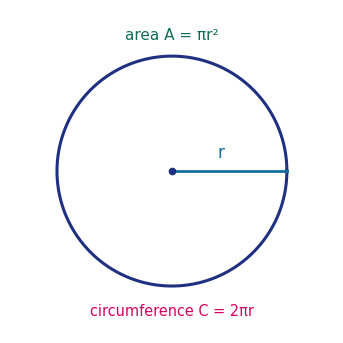
The distance around a circle is its circumference. For every circle, dividing the circumference by the diameter always gives the same number, called π (pi), which is about 3.14159 and is irrational. Since the diameter is twice the radius, the circumference works out as below.
|
Circumference of a circle C = 2πr C is the distance around, r is the radius, and π is the fixed ratio of circumference to diameter. Because the diameter d = 2r, the circumference is π × d = 2πr. In real life: It tells a cyclist how far one turn of a wheel carries them, and a tailor how much ribbon wraps a round cake. |
2. Area of a rectangle and a parallelogram
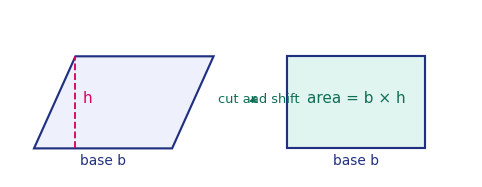
A rectangle of length l and breadth b holds l rows of b unit squares, so its area is l × b. A parallelogram can be turned into a rectangle with the same base and height, which gives its area.
Why the parallelogram area is base times height
| 1 | Slice off a triangle. Take a parallelogram and cut a right triangle from one end along its height. |
| 2 | Shift it across. Slide that triangle to the other end. It fits exactly, turning the parallelogram into a rectangle. |
| 3 | The rectangle has the same base and height. So the parallelogram and the rectangle have equal area, base × height. |
|
Area of a parallelogram Area = base × height The height is the straight up and down distance between the two parallel sides, not the slanting side. Multiplying base by height gives the space inside. In real life: Floor tiles and slanted garden plots are often parallelograms, and this tells you how much material covers them. |
3. Area of a triangle
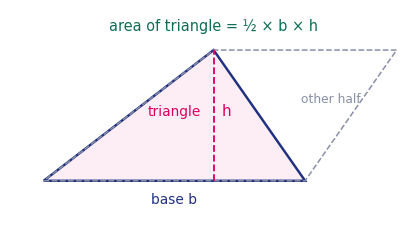
Why the triangle area is half base times height
| 1 | Make a matching copy. Take a triangle and place a second identical copy against it, turned around. |
| 2 | They form a parallelogram. Together the two triangles make a parallelogram with the same base and height. |
| 3 | Halve the parallelogram. The parallelogram has area base × height, and one triangle is exactly half of it, so the triangle has area one half × base × height. |
|
Area of a triangle Area = ½ × base × height The height is the perpendicular distance from the base to the opposite corner. A triangle is exactly half of a parallelogram on the same base and height, which is where the one half comes from. In real life: Roof faces, sails and warning signs are triangles, and this finds how much cloth or metal they take. |
4. Heron’s formula, area from three sides
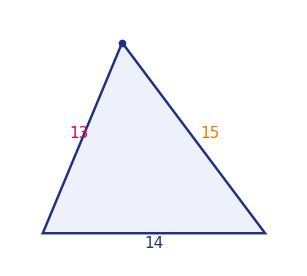
Sometimes you know the three sides of a triangle but not its height. Heron of Alexandria gave a formula that needs only the sides. First find the semi-perimeter s, which is half the perimeter.
|
Heron’s formula Area = √[ s(s − a)(s − b)(s − c) ], where s = (a + b + c) / 2 Here a, b, c are the three sides and s is the semi-perimeter, half of a + b + c. You work out s, then the three differences, multiply all four together, and take the square root. In real life: A surveyor who has measured only the three sides of a triangular plot can find its area on the spot with this. |
|
Worked example 1 Question. Find the area of a triangle with sides 13, 14 and 15 units.
Answer: Area = 84 square units. |
|
Worked example 2 Question. Find the area of a triangle with base 6 cm and height 4 cm.
Answer: Area = 12 square centimetres. |
|
Worked example 3 Question. A right triangle has legs 3 cm and 4 cm. Check its area two ways.
Answer: Area = 6 square centimetres by both methods. |
5. Area of a circle
If you cut a circle into many thin sectors and lay them side by side, top and tail, they form a shape very close to a rectangle. Its height is the radius r and its length is half the circumference, πr. So the area is length × height = πr × r.
|
Area of a circle Area = πr² r is the radius. The area grows with the square of the radius, so doubling the radius makes the circle four times as large. In real life: It tells you how much pizza is in a large versus a medium, and how much water a round tank holds per metre of depth. |
Practise with the interactive
Drag the sides of a triangle or the radius of a circle and watch the perimeter and area update live. The interactive opens right here in the lesson.
Practice set A, multiple choice
1. The area of a parallelogram is …
Base × height. The height is the perpendicular distance between the parallel sides, not the slanting side.
2. Heron’s formula needs …
Only the three sides. You compute the semi-perimeter s = (a + b + c) / 2, then Area = √[s(s − a)(s − b)(s − c)].
3. A circle has radius 7 cm. Using π = 22/7, its circumference is …
| 1 | Use C = 2πr. C = 2 × 22/7 × 7. |
| 2 | Cancel and multiply. The 7 cancels, giving 2 × 22 = 44 cm. |
4. If the radius of a circle doubles, its area becomes …
Four times as large, because area = πr² depends on the square of the radius, and 2² = 4.
Practice set B, short answer
1. Find the area of a rectangle 8 cm by 5 cm.
| 1 | Use length times breadth. Area = l × b = 8 × 5. |
| 2 | Multiply. = 40 square centimetres. |
2. Find the area of a triangle with sides 5, 5 and 6 cm using Heron’s formula.
| 1 | Semi-perimeter. s = (5 + 5 + 6) / 2 = 16 / 2 = 8. |
| 2 | Differences. s − a = 3, s − b = 3, s − c = 2. |
| 3 | Apply the formula. Area = √[8 × 3 × 3 × 2] = √144 = 12 square centimetres. |
3. Find the area of a circle of radius 7 cm, taking π = 22/7.
| 1 | Use the area formula. Area = πr² = 22/7 × 7 × 7. |
| 2 | Cancel a 7. = 22 × 7 = 154 square centimetres. |
Quick summary
| Idea | The formula |
| Circumference | C = 2πr. |
| Rectangle area | length × breadth. |
| Parallelogram area | base × height. |
| Triangle area | ½ × base × height. |
| Heron’s formula | √[s(s − a)(s − b)(s − c)], s = (a + b + c)/2. |
| Circle area | πr². |
| Open the Virtual Lab |
These free Grade 9 Maths notes explain perimeter and area for rectangles, parallelograms, triangles and circles, including Heron’s formula and the circle formulas, with step by step worked examples for students using the new Ganita Manjari book.
© 2026 School Revise. All rights reserved. This lesson is original content written by School Revise, aligned to the CBSE and NCERT Class 9 Maths syllabus. Unauthorised copying, reproduction or redistribution is not permitted. Curriculum names are used only to indicate alignment.
 Google