Curriculum
Mathematics Grade IX
Mathematics Grade 9
0/8
-
Chapter 1: Orienting Yourself: The Use of Coordinates
 Preview
 -
Chapter 2: Introduction to Linear Polynomials
Preview
-
Chapter 3: The World of Numbers
Preview
-
Chapter 4: Exploring Algebraic Identities
Preview
-
Chapter 5: I’m Up and Down, and Round and Round
Preview
-
Chapter 6: Measuring Space: Perimeter and Area
Preview
-
Chapter 7: The Mathematics of Maybe: Introduction to Probability
Preview
-
Chapter 8: Predicting What Comes Next: Exploring Sequences and Progressions
Preview
Advanced Maths
0/6
Chapter 4: Exploring Algebraic Identities
School Revise · Grade 9 Maths · Chapter 4
Exploring Algebraic Identities
Ganita Manjari, Class 9. An identity is a rule that is true for every value you put in. Here we prove three key identities by looking at areas, then use them to expand, to factorise, and to do quick mental arithmetic.
|
|
||
|
|
What this chapter is about
An identity is an equation that stays true whatever numbers you substitute. For example (a + b)² = a² + 2ab + b² works for a = 2, b = 5 and for any other pair. In this chapter we do not just quote these rules, we see them as areas of squares and rectangles, which makes them obvious and easy to trust. Then we run them backwards to factorise.
|
Identity versus equation an identity is true for all values; an ordinary equation is true only for special values x + 3 = 7 is an equation, true only when x = 4. But (a + b)² = a² + 2ab + b² is an identity, true for every a and b. |
1. The square of a sum
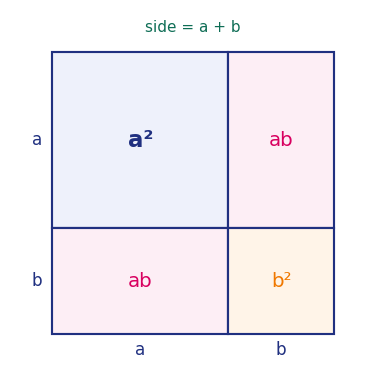
Proof by area
| 1 | Draw a square of side a + b. Its total area is (a + b) × (a + b) = (a + b)². |
| 2 | Cut it into four pieces. A vertical and a horizontal line split it into a square of side a, a square of side b, and two equal rectangles each a by b, as in the picture. |
| 3 | Add the four areas. a² (top left) + ab (top right) + ab (bottom left) + b² (bottom right). |
| 4 | Collect the like pieces. The two ab rectangles add to 2ab, so the total is a² + 2ab + b². |
| 5 | Match the two ways of counting. The whole area counted one way is (a + b)², and counted the other way is a² + 2ab + b². They must be equal. |
|
Square of a sum (a + b)² = a² + 2ab + b² The square of a sum is the first term squared, plus twice the product of the two terms, plus the second term squared. The middle piece 2ab comes from the two equal rectangles in the picture. In real life: It gives quick mental arithmetic. To find 103², think (100 + 3)² = 100² + 2 × 100 × 3 + 3² = 10000 + 600 + 9 = 10609, all in your head. |
|
Worked example 1 Question. Expand (x + 5)².
Answer: (x + 5)² = x² + 10x + 25. |
2. The square of a difference
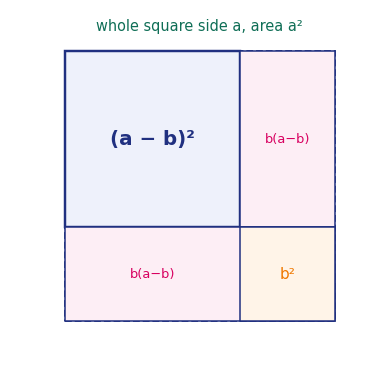
Proof by area
| 1 | Start from the big square. Take a square of side a, whose area is a². |
| 2 | Remove two strips. To be left with a square of side (a − b), remove a strip of area b(a − b) from the side and another from the bottom. |
| 3 | Correct the double count. Those two strips overlap in a small b by b square, which was taken away twice, so add back b². |
| 4 | Collect the pieces. (a − b)² = a² − b(a − b) − b(a − b) + b², which tidies to a² − 2ab + b². |
|
Square of a difference (a − b)² = a² − 2ab + b² The same as the square of a sum, but the middle term is subtracted. Only the sign of the 2ab term changes. In real life: To find 98², think (100 − 2)² = 10000 − 400 + 4 = 9604 without a calculator. |
|
Worked example 2 Question. Expand (2x − 3)².
Answer: (2x − 3)² = 4x² − 12x + 9. |
3. The difference of two squares
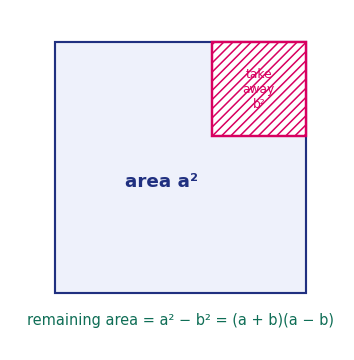
Proof by area
| 1 | Start with a square minus a square. Take a square of area a² and cut a smaller square of area b² from one corner. The area left is a² − b². |
| 2 | Rearrange into a rectangle. Slide the L shaped piece to form a rectangle. Its longer side is a + b and its shorter side is a − b. |
| 3 | Match the areas. The same region is a² − b² one way and (a + b)(a − b) the other way, so they are equal. |
|
Difference of two squares a² − b² = (a + b)(a − b) Any difference of two perfect squares factorises into the sum times the difference of the two roots. Read backwards, it also tells you (a + b)(a − b) always gives a² − b². In real life: It makes tricky products easy. 43 × 37 = (40 + 3)(40 − 3) = 40² − 3² = 1600 − 9 = 1591. |
|
Worked example 3 Question. Factorise x² − 16.
Answer: x² − 16 = (x + 4)(x − 4). |
4. Using identities to factorise
Factorising means writing an expression as a product. The same identities, read from right to left, turn a sum back into a bracket. If you can recognise a² + 2ab + b² you can write it as (a + b)², and if you can recognise a difference of two squares you can split it into two brackets. This skill is the key to solving equations in later chapters.
Practise with the interactive
Drag the side lengths a and b and watch the four areas rearrange, so you can see the identity forming in front of you. The interactive opens right here in the lesson.
Practice set A, multiple choice
1. (a + b)² equals …
a² + 2ab + b². The middle term 2ab comes from the two equal rectangles in the area picture.
2. Which identity helps factorise x² − 25?
| 1 | Recognise the form. x² − 25 = x² − 5², a difference of two squares. |
| 2 | Name the identity. Use a² − b² = (a + b)(a − b), giving (x + 5)(x − 5). |
3. (a − b)² differs from (a + b)² only in …
The sign of the middle term. (a − b)² = a² − 2ab + b², so the 2ab is subtracted.
4. 101² using an identity is …
| 1 | Rewrite. 101 = 100 + 1, so 101² = (100 + 1)². |
| 2 | Apply the sum identity. = 100² + 2 × 100 × 1 + 1² = 10000 + 200 + 1. |
| 3 | Add. = 10201. |
Practice set B, short answer
1. Expand (x + 7)².
| 1 | Parts. a = x, b = 7. |
| 2 | Apply. x² + 2 × x × 7 + 7². |
| 3 | Simplify. x² + 14x + 49. |
2. Factorise 9x² − 49.
| 1 | Spot two squares. 9x² = (3x)² and 49 = 7², so this is a difference of two squares. |
| 2 | Apply the identity. With a = 3x and b = 7, (a + b)(a − b). |
| 3 | Write the factors. (3x + 7)(3x − 7). |
3. Find 96 × 104 using an identity.
| 1 | Write as a sum and difference. 96 = 100 − 4 and 104 = 100 + 4. |
| 2 | Apply the difference of squares. (100 − 4)(100 + 4) = 100² − 4². |
| 3 | Work it out. = 10000 − 16 = 9984. |
Quick summary
| Idea | The identity and what it does |
| Square of a sum | (a + b)² = a² + 2ab + b². |
| Square of a difference | (a − b)² = a² − 2ab + b². |
| Difference of two squares | a² − b² = (a + b)(a − b). |
| Factorising | Read an identity right to left to split an expression into brackets. |
| Open the Virtual Lab |
These free Grade 9 Maths notes explain the algebraic identities for the square of a sum, the square of a difference and the difference of two squares, with area proofs and factorisation, for students using Ganita Manjari.
© 2026 School Revise. All rights reserved. This lesson is original content written by School Revise, aligned to the CBSE and NCERT Class 9 Maths syllabus. Unauthorised copying, reproduction or redistribution is not permitted. Curriculum names are used only to indicate alignment.
 Google