Curriculum
Mathematics Grade IX
Mathematics Grade 9
0/8

Ch-5 Combinations
School Revise · Grade 9 · Advanced Maths (Optional) · Chapter 5
Combinatorics
Mathematics at Advanced Level, Class 9. Combinatorics is the art of counting without listing. This optional chapter gives the fundamental principle of counting, factorials, and the two great tools, permutations and combinations.
|
|
||
|
|
What this chapter is about
How many passwords, how many teams, how many routes. Listing them all is hopeless, so we count cleverly. In this chapter we meet the counting principle, the factorial, and permutations and combinations, which count arrangements and selections.
1. The fundamental principle of counting
|
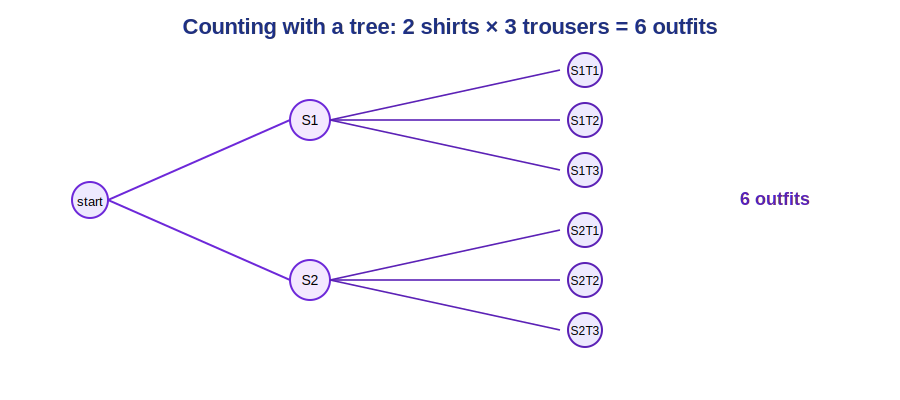
The counting principle if one choice can be made in m ways and a second in n ways, then together they can be made in m × n ways For choices made one after another (this and then that) you multiply. For a choice between alternatives (this or that) you add. A tree diagram shows every path. In real life: A meal deal with 4 mains and 3 drinks offers 4 × 3 = 12 different combinations, worked out without listing a single one. |
|
Worked example 1 Question. A wardrobe has 2 shirts and 3 trousers. How many different outfits are possible?
Answer: 6 different outfits. |
2. Permutations and combinations
|
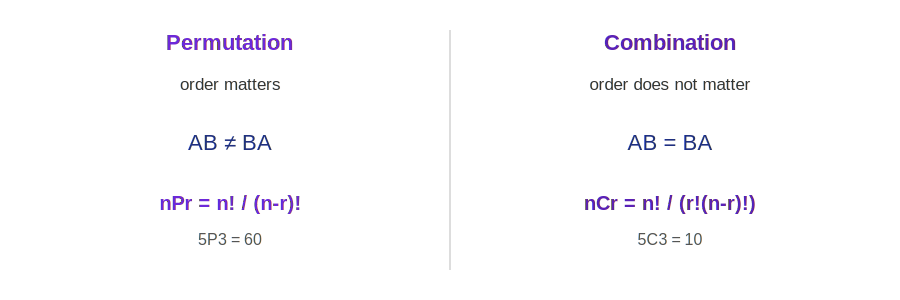
Permutations and combinations a permutation counts arrangements where order matters, nPr = n! / (n − r)!; a combination counts selections where order does not, nCr = n! / (r!(n − r)!) The factorial n! means n × (n − 1) × … × 1, and 0! = 1. Use a permutation when rearranging changes the result, and a combination when it does not. In real life: The order of digits matters in a PIN, so that is a permutation, but the members of a team are the same in any order, so that is a combination. |
|
Worked example 2 Question. In how many ways can 3 of 5 different books be arranged on a shelf?
Answer: 60 ways. |
|
Worked example 3 Question. How many ways can a team of 3 be chosen from 5 people?
Answer: 10 ways. |
Practise with the interactive
Try this chapter hands on: change the values and watch the answer update live and animate. The interactive opens right here in the lesson.
Practice set A, multiple choice
1. For choices made one after another, you …
Multiply the numbers of ways, by the fundamental principle of counting.
2. The value of 0! is …
1, by definition, which keeps the permutation and combination formulas working.
3. Use a permutation rather than a combination when …
Order matters, that is, when rearranging the chosen items gives a different result.
4. 4P2 equals …
| 1 | Use n!/(n − r)!. 4!/2! = 4 × 3. |
| 2 | So. = 12. |
Practice set B, short answer
1. A PIN has 4 digits, each from 0 to 9, repeats allowed. How many PINs are possible?
| 1 | 4 independent choices of 10. 10 × 10 × 10 × 10. |
| 2 | So. = 10000. |
2. How many ways can 2 of 6 people be chosen for a committee?
| 1 | Order does not matter, use nCr. 6C2 = 6!/(2! × 4!). |
| 2 | Work it out. = (6 × 5)/(2 × 1) = 15. |
3. How many arrangements of the letters A, B, C, D taken all together?
| 1 | All 4, order matters. 4! = 4 × 3 × 2 × 1. |
| 2 | So. = 24. |
Quick summary
| Idea | The idea |
| Counting principle | Multiply choices made in sequence. |
| Factorial | n! = n × … × 1, and 0! = 1. |
| Permutation | Order matters; nPr = n!/(n − r)!. |
| Combination | Order does not; nCr = n!/(r!(n − r)!). |
| PIN | A permutation with repetition. |
| Team | A combination. |
| Open the Virtual Lab |
These free Grade 9 Advanced Maths notes explain the counting principle, factorials, permutations and combinations with worked problems, with clear step by step worked examples and labelled diagrams for every student using the optional Advanced Level book.
© 2026 School Revise. All rights reserved. This lesson is original content written by School Revise, aligned to the CBSE Class 9 Mathematics at Advanced Level (Optional) syllabus. Unauthorised copying, reproduction or redistribution is not permitted. Curriculum names are used only to indicate alignment.
 Google