Curriculum
Mathematics Grade IX
Mathematics Grade 9
0/8
-
Chapter 1: Orienting Yourself: The Use of Coordinates
 Preview
 -
Chapter 2: Introduction to Linear Polynomials
Preview
-
Chapter 3: The World of Numbers
Preview
-
Chapter 4: Exploring Algebraic Identities
Preview
-
Chapter 5: I’m Up and Down, and Round and Round
Preview
-
Chapter 6: Measuring Space: Perimeter and Area
Preview
-
Chapter 7: The Mathematics of Maybe: Introduction to Probability
Preview
-
Chapter 8: Predicting What Comes Next: Exploring Sequences and Progressions
Preview
Advanced Maths
0/6
Chapter 2: Introduction to Linear Polynomials
School Revise · Grade 9 Maths · Chapter 2
Introduction to Linear Polynomials
Ganita Manjari, Class 9. A polynomial is just a tidy way to write an algebraic rule. Here we learn what a linear polynomial is, how to find its value and its zero, and why its graph is always a straight line, with every step shown.
|
|
||
|
|
What this chapter is about
Think of an auto fare. You pay a fixed amount when you sit in, then a steady charge for every kilometre. Written as a rule that is a linear polynomial. In this chapter we learn the language of polynomials, then two simple tools, the value of a polynomial and its zero, and we see why a linear rule always draws a straight line.
1. What a polynomial is
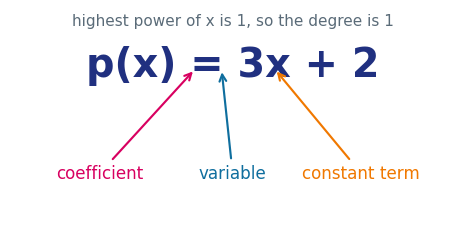
A polynomial in one variable is an expression built only from numbers and a variable raised to whole number powers, joined by plus and minus. Each piece is a term. In each term the number multiplying the variable is the coefficient, and a term with no variable is the constant term.
|
The linear polynomial p(x) = ax + b, where a is not 0 This is a polynomial of degree 1, called linear because its graph is a straight line. Here a is the coefficient of x and b is the constant term. The condition a is not 0 matters, because if a were 0 the x would vanish and it would no longer be linear. In real life: An auto fare of 30 rupees plus 15 rupees a kilometre is p(x) = 15x + 30. A phone plan with a monthly rental plus a rate per gigabyte works the same way. |
Degree of a polynomial
The degree is the highest power of the variable. A constant like −9 has degree 0, a linear polynomial like 4x − 3 has degree 1, a quadratic like x² + 1 has degree 2, and a cubic has degree 3. The degree tells you the shape of the graph, and for a linear polynomial that shape is a straight line.
Try this: Write down the degree of each: 7, 2x + 5, x² − 3x, and x³ + 1. Then say which one is linear.
2. The value of a polynomial
What it is: the number you get when you put a chosen value of x into the polynomial. Why we need it: it answers questions like what does the fare come to for 4 kilometres.
|
Value of a polynomial p(k) means replace every x with k, then work it out You substitute the given number for x and simplify using the normal order of operations, multiply before you add. In real life: If the fare is p(x) = 15x + 30, then p(4) tells you the cost of a 4 kilometre ride. |
|
Worked example 1 Question. If p(x) = 3x + 2, find p(4).
Answer: p(4) = 14. |
3. The zero of a polynomial
What it is: the value of x that makes the whole polynomial equal to 0. Why we need it: it is the answer to the question, for what input does the output become nothing, and on a graph it is where the line crosses the x axis.
Where the zero of a linear polynomial comes from
We do not just quote a rule, we work it out. Start from p(x) = ax + b and ask when it equals 0.
| 1 | Set the polynomial to 0. By the definition of a zero, we want ax + b = 0. |
| 2 | Move the constant across. Subtract b from both sides, which keeps the equation balanced: ax = −b. |
| 3 | Divide by the coefficient. Divide both sides by a, allowed because a is not 0: x = −b / a. |
|
Zero of a linear polynomial x = −b / a This single value of x makes ax + b equal to 0. It is also the point where the straight line graph cuts the x axis. In real life: If a tank empties by the rule h(t) = 3 − 0.5t, the zero t = 6 tells you the month the tank becomes empty. |
|
Worked example 2 Question. Find the zero of p(x) = 2x + 1.
Answer: The zero is x = −1/2. |
|
Worked example 3 Question. Find the zero of p(x) = 3x − 9.
Answer: The zero is x = 3. |
4. The graph of a linear polynomial
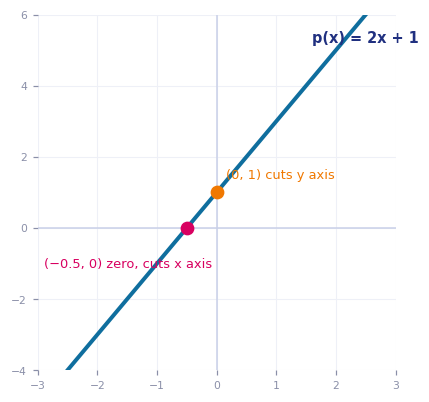
Plot the value of the polynomial for a few values of x and join the points. For a linear polynomial they always lie on a perfectly straight line. The line meets the y axis at the constant term b, and it meets the x axis at the zero, x = −b / a. The steepness of the line is set by the coefficient a, called the slope.
Try this: For p(x) = 2x + 1, work out p(0), p(1) and p(−1), plot the three points, and check they lie on the line shown above.
5. Linear growth and linear decay
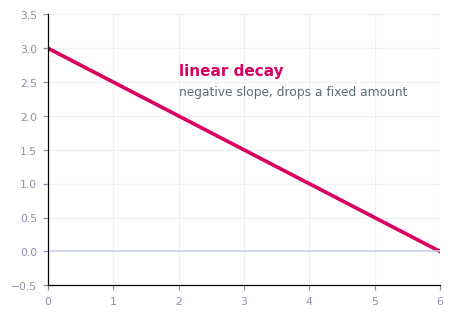
When the coefficient a is positive the line rises, so the quantity grows by a fixed amount each step. This is linear growth, like a fare that adds 15 rupees every kilometre. When a is negative the line falls, so the quantity drops by a fixed amount each step. This is linear decay, like a water tank that loses half a metre every month. The same rule ax + b describes both, only the sign of a changes.
Practise with the interactive
Change a and b with the sliders, watch the line tilt and shift, and read off the value and the zero as they update. The interactive opens right here in the lesson.
Practice set A, multiple choice
1. The degree of 5x³ − 2x² + x − 8 is …
| 1 | Find the highest power. Look for the largest power of x among the terms. |
| 2 | Read it off. The highest power is 3, so the degree is 3. |
2. Which of these is a linear polynomial? (a) x² − 9 (b) 4x + 2 (c) x³ + 1
Answer (b) 4x + 2. A linear polynomial has degree 1, and only 4x + 2 has its highest power equal to 1.
3. If p(x) = 5x − 7, then p(2) is …
| 1 | Substitute. p(2) = 5 × 2 − 7. |
| 2 | Multiply first. 5 × 2 = 10, so p(2) = 10 − 7. |
| 3 | Subtract. p(2) = 3. |
4. The zero of p(x) = x + 4 is …
| 1 | Set to 0. x + 4 = 0. |
| 2 | Solve. Subtract 4 from both sides, x = −4. |
Practice set B, short answer
1. Find the value of p(x) = 4x + 5 at x = 3.
| 1 | Substitute. p(3) = 4 × 3 + 5. |
| 2 | Multiply then add. 4 × 3 = 12, so p(3) = 12 + 5 = 17. |
2. Find the zero of p(x) = 7x − 21.
| 1 | Set to 0. 7x − 21 = 0. |
| 2 | Move the constant. Add 21 to both sides, 7x = 21. |
| 3 | Divide by the coefficient. Divide by 7, x = 3. |
3. Does the graph of p(x) = −2x + 6 rise or fall, and where does it cut the x axis?
| 1 | Look at the coefficient. The coefficient of x is −2, which is negative, so the line falls. This is linear decay. |
| 2 | Find the zero. Set −2x + 6 = 0, so 2x = 6 and x = 3. The line cuts the x axis at (3, 0). |
Quick summary
| Idea | What to remember, and why |
| Linear polynomial | p(x) = ax + b, a not 0. Degree 1, graph a straight line. |
| Value | p(k): put x = k and simplify. |
| Zero | x = −b / a, where the line cuts the x axis. |
| Growth or decay | a positive rises (growth), a negative falls (decay). |
| Open the Virtual Lab |
These free Grade 9 Maths notes explain polynomials, degree, the linear polynomial ax plus b, the value and zero of a polynomial and its straight line graph, with worked examples for students following the Ganita Manjari book.
© 2026 School Revise. All rights reserved. This lesson is original content written by School Revise, aligned to the CBSE and NCERT Class 9 Maths syllabus. Unauthorised copying, reproduction or redistribution is not permitted. Curriculum names are used only to indicate alignment.
 Google