Curriculum
Mathematics Grade IX
Mathematics Grade 9
0/8

Ch-1 Sets
School Revise · Grade 9 · Advanced Maths (Optional) · Chapter 1
Sets
Mathematics at Advanced Level, Class 9. This optional chapter builds the language of sets that all higher mathematics uses. We define a set carefully, write it in two ways, meet subsets and power sets, and use Venn diagrams to combine sets and count.
|
|
||
|
|
What this chapter is about
This is the optional Advanced Level, taken in addition to the standard course. A set is just a tidy way of talking about a collection of things. In this chapter we learn to describe a set exactly, decide when one set sits inside another, list all the subsets of a set, and combine two sets in different ways while counting how many elements result.
1. What a set is
|
Definition of a set a set is a well defined collection of objects; each object is an element, or member, of the set Well defined means there is no argument about whether a thing is in the collection. The vowels of the alphabet form a set. The three best students of a class do not, because best means different things to different people. In real life: A blood bank sorts donors into the sets A, B, AB and O, and this exact sorting decides who can safely give blood to whom. |
|
Two ways to write a set roster form lists the elements inside braces; set builder form states the rule the elements obey In roster form the vowels are written V = {a, e, i, o, u}. In set builder form the same set is {x : x is a vowel}. We write e ∈ V for e belongs to V, and c ∉ V for c does not. Order does not matter and elements are never repeated. In real life: Set builder form lets us describe huge or infinite sets, like all even numbers, that could never be fully listed. |
|
Worked example 1 Question. Write, in roster form, the set of whole numbers less than or equal to 5.
Answer: A = {0, 1, 2, 3, 4, 5}. |
2. Subsets, cardinality and the power set
|
Subset A is a subset of B, written A ⊆ B, if every element of A is also an element of B If even one element of A is missing from B, then A is not a subset of B. The empty set is a subset of every set, and every set is a subset of itself. In real life: The set of students who walk to school is a subset of the set of all students in the class. |
|
Cardinality and the power set the cardinality n(A) is the number of distinct elements in A; the power set is the set of all its subsets A set with n elements has exactly 2ⁿ subsets, so its power set has 2ⁿ members. For D = {a, b}, the subsets are the empty set, {a}, {b} and {a, b}, four in all, and 2² = 4. In real life: Knowing there are 2ⁿ subsets tells you at once how many different teams, playlists or menus you could build from n items. |
|
Worked example 2 Question. How many subsets does a set with 4 elements have?
Answer: 16 subsets. |
3. Combining sets: the operations
|
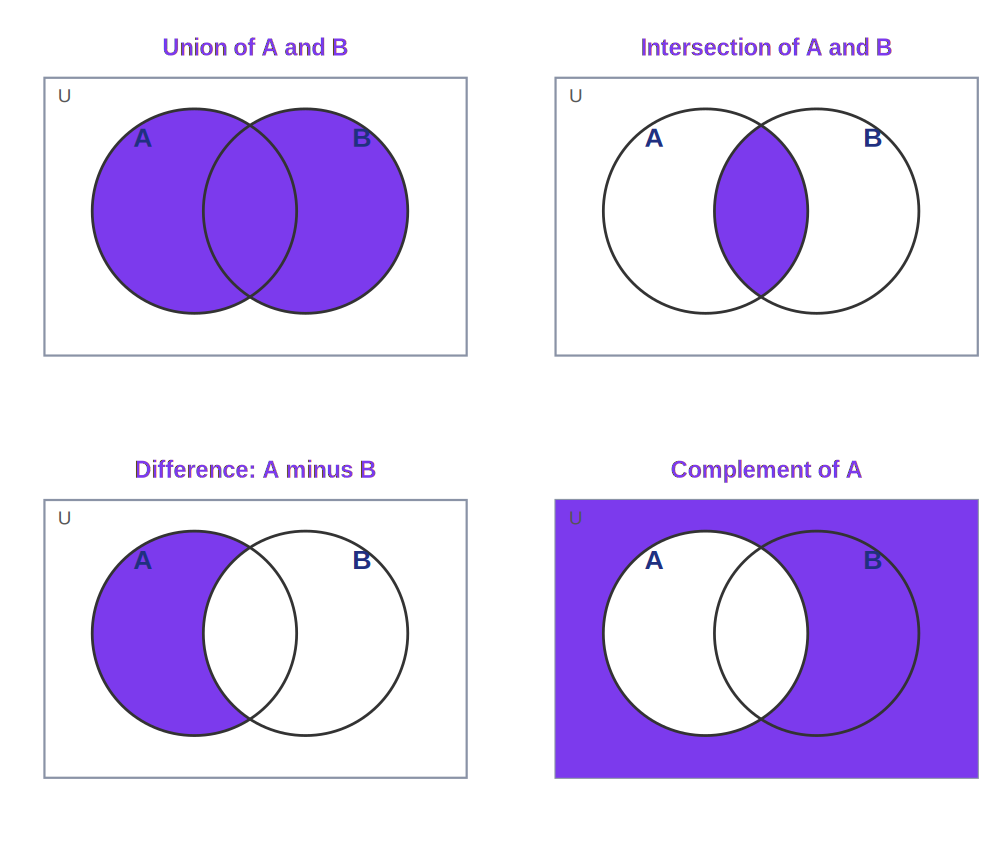
The four set operations union A ∪ B is in A or B or both; intersection A ∩ B is in both; difference A − B is in A but not B; complement A’ is everything in U but not in A A Venn diagram draws the universal set U as a rectangle and each set as a circle inside it. The shaded region shows the result of the operation. Two sets with nothing in common are called disjoint, and their intersection is the empty set. In real life: Union answers who plays cricket or football, intersection answers who plays both, and difference answers who plays only cricket. |
Try this: A useful law, easy to see on a Venn diagram, is De Morgan’s law: (A ∪ B)’ = A’ ∩ B’. The outside of the union is the overlap of the outsides.
4. Counting with sets
|
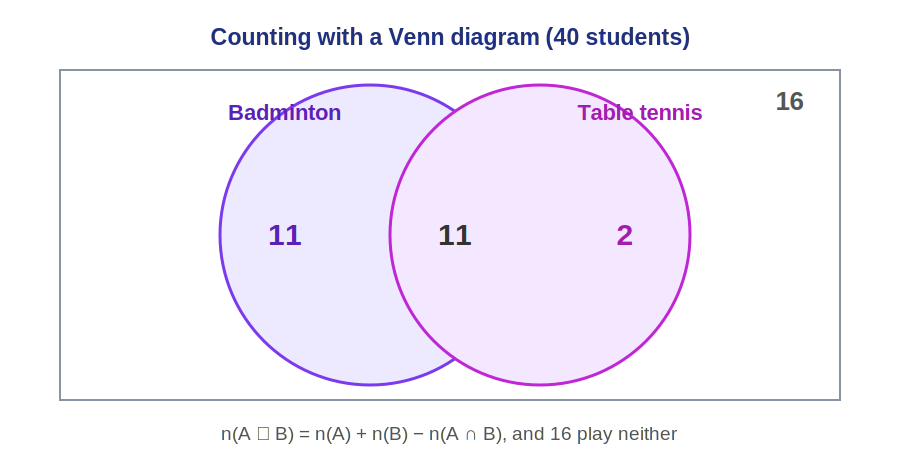
The cardinal formula for two finite sets, n(A ∪ B) = n(A) + n(B) − n(A ∩ B) If you simply add n(A) and n(B), the elements in both get counted twice, so we subtract the overlap n(A ∩ B) once to correct it. This lets us count a combined group without listing everyone. In real life: A shop can work out how many customers bought tea or coffee from the numbers who bought each and the number who bought both. |
|
Worked example 3 Question. In a class of 40, 22 play badminton, 11 play both badminton and table tennis, and 16 play neither. How many play table tennis but not badminton?
Answer: 2 students play table tennis but not badminton. |
Practise with the interactive
Pick an operation to shade the Venn region, then set the group sizes and watch the counting formula update live. The interactive opens right here in the lesson.
Practice set A, multiple choice
1. Which of these is a well defined set?
The set of vowels in the English alphabet. The three best students is not a set, because best is a matter of opinion.
2. A set with 3 elements has how many subsets?
| 1 | Use 2ⁿ with n = 3. 2³. |
| 2 | Work it out. = 8 subsets. |
3. The intersection of two disjoint sets is …
The empty set, because disjoint sets share no elements at all.
4. n(A ∪ B) equals …
n(A) + n(B) − n(A ∩ B). The overlap is subtracted once so it is not counted twice.
Practice set B, short answer
1. Write {x : x is an odd natural number less than 10} in roster form.
{1, 3, 5, 7, 9}. These are the odd natural numbers below 10.
2. List the power set of {p, q}.
| 1 | Find every subset. the empty set, {p}, {q}, {p, q}. |
| 2 | Collect them. P = { { }, {p}, {q}, {p, q} }, which has 2² = 4 members. |
3. In a group of 120 students, 92 can teach a language and 46 can teach maths, and every student teaches at least one. How many can teach both?
| 1 | Everyone teaches at least one. so n(L ∪ M) = 120. |
| 2 | Apply the cardinal formula. 120 = 92 + 46 − n(both). |
| 3 | Solve. n(both) = 138 − 120 = 18. |
Quick summary
| Idea | The idea |
| Set | A well defined collection of objects. |
| Roster / set builder | List the elements / state the rule. |
| Subset | Every element of A is in B. |
| Power set | All subsets; 2ⁿ of them. |
| Operations | Union, intersection, difference, complement. |
| Cardinal formula | n(A ∪ B) = n(A) + n(B) − n(A ∩ B). |
| Open the Virtual Lab |
These free Grade 9 Advanced Maths notes explain sets, roster and set builder form, subsets, power sets, Venn diagrams, set operations and the cardinal formula, with clear worked examples and practice for the optional Advanced Level book.
© 2026 School Revise. All rights reserved. This lesson is original content written by School Revise, aligned to the CBSE Class 9 Mathematics at Advanced Level (Optional) syllabus. Unauthorised copying, reproduction or redistribution is not permitted. Curriculum names are used only to indicate alignment.
 Google