Curriculum
Grade XII Biology
Biology Chapters
0/13
-
CH-1 Sexual-Reproduction-Flowering-Plants
 Preview
 -
CH-2 Human-Reproduction
Preview
-
CH-3 Reproductive-Health
Preview
-
CH-4 Inheritance-And-Variation
Preview
-
CH-5 Molecular-Basis-Of-Inheritance
Preview
-
CH-6 Evolution
Preview
-
CH-7 Human-Health-And-Disease
Preview
-
CH-8 Microbes-In-Human-Welfare
Preview
-
CH-9 Biotechnology-Principles
Preview
-
CH-10 Biotechnology-Applications
Preview
-
CH-11 -Organisms-And-Populations
Preview
-
CH-12 Ecosystem
Preview
-
CH-13 -Biodiversity-And-Conservation
Preview
Work Sheets
0/13

CH-1 Sexual-Reproduction-Flowering-Plants
|
Grade 12 Science | Chapter 1 Sexual Reproduction in Flowering PlantsThe flower is the reproductive part of a flowering plant. This chapter builds flower structure, the making of pollen and the ovule, pollination, the double fertilisation unique to flowering plants, and how the seed and fruit form afterwards.
|
|
Contents
|
1. The Flower |
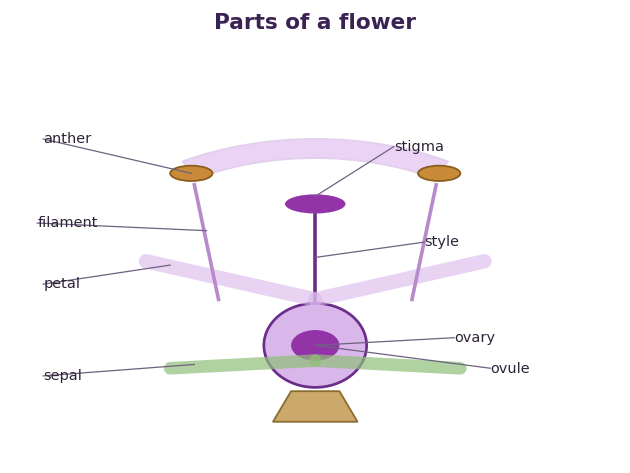
The flower is the reproductive unit of a flowering plant. It has four whorls: the protective sepals and petals, the male stamens and the female pistil. Each stamen has an anther on a filament, and the pistil has a stigma, a style and an ovary that holds the ovules.
|
Core idea A single flower usually carries both the male part, the stamen, and the female part, the pistil, so it can package the whole of reproduction in one structure.
|
|
Diagram 1 – Parts of a Flower
Fig 1. The stamen makes pollen while the pistil holds the ovules, so the flower carries both sides of reproduction. |
2. The Stamen and Pollen |
The stamen is the male part. Inside the anther, cells divide to form pollen grains, each carrying the male gametes. A pollen grain is the male gametophyte, small and tough, and is carried to the female part during pollination.
3. The Pistil and the Ovule |
The pistil is the female part. Its swollen base, the ovary, holds one or more ovules. Inside each ovule sits the embryo sac, the female gametophyte, which contains the egg cell and, at its centre, two polar nuclei. These are the targets of the two male gametes.
4. Pollination |
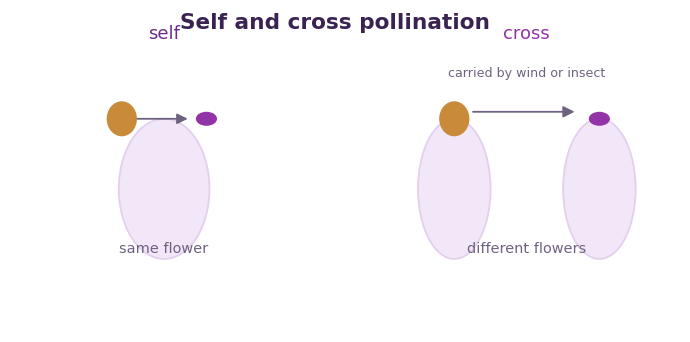
Pollination is the transfer of pollen from an anther to a stigma. In self pollination the pollen lands on the same flower, while in cross pollination it is carried to another flower by wind, water or animals such as insects. Many plants have devices that discourage self pollination, because cross pollination brings useful variation.
|
Diagram 3 – Pollination
Fig 2. Self pollination stays within one flower, while cross pollination carries pollen between flowers and mixes their features. |
5. Double Fertilisation |
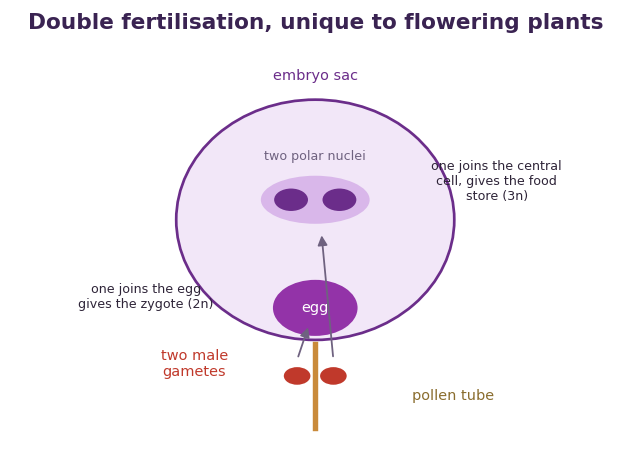
Once on the stigma, a pollen grain grows a pollen tube down to the ovule, carrying two male gametes. In the embryo sac, double fertilisation takes place. One male gamete joins the egg to form the zygote, which grows into the embryo. The other joins the two polar nuclei to form the endosperm, the food store for the young plant. This double event is unique to flowering plants.
|
Diagram 2 – Double Fertilisation
Fig 3. One gamete makes the embryo and the other makes its food store, both from the same pollen tube. |
6. Seed and Fruit |
After fertilisation the parts of the flower change. The ovule becomes the seed, holding the embryo and its endosperm. The ovary grows into the fruit, which protects the seeds and often helps to spread them. The other whorls of the flower usually wither and fall away.
7. Key Reasoning (Principles) |
|
Principle 1: The flower carries both sexes In most plants a single flower holds both the male stamen and the female pistil, so it packages the whole of sexual reproduction in one structure. |
|
Principle 2: Fertilisation is double and unique Two male gametes are used at once, one to make the embryo and one to make the endosperm, an event found only in flowering plants. |
|
Principle 3: Cross pollination brings variation Carrying pollen between flowers mixes their features, so plants have devices that favour cross pollination over self pollination. |
8. Worked Examples |
| Example 1 |
|
Q: Which whorl of the flower is the male part? Show SolutionIt makes pollen. Answer: The stamen. |
| Example 2 |
|
Q: Where are pollen grains made? Show SolutionInside the male part. Answer: In the anther. |
| Example 3 |
|
Q: What does the ovary hold? Show SolutionThe female cells sit inside it. Answer: The ovules. |
| Example 4 |
|
Q: What sits inside the ovule? Show SolutionThe female gametophyte. Answer: The embryo sac, with the egg and polar nuclei. |
| Example 5 |
|
Q: What is the transfer of pollen to a stigma called? Show SolutionIt may be self or cross. Answer: Pollination. |
| Example 6 |
|
Q: How many male gametes take part in fertilisation? Show SolutionIt is a double event. Answer: Two. |
| Example 7 |
|
Q: What does the zygote grow into? Show SolutionFormed from egg and one gamete. Answer: The embryo. |
| Example 8 |
|
Q: What forms the food store of the seed? Show SolutionFormed from the polar nuclei. Answer: The endosperm. |
| Example 9 |
|
Q: What does the ovule become after fertilisation? Show SolutionIt holds the embryo. Answer: The seed. |
| Example 10 |
|
Q: What does the ovary become? Show SolutionIt protects the seeds. Answer: The fruit. |
9. Practice Sets A to D |
| Set A – Multiple Choice (Basic) |
|
1. The male part of a flower is the: (a) pistil (b) stamen (c) sepal (d) petal 2. Pollen grains are made in the: (a) ovary (b) anther (c) stigma (d) style 3. The egg cell sits in the: (a) anther (b) embryo sac (c) petal (d) filament 4. Double fertilisation uses this many male gametes: (a) one (b) two (c) three (d) four 5. After fertilisation the ovary becomes the: (a) seed (b) fruit (c) flower (d) root Reveal Answers1. (b) stamen. 2. (b) anther. 3. (b) embryo sac. 4. (b) two. 5. (b) fruit. |
| Set B – Short Answer (Understanding) |
|
1. Name the four whorls of a flower. 2. Where and what are pollen grains? 3. Describe the ovule. 4. What is pollination, self and cross? 5. Explain double fertilisation. Reveal Answers1. Sepals, petals, stamens and the pistil. 2. They are made in the anther and carry the male gametes; each is the male gametophyte. 3. It sits in the ovary and holds the embryo sac, with the egg cell and two polar nuclei. 4. The transfer of pollen to a stigma; self is within a flower, cross is between flowers. 5. One male gamete joins the egg to make the embryo, the other joins the polar nuclei to make the endosperm. |
| Set C – Application and Reasoning |
|
1. Why is a pollen grain small and tough? 2. Why do many plants favour cross pollination? 3. Why does the pollen tube grow down to the ovule? 4. Why is the endosperm important to the young plant? 5. Why do the petals often wither after fertilisation? Reveal Answers1. It must travel to another flower and survive the journey, so a small tough grain is well suited. 2. It mixes features between plants, giving variation that helps the species adapt and survive. 3. It carries the two male gametes to the egg and central cell so that fertilisation can take place. 4. It is the food store that nourishes the growing embryo until the seedling can feed itself. 5. Their job of attracting pollinators is done, so they are no longer needed and fall away. |
| Set D – Higher Order (Challenge) |
|
1. Explain why the flower is an efficient reproductive structure. 2. Explain what makes double fertilisation special. 3. Explain how a fruit helps a plant beyond protection. 4. Explain why self pollination can be a disadvantage. 5. Explain the link between the ovule, the seed and the next generation. Reveal Answers1. It gathers the male and female parts, protection and attraction for pollinators into one compact unit. 2. Two gametes are used together to form both the embryo and its dedicated food store, seen only in flowering plants. 3. It often aids dispersal, carrying the seeds away from the parent so they find new ground to grow. 4. It gives no mixing of features, so the offspring lack the variation that helps a species adapt. 5. The ovule becomes the seed that carries the embryo, which grows into the plant of the next generation. |
|
Chapter Summary
|
|||||||||||||||||||||||||||||||
| Eight Point Exam Quick Check | ||||||||||||||||||||||||||||||||
|
||||||||||||||||||||||||||||||||
|
School Revise Virtual Lab Explore these ideas with interactive simulations and visual tools.
|
|
Class 12 Biology Chapter 1: Sexual Reproduction in Flowering Plants, Complete Notes and Practice These free Class 12 Biology notes on Sexual Reproduction in Flowering Plants follow the NCERT syllabus and cover flower structure, pollination, double fertilisation and the seed and fruit, with worked examples and graded practice, free on SchoolRevise.com. |
 Google