Curriculum
Grade XII Biology
Biology Chapters
0/13
-
CH-1 Sexual-Reproduction-Flowering-Plants
 Preview
 -
CH-2 Human-Reproduction
Preview
-
CH-3 Reproductive-Health
Preview
-
CH-4 Inheritance-And-Variation
Preview
-
CH-5 Molecular-Basis-Of-Inheritance
Preview
-
CH-6 Evolution
Preview
-
CH-7 Human-Health-And-Disease
Preview
-
CH-8 Microbes-In-Human-Welfare
Preview
-
CH-9 Biotechnology-Principles
Preview
-
CH-10 Biotechnology-Applications
Preview
-
CH-11 -Organisms-And-Populations
Preview
-
CH-12 Ecosystem
Preview
-
CH-13 -Biodiversity-And-Conservation
Preview
Work Sheets
0/13

CH-10 Biotechnology-Applications
|
Grade 12 Science | Chapter 10 Biotechnology and its ApplicationsThis chapter shows biotechnology at work. It builds genetically modified crops such as Bt cotton, engineered human insulin, gene therapy, the molecular methods that detect disease early, and the ethical questions these powerful tools raise.
|
|
Contents
|
1. Biotechnology in Farming |
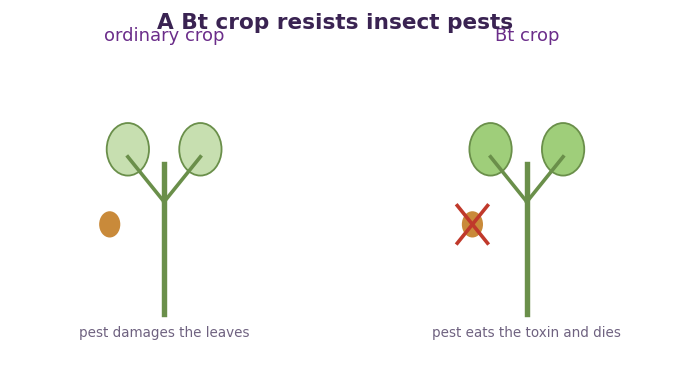
Genetically modified crops carry a useful new gene. In Bt cotton, a gene from the bacterium Bacillus thuringiensis makes a protein that is toxic to certain insect pests, so the crop protects itself and needs less chemical spray. Other modified crops resist disease, tolerate harsh conditions, or carry more nutrition.
|
Core idea By adding a chosen gene, a crop can be given a new power, such as killing the pests that eat it, and a microbe can be made to produce a human medicine.
|
|
Diagram 1 – Bt Crop
Fig 1. A Bt crop makes a protein that harms the pest, so the pest dies and the crop is protected. |
2. Biotechnology in Medicine |
Biotechnology gives us safer medicines and better ways to find disease. A landmark example is human insulin made by engineered bacteria, so people with diabetes no longer depend on insulin taken from animals, which could cause reactions.
3. Engineered Insulin |
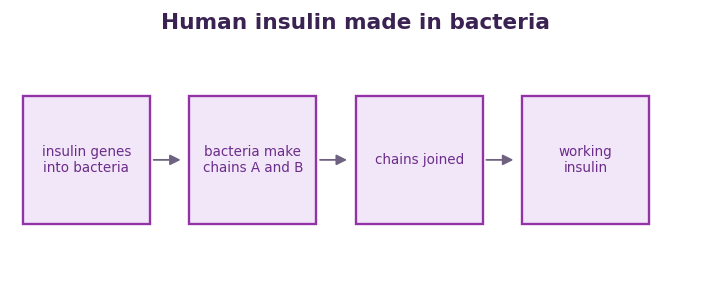
Human insulin is a small protein of two short chains, A and B. The genes for these chains are put into bacteria, which make the chains in large amounts. The chains are then joined to give working human insulin, identical to our own.
|
Diagram 2 – Engineered Insulin
Fig 2. Bacteria carrying the insulin genes make the two chains, which are joined to give working human insulin. |
4. Gene Therapy |
Gene therapy tries to correct a fault by giving the patient a working copy of a gene. An early success treated a child born with a serious immune weakness, an ADA deficiency, by supplying the missing gene, so the immune system could work.
5. Molecular Diagnosis |
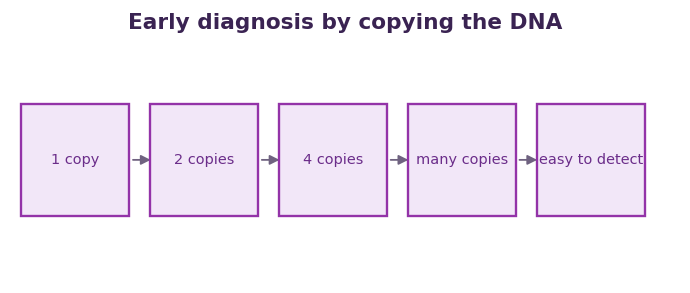
Molecular diagnosis finds a disease very early, often before symptoms appear. One method copies a tiny amount of the pathogen’s DNA many times until it can be detected, and another finds the body’s response to the germ. Early detection means earlier and better treatment.
|
Diagram 3 – Early Diagnosis
Fig 3. A tiny trace of DNA is copied again and again until there is enough to detect the disease early. |
6. Transgenic Animals and Ethics |
Transgenic animals, which carry an added gene, are used in research and to make useful medicines in their milk. Such powerful tools raise ethical questions, so bodies oversee their safe use, and rules guard against misuse such as taking a community’s natural resources or knowledge without fair return.
7. Key Reasoning (Principles) |
|
Principle 1: A new gene gives a crop a new power Adding a chosen gene, such as the Bt gene, lets a crop protect itself against pests or gain other useful features, with less need for chemicals. |
|
Principle 2: Engineered microbes make safe medicines By carrying a human gene, bacteria can make a human product such as insulin, giving a safe and plentiful supply that once came from animals. |
|
Principle 3: Molecular methods find disease early Copying or detecting a pathogen’s traces reveals a disease before symptoms show, and such powerful tools call for careful ethical oversight. |
8. Worked Examples |
| Example 1 |
|
Q: What does the Bt gene give a crop? Show SolutionFrom a bacterium. Answer: Resistance to certain insect pests. |
| Example 2 |
|
Q: Why is Bt cotton useful? Show SolutionIt needs less spray. Answer: It protects itself from pests, cutting chemical use. |
| Example 3 |
|
Q: Where is engineered human insulin made? Show SolutionFast growing microbes. Answer: In bacteria. |
| Example 4 |
|
Q: How many chains does human insulin have? Show SolutionTwo short ones. Answer: Two, A and B. |
| Example 5 |
|
Q: What does gene therapy try to do? Show SolutionFix a fault. Answer: Give a working copy of a faulty gene. |
| Example 6 |
|
Q: What disease did early gene therapy treat? Show SolutionAn immune weakness. Answer: An immune deficiency (ADA deficiency). |
| Example 7 |
|
Q: What is the value of molecular diagnosis? Show SolutionBefore symptoms. Answer: It finds disease very early. |
| Example 8 |
|
Q: How does one method detect a trace of DNA? Show SolutionIt multiplies it. Answer: By copying it many times until it can be found. |
| Example 9 |
|
Q: What is a transgenic animal? Show SolutionIt has an extra gene. Answer: An animal that carries an added gene. |
| Example 10 |
|
Q: Why is ethical oversight needed? Show SolutionThe tools are powerful. Answer: To ensure safe and fair use. |
9. Practice Sets A to D |
| Set A – Multiple Choice (Basic) |
|
1. Bt cotton resists: (a) drought (b) insect pests (c) frost (d) flood 2. The Bt gene comes from a: (a) virus (b) bacterium (c) fungus (d) plant 3. Human insulin is made in: (a) cattle (b) bacteria (c) yeast only (d) plants 4. Gene therapy gives a: (a) drug (b) working gene (c) vaccine (d) hormone 5. Molecular diagnosis finds disease: (a) very late (b) very early (c) never (d) by guessing Reveal Answers1. (b) insect pests. 2. (b) bacterium. 3. (b) bacteria. 4. (b) working gene. 5. (b) very early. |
| Set B – Short Answer (Understanding) |
|
1. What is a genetically modified crop? 2. How does Bt cotton resist pests? 3. How is human insulin made now? 4. What is gene therapy? 5. What is molecular diagnosis? Reveal Answers1. A crop that carries a useful new gene, giving it a new feature such as pest resistance. 2. It carries a Bt gene that makes a protein toxic to certain insects, so the pests die when they eat it. 3. By engineered bacteria that carry the human insulin genes and make the two chains, which are then joined. 4. Giving a patient a working copy of a faulty gene so that the missing function can be restored. 5. Finding a disease very early by detecting a pathogen’s DNA or the body’s response before symptoms show. |
| Set C – Application and Reasoning |
|
1. Why does Bt cotton reduce chemical spraying? 2. Why is engineered insulin better than animal insulin? 3. Why must the two insulin chains be joined? 4. Why is early diagnosis so valuable? 5. Why do transgenic tools need oversight? Reveal Answers1. The crop makes its own protection against the pest, so far less chemical pesticide is needed. 2. It is identical to human insulin, so it works well and avoids the reactions that animal insulin could cause. 3. Only when the A and B chains are joined does the molecule take its working shape and act as insulin. 4. It allows treatment to start before the disease has done harm, greatly improving the chance of recovery. 5. They are powerful and can be misused, so careful rules protect people, animals and communities. |
| Set D – Higher Order (Challenge) |
|
1. Explain how a single gene can protect a whole crop. 2. Explain the advance from animal to engineered insulin. 3. Explain how gene therapy differs from an ordinary medicine. 4. Explain how copying DNA enables early diagnosis. 5. Explain why biotechnology raises ethical questions. Reveal Answers1. The added gene makes a pest killing protein throughout the plant, so any pest that feeds on it is harmed. 2. Insulin once came from animals and could cause reactions, but engineered bacteria now make a human copy safely and in plenty. 3. A medicine treats symptoms, while gene therapy supplies a working gene to correct the underlying fault itself. 4. A tiny trace is copied again and again until there is enough to detect, revealing the disease before symptoms appear. 5. Such power over life can be misused, so questions of safety, consent and fairness must be carefully weighed. |
|
Chapter Summary
|
|||||||||||||||||||||||||||||||
| Eight Point Exam Quick Check | ||||||||||||||||||||||||||||||||
|
||||||||||||||||||||||||||||||||
|
School Revise Virtual Lab Explore these ideas with interactive simulations and visual tools.
|
|
Class 12 Biology Chapter 10: Biotechnology and its Applications, Complete Notes and Practice These free Class 12 Biology notes on Biotechnology and its Applications follow the NCERT syllabus and cover genetically modified crops, engineered insulin, gene therapy, molecular diagnosis and ethical issues, with clear diagrams, worked examples and graded practice, free on SchoolRevise.com. |
 Google