Curriculum
Grade XII Biology
Biology Chapters
0/13
-
CH-1 Sexual-Reproduction-Flowering-Plants
 Preview
 -
CH-2 Human-Reproduction
Preview
-
CH-3 Reproductive-Health
Preview
-
CH-4 Inheritance-And-Variation
Preview
-
CH-5 Molecular-Basis-Of-Inheritance
Preview
-
CH-6 Evolution
Preview
-
CH-7 Human-Health-And-Disease
Preview
-
CH-8 Microbes-In-Human-Welfare
Preview
-
CH-9 Biotechnology-Principles
Preview
-
CH-10 Biotechnology-Applications
Preview
-
CH-11 -Organisms-And-Populations
Preview
-
CH-12 Ecosystem
Preview
-
CH-13 -Biodiversity-And-Conservation
Preview
Work Sheets
0/13

CH-6 Evolution
|
Grade 12 Science | Chapter 6 EvolutionEvolution explains how the great variety of life arose and changes over time. This chapter builds the origin of life, the evidence for evolution, Darwin’s natural selection, the sources of variation and the Hardy Weinberg principle for populations.
|
|
Contents
|
1. The Origin of Life |
Life is thought to have arisen from simple chemicals over a very long time, a process called chemical evolution. Oparin and Haldane proposed that the early conditions allowed simple molecules to join into more complex ones. The Miller and Urey experiment supported this by making organic molecules from a mixture that copied the early atmosphere.
|
Core idea Life arose and diversified by descent with modification over vast stretches of time, and the range of living things today is the record of that long history.
|
|
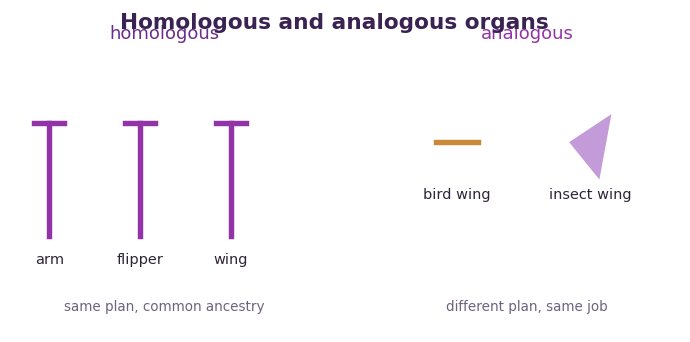
Diagram 1 – Homologous and Analogous
Fig 1. Homologous organs share a plan from a common ancestor, while analogous organs share only a function. |
2. Evidence for Evolution |
Many lines of evidence support evolution. Fossils record how life has changed through time. Homologous organs, such as the forelimbs of different mammals, share the same plan and point to a common ancestor. Analogous organs share only a function and arise from similar needs. Likenesses in early development and in molecules add further support.
3. Darwin’s Natural Selection |
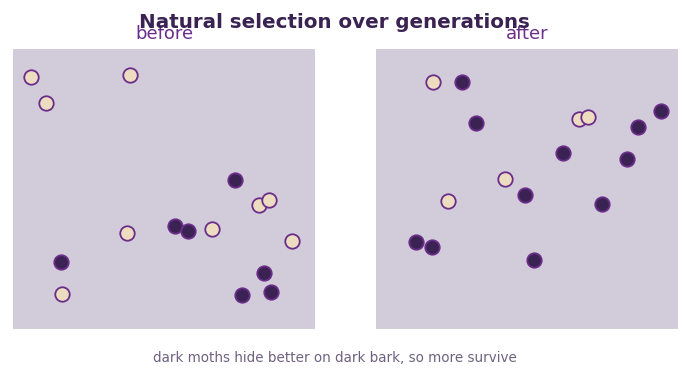
Darwin explained change by natural selection. Individuals vary, and more are born than can survive. Those better suited to their surroundings, the fitter ones, survive and leave more offspring. Over many generations this shifts the features of the population and produces adaptation to the environment.
|
Diagram 2 – Natural Selection
Fig 2. When dark moths hide better on dark bark, more of them survive, so the population becomes darker over time. |
4. Variation and Selection |
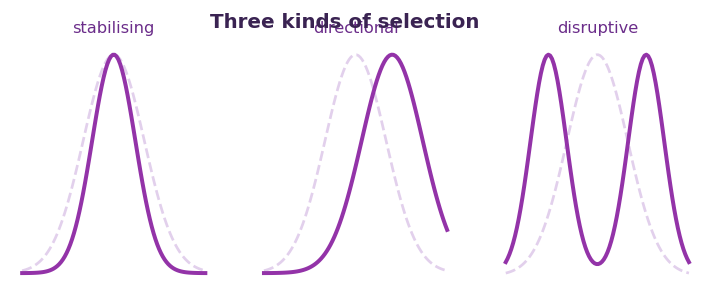
Variation is the raw material of evolution and comes from mutation and the reshuffling of genes. Selection can act in different ways. It can be stabilising, favouring the middle, directional, favouring one extreme, or disruptive, favouring both extremes over the middle.
|
Diagram 3 – Kinds of Selection
Fig 3. Selection may favour the middle, shift towards one extreme, or split the population towards both extremes. |
5. The Hardy Weinberg Principle |
The Hardy Weinberg principle describes a population that is not changing. In a large population with no disturbing forces, the allele frequencies stay constant, written p plus q equals 1, and the genotype frequencies are p squared, 2 p q and q squared. Real change comes when a force acts: mutation, gene flow by migration, genetic drift by chance, or natural selection.
6. Human Evolution |
Humans share a common ancestry with the apes. The fossil record shows a series of ancestral forms, with gradual changes such as upright walking, a larger brain and the use of tools, leading over a long time to modern humans.
7. Key Reasoning (Principles) |
|
Principle 1: Life arose by descent with modification The diversity of living things is the outcome of long descent from earlier forms with steady change, recorded in fossils and in shared structures. |
|
Principle 2: Natural selection shapes populations Variation together with the differential survival of the fitter individuals shifts the features of a population and produces adaptation over generations. |
|
Principle 3: Allele frequencies stay put unless disturbed A large undisturbed population keeps constant allele frequencies, and change comes only when mutation, gene flow, drift or selection acts. |
8. Worked Examples |
| Example 1 |
|
Q: What did the Miller and Urey experiment show? Show SolutionIt copied the early atmosphere. Answer: That organic molecules can form from simple chemicals. |
| Example 2 |
|
Q: What are homologous organs evidence of? Show SolutionSame plan, different use. Answer: Common ancestry. |
| Example 3 |
|
Q: What are analogous organs evidence of? Show SolutionDifferent plan, same use. Answer: Similar function, not common ancestry. |
| Example 4 |
|
Q: What is the main mechanism of evolution by Darwin? Show SolutionThe fitter survive. Answer: Natural selection. |
| Example 5 |
|
Q: Where does variation come from? Show SolutionTwo main sources. Answer: Mutation and the reshuffling of genes. |
| Example 6 |
|
Q: Name the three kinds of selection. Show SolutionFavouring middle or extremes. Answer: Stabilising, directional and disruptive. |
| Example 7 |
|
Q: When do allele frequencies stay constant? Show SolutionA large undisturbed population. Answer: Under the Hardy Weinberg principle. |
| Example 8 |
|
Q: Name one force that changes allele frequencies. Show SolutionIt disturbs the population. Answer: Mutation (or gene flow, drift or selection). |
| Example 9 |
|
Q: A recessive disorder has a frequency of 0.01. What is q? Show Solutionq squared is the disorder frequency. Answer: 0.1. |
| Example 10 |
|
Q: With whom do humans share a common ancestry? Show SolutionOur nearest relatives. Answer: The apes. |
9. Practice Sets A to D |
| Set A – Multiple Choice (Basic) |
|
1. Chemical evolution means life arose from: (a) other planets (b) simple chemicals (c) nothing (d) fossils 2. Homologous organs point to: (a) common function (b) common ancestry (c) chance (d) climate 3. The main mechanism of evolution is: (a) natural selection (b) acquired habits (c) migration only (d) drift only 4. Variation comes from mutation and: (a) selection (b) reshuffling of genes (c) fossils (d) climate 5. Hardy Weinberg frequencies stay constant in a population that is: (a) small (b) large and undisturbed (c) migrating (d) mutating Reveal Answers1. (b) simple chemicals. 2. (b) common ancestry. 3. (a) natural selection. 4. (b) reshuffling of genes. 5. (b) large and undisturbed. |
| Set B – Short Answer (Understanding) |
|
1. What is chemical evolution? 2. Distinguish homologous and analogous organs. 3. State Darwin’s idea of natural selection. 4. Name the three kinds of selection. 5. State the Hardy Weinberg principle. Reveal Answers1. The idea that life arose from simple chemicals joining into more complex ones over a long time. 2. Homologous organs share a plan from a common ancestor; analogous organs share only a function. 3. Individuals vary, the fitter survive and reproduce more, and over generations the population changes. 4. Stabilising, directional and disruptive selection. 5. In a large undisturbed population the allele frequencies stay constant, as p plus q equals 1. |
| Set C – Application and Reasoning |
|
1. Why are fossils useful evidence for evolution? 2. Why do homologous organs suggest common ancestry? 3. Why does natural selection lead to adaptation? 4. Why does a small population drift more than a large one? 5. Why does the frequency of a recessive disorder tell us q? Reveal Answers1. They show the forms of past life and how they changed through time, tracing a record of descent. 2. Sharing the same underlying plan is best explained by inheriting it from a shared ancestor. 3. The features that help survival are passed on more often, so the population fits its environment better over time. 4. In a small group chance events can swing the frequencies far more, since a few individuals count for much. 5. The disorder appears only in the double recessive, whose frequency is q squared, so q is its square root. |
| Set D – Higher Order (Challenge) |
|
1. Explain how several lines of evidence together support evolution. 2. Explain the difference between stabilising and directional selection. 3. Explain why the Hardy Weinberg state is a useful baseline. 4. Explain how migration can change allele frequencies. 5. Explain how upright walking marks a step in human evolution. Reveal Answers1. Fossils, shared structures, embryos and molecules all point the same way, so together they make a strong case. 2. Stabilising selection favours the middle and narrows variation, while directional selection favours one extreme and shifts the population. 3. It tells us what to expect with no forces acting, so any departure reveals that a force such as selection is at work. 4. When individuals move between populations they carry alleles with them, adding or removing them and shifting the frequencies. 5. Walking upright freed the hands and changed the body, a clear change seen in the line leading to modern humans. |
|
Chapter Summary
|
|||||||||||||||||||||||||||||||
| Eight Point Exam Quick Check | ||||||||||||||||||||||||||||||||
|
||||||||||||||||||||||||||||||||
|
School Revise Virtual Lab Explore these ideas with interactive simulations and visual tools.
|
|
Class 12 Biology Chapter 6: Evolution, Complete Notes and Practice These free Class 12 Biology notes on Evolution follow the NCERT syllabus and cover the origin of life, the evidence for evolution, Darwin’s natural selection, variation and the Hardy Weinberg principle, with clear diagrams, worked examples and graded practice, free on SchoolRevise.com. |
 Google