Curriculum
Grade XII Biology
Biology Chapters
0/13
-
CH-1 Sexual-Reproduction-Flowering-Plants
 Preview
 -
CH-2 Human-Reproduction
Preview
-
CH-3 Reproductive-Health
Preview
-
CH-4 Inheritance-And-Variation
Preview
-
CH-5 Molecular-Basis-Of-Inheritance
Preview
-
CH-6 Evolution
Preview
-
CH-7 Human-Health-And-Disease
Preview
-
CH-8 Microbes-In-Human-Welfare
Preview
-
CH-9 Biotechnology-Principles
Preview
-
CH-10 Biotechnology-Applications
Preview
-
CH-11 -Organisms-And-Populations
Preview
-
CH-12 Ecosystem
Preview
-
CH-13 -Biodiversity-And-Conservation
Preview
Work Sheets
0/13

CH-5 Molecular-Basis-Of-Inheritance
|
Grade 12 Science | Chapter 5 Molecular Basis of InheritanceThis chapter looks at inheritance at the level of the molecule. It builds the structure of DNA, the proof that DNA is the genetic material, how DNA copies itself, and how its code is read out into RNA and then into protein.
|
|
Contents
|
1. The Structure of DNA |
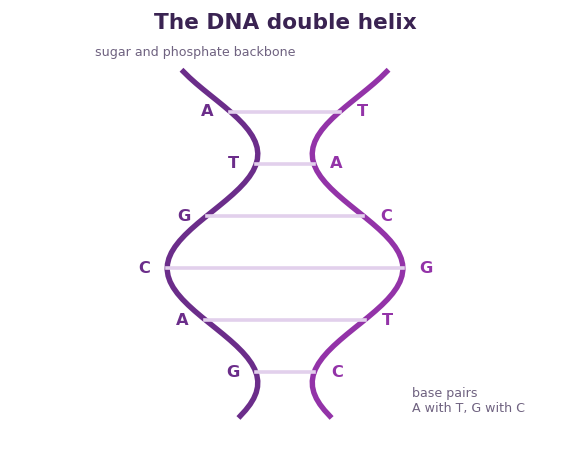
DNA is a double helix, worked out by Watson and Crick. Two strands of nucleotides, each a sugar, a phosphate and a base, wind around each other in opposite directions. The strands are held together by base pairing, where adenine pairs with thymine and guanine pairs with cytosine, and the sugar and phosphate form the backbone.
|
Core idea The two strands carry the same information twice over, because each base pairs with only one partner, and this is the key to both storing and copying the code.
|
|
Diagram 1 – DNA Structure
Fig 1. Two strands wind into a double helix, held by base pairs of A with T and G with C. |
2. DNA as the Genetic Material |
Careful experiments showed that DNA, not protein, carries the code of life. Griffith found that something could pass a trait from dead to living bacteria, and later work by Hershey and Chase, using viruses, showed clearly that it was the DNA that entered and directed the cell.
3. DNA Replication |
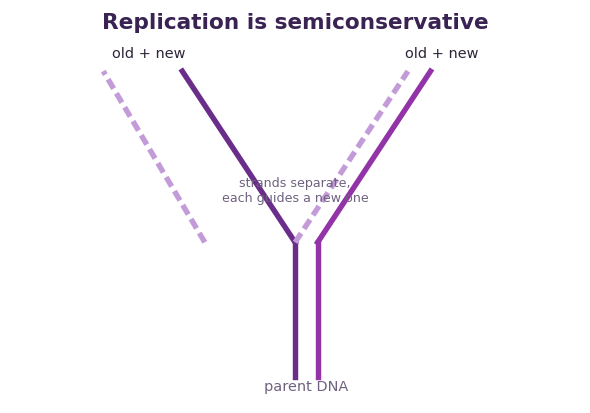
When a cell divides, its DNA must be copied. Replication is semiconservative: the two strands separate, and each acts as a template for building a new partner. So every new DNA molecule has one old strand and one new strand, which Meselson and Stahl confirmed by experiment.
|
Diagram 2 – Replication
Fig 2. The two strands part and each guides the building of a new strand, so each copy keeps one old strand. |
4. Transcription |
To use a gene, its code is first copied from DNA into messenger RNA, a step called transcription. RNA is single stranded and, importantly, it uses the base uracil in place of thymine, so where the DNA reads A the RNA carries U.
5. The Genetic Code and Translation |
The messenger RNA is read in threes. Each triplet, a codon, stands for one amino acid. In translation, a ribosome reads the codons in order and joins the matching amino acids into a protein. The genetic code is nearly the same in all living things, which shows their shared origin.
6. Gene Expression |
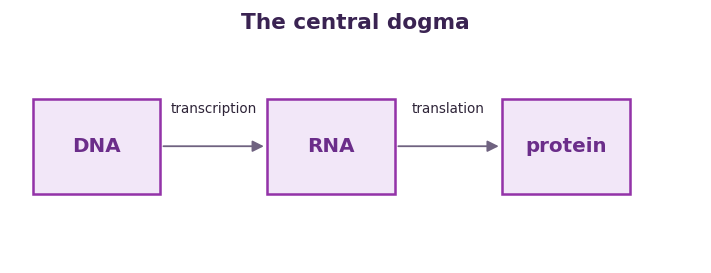
The flow of information, DNA to RNA to protein, is called the central dogma. Cells do not use every gene at once; they switch genes on and off as needed, a control seen clearly in the lac system of bacteria. Reading the whole human genome has opened a new understanding of our biology.
|
Diagram 3 – The Central Dogma
Fig 3. Information flows from DNA to RNA to protein, by transcription and then translation. |
7. Key Reasoning (Principles) |
|
Principle 1: Base pairing stores and copies the code Because each base pairs with only one partner, each strand fixes the other, so DNA can hold information and be copied faithfully. |
|
Principle 2: Replication is semiconservative The strands separate and each templates a new one, so every copy keeps one old strand, which limits errors and preserves the code. |
|
Principle 3: Information flows DNA to RNA to protein The code is transcribed into RNA and then translated into protein, the central path by which a gene shapes a trait. |
8. Worked Examples |
| Example 1 |
|
Q: What is the shape of DNA? Show SolutionTwo strands wound together. Answer: A double helix. |
| Example 2 |
|
Q: With which base does adenine pair in DNA? Show SolutionThe base pairing rule. Answer: Thymine. |
| Example 3 |
|
Q: What did Hershey and Chase show? Show SolutionUsing viruses. Answer: That DNA is the genetic material. |
| Example 4 |
|
Q: What kind of replication does DNA use? Show SolutionEach copy keeps one old strand. Answer: Semiconservative. |
| Example 5 |
|
Q: What is the copying of DNA into RNA called? Show SolutionThe first step of using a gene. Answer: Transcription. |
| Example 6 |
|
Q: Which base does RNA use in place of thymine? Show SolutionNot found in DNA. Answer: Uracil. |
| Example 7 |
|
Q: How many bases make a codon? Show SolutionRead in threes. Answer: Three. |
| Example 8 |
|
Q: What does a codon stand for? Show SolutionThe building block of protein. Answer: An amino acid. |
| Example 9 |
|
Q: What is the building of protein from RNA called? Show SolutionDone by ribosomes. Answer: Translation. |
| Example 10 |
|
Q: State the central dogma. Show SolutionThe flow of information. Answer: DNA to RNA to protein. |
9. Practice Sets A to D |
| Set A – Multiple Choice (Basic) |
|
1. DNA is shaped as a: (a) single line (b) double helix (c) sphere (d) sheet 2. In DNA, guanine pairs with: (a) adenine (b) thymine (c) cytosine (d) uracil 3. DNA replication is: (a) conservative (b) semiconservative (c) random (d) none 4. RNA uses in place of thymine the base: (a) adenine (b) uracil (c) guanine (d) cytosine 5. A codon is made of this many bases: (a) one (b) two (c) three (d) four Reveal Answers1. (b) double helix. 2. (c) cytosine. 3. (b) semiconservative. 4. (b) uracil. 5. (c) three. |
| Set B – Short Answer (Understanding) |
|
1. Describe the structure of DNA. 2. How was DNA shown to be the genetic material? 3. Why is replication called semiconservative? 4. What is transcription? 5. What happens in translation? Reveal Answers1. Two strands of nucleotides wound into a double helix, held by base pairs of A with T and G with C. 2. Experiments such as those of Hershey and Chase showed that DNA, not protein, enters and directs the cell. 3. Each new molecule keeps one old strand and gains one new one, so half is conserved. 4. The copying of a gene from DNA into messenger RNA, which uses uracil in place of thymine. 5. A ribosome reads the codons of the messenger RNA and joins the matching amino acids into a protein. |
| Set C – Application and Reasoning |
|
1. Why does base pairing allow faithful copying? 2. Why must the two strands run in opposite directions matter for pairing? 3. Why does semiconservative replication reduce errors? 4. Why is a triplet code needed to name twenty amino acids? 5. Why is the near universal code strong evidence for common ancestry? Reveal Answers1. Each base has only one partner, so an old strand exactly fixes the new one that is built against it. 2. The bases can only meet and pair properly when the strands lie in opposite directions along their length. 3. Keeping one proven old strand as a template means the new strand is checked against a correct copy. 4. Pairs of bases give only sixteen combinations, too few, while triplets give sixty four, more than enough for twenty. 5. If very different organisms use the same code, they most likely inherited it from a single shared ancestor. |
| Set D – Higher Order (Challenge) |
|
1. Explain how the double helix suits DNA to storing and copying information. 2. Explain the experimental logic that DNA is the genetic material. 3. Explain how semiconservative replication was demonstrated. 4. Explain the path from a gene to a protein. 5. Explain why cells switch genes on and off. Reveal Answers1. Two paired strands store the code twice and, on separating, each serves as a template to make an exact new partner. 2. By labelling DNA and protein separately and seeing which entered the cell, the DNA was shown to carry the instructions. 3. By following the density of DNA through generations, each copy was shown to keep one old and gain one new strand. 4. The gene is transcribed into messenger RNA, whose codons are then translated by a ribosome into a chain of amino acids. 5. A cell needs different proteins at different times, so it turns genes on only when their products are required. |
|
Chapter Summary
|
|||||||||||||||||||||||||||||||
| Eight Point Exam Quick Check | ||||||||||||||||||||||||||||||||
|
||||||||||||||||||||||||||||||||
|
School Revise Virtual Lab Explore these ideas with interactive simulations and visual tools.
|
|
Class 12 Biology Chapter 5: Molecular Basis of Inheritance, Complete Notes and Practice These free Class 12 Biology notes on the Molecular Basis of Inheritance follow the NCERT syllabus and cover DNA structure, replication, transcription, the genetic code and translation, with worked examples and graded practice, free on SchoolRevise.com. |
 Google