Curriculum
Grade XII Biology
Biology Chapters
0/13
-
CH-1 Sexual-Reproduction-Flowering-Plants
 Preview
 -
CH-2 Human-Reproduction
Preview
-
CH-3 Reproductive-Health
Preview
-
CH-4 Inheritance-And-Variation
Preview
-
CH-5 Molecular-Basis-Of-Inheritance
Preview
-
CH-6 Evolution
Preview
-
CH-7 Human-Health-And-Disease
Preview
-
CH-8 Microbes-In-Human-Welfare
Preview
-
CH-9 Biotechnology-Principles
Preview
-
CH-10 Biotechnology-Applications
Preview
-
CH-11 -Organisms-And-Populations
Preview
-
CH-12 Ecosystem
Preview
-
CH-13 -Biodiversity-And-Conservation
Preview
Work Sheets
0/13

CH-13 -Biodiversity-And-Conservation
|
Grade 12 Science | Chapter 13 Biodiversity and ConservationBiodiversity is the great variety of life on Earth. This chapter builds its levels and patterns, why it matters, what is causing its loss, and how we conserve it, both in the natural home and away from it.
|
|
Contents
|
1. What Biodiversity Is |
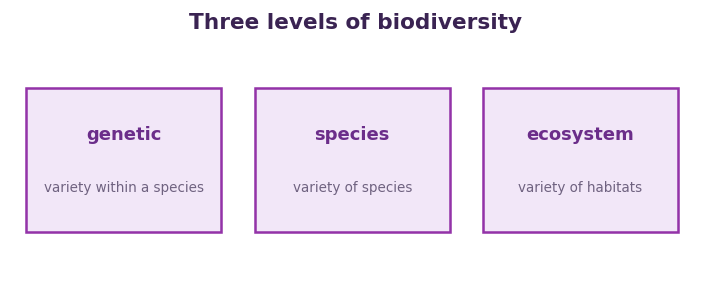
Biodiversity is the variety of all life. It has three levels. Genetic diversity is the variety within a single species. Species diversity is the variety of different species. Ecosystem diversity is the variety of habitats, from forests to reefs, each with its own community.
|
Core idea Life comes in a vast variety, from the genes within a species to whole ecosystems, and this variety is valuable and now under threat, so it must be conserved.
|
|
Diagram 1 – Levels of Biodiversity
Fig 1. Biodiversity runs from the genes within one species, to many species, to whole ecosystems. |
2. Patterns of Biodiversity |
Biodiversity is not spread evenly. There is far more life in the tropics than towards the poles, a pattern called the latitudinal gradient. Larger areas also tend to hold more species, the species area relationship. So warm, wet, large regions are the richest in life.
3. Why It Matters |
Biodiversity is valuable in several ways. It has ecological value, giving stable, productive ecosystems and services such as clean air and water. It has economic value, as the source of our food, medicines and materials. And it has ethical value, for every species has a worth of its own and a right to exist.
4. Loss of Biodiversity |
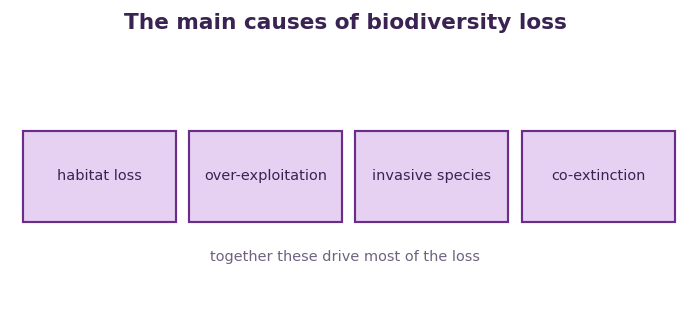
Species are being lost far faster than is natural. The main causes are often called the evil quartet: habitat loss, as wild places are cleared, over exploitation, as species are taken faster than they recover, invasive species, which crowd out natives, and co extinction, when one species lost takes another with it.
|
Diagram 2 – Causes of Loss
Fig 2. Four main causes, the evil quartet, drive most of the loss of biodiversity today. |
5. Conservation In the Home |
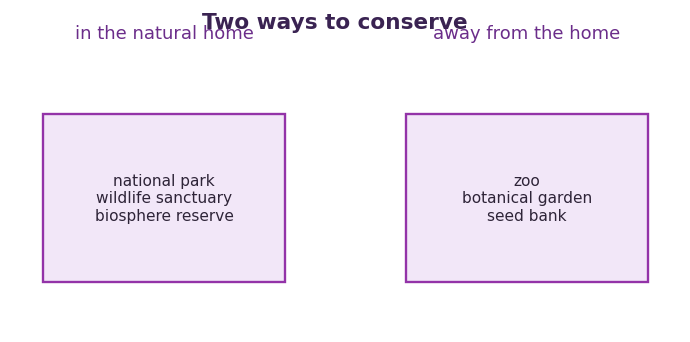
In situ conservation protects species in their natural home. It is done through national parks, wildlife sanctuaries and biosphere reserves, where whole habitats are guarded. Areas that are especially rich yet under threat, the biodiversity hotspots, are given priority for protection.
|
Diagram 3 – Two Ways to Conserve
Fig 3. In situ conservation protects species in their home, while ex situ protects them away from it. |
6. Conservation Away From Home |
Ex situ conservation protects species away from their home, when their habitat is not safe. It uses zoos, botanical gardens and seed banks, which keep animals, plants and seeds safe and can help breed and later return them. Community efforts, such as protecting sacred groves, also help.
7. Key Reasoning (Principles) |
|
Principle 1: Biodiversity has three levels It runs from genetic diversity within a species, through species diversity, to ecosystem diversity, so it must be understood and protected at every level. |
|
Principle 2: Biodiversity is valuable and threatened It has ecological, economic and ethical value, yet the evil quartet of causes is driving its loss far faster than nature can replace it. |
|
Principle 3: Conservation is in situ or ex situ We protect species in their natural home through parks and reserves, and away from home through zoos, gardens and seed banks when needed. |
8. Worked Examples |
| Example 1 |
|
Q: Name the three levels of biodiversity. Show SolutionFrom genes to habitats. Answer: Genetic, species and ecosystem diversity. |
| Example 2 |
|
Q: Where is biodiversity richest? Show SolutionWarm and wet. Answer: In the tropics. |
| Example 3 |
|
Q: What is the species area relationship? Show SolutionBigger areas. Answer: Larger areas tend to hold more species. |
| Example 4 |
|
Q: Give one economic value of biodiversity. Show SolutionUseful products. Answer: It is a source of food, medicines or materials. |
| Example 5 |
|
Q: Name the four causes of loss. Show SolutionThe evil quartet. Answer: Habitat loss, over exploitation, invasive species and co extinction. |
| Example 6 |
|
Q: What is in situ conservation? Show SolutionIn the home. Answer: Protecting species in their natural home. |
| Example 7 |
|
Q: Give one in situ method. Show SolutionA protected area. Answer: A national park (or sanctuary or biosphere reserve). |
| Example 8 |
|
Q: What is ex situ conservation? Show SolutionAway from home. Answer: Protecting species away from their natural home. |
| Example 9 |
|
Q: Give one ex situ method. Show SolutionOff site protection. Answer: A zoo (or botanical garden or seed bank). |
| Example 10 |
|
Q: What is a biodiversity hotspot? Show SolutionRich yet threatened. Answer: A region rich in species and under threat, given priority. |
9. Practice Sets A to D |
| Set A – Multiple Choice (Basic) |
|
1. The variety within a species is: (a) species diversity (b) genetic diversity (c) ecosystem diversity (d) none 2. Biodiversity is richest: (a) at the poles (b) in the tropics (c) in deserts (d) on mountains 3. Larger areas hold: (a) fewer species (b) more species (c) the same (d) no species 4. A cause in the evil quartet is: (a) rainfall (b) habitat loss (c) sunlight (d) tides 5. A national park is a method of: (a) ex situ (b) in situ (c) neither (d) both Reveal Answers1. (b) genetic diversity. 2. (b) in the tropics. 3. (b) more species. 4. (b) habitat loss. 5. (b) in situ. |
| Set B – Short Answer (Understanding) |
|
1. List the three levels of biodiversity. 2. State the latitudinal gradient. 3. Name the values of biodiversity. 4. List the evil quartet. 5. Distinguish in situ and ex situ conservation. Reveal Answers1. Genetic, species and ecosystem diversity. 2. Biodiversity increases from the poles towards the tropics. 3. Ecological, economic and ethical value. 4. Habitat loss, over exploitation, invasive species and co extinction. 5. In situ protects species in their natural home; ex situ protects them away from it. |
| Set C – Application and Reasoning |
|
1. Why is genetic diversity within a species important? 2. Why are the tropics so rich in life? 3. Why does habitat loss cause so much extinction? 4. Why can an invasive species harm natives? 5. Why is ex situ conservation sometimes needed? Reveal Answers1. It gives a species the variety to adapt to change and resist disease, so it is more likely to survive. 2. Their warm, wet and stable conditions over long times have allowed many species to arise and persist. 3. When a home is cleared the species that depend on it lose their food and shelter and cannot survive. 4. It may have no natural checks in the new place, so it spreads and crowds out the native species. 5. When a habitat is too damaged to be safe, protecting the species away from it can prevent their loss. |
| Set D – Higher Order (Challenge) |
|
1. Explain how the three levels of biodiversity connect. 2. Explain why biodiversity has ethical as well as practical value. 3. Explain how the evil quartet works together to drive loss. 4. Explain why hotspots are given priority. 5. Explain how in situ and ex situ methods complement each other. Reveal Answers1. Genes make up species and species make up ecosystems, so protecting one level supports the others in turn. 2. Beyond the goods it gives us, every species has a worth of its own and a right to exist, which we ought to respect. 3. Clearing homes, over taking species, spreading invaders and losing partners each add to a loss that together is severe. 4. They hold many species found nowhere else yet face great threat, so protecting them saves the most life for the effort. 5. Parks guard whole habitats in place, while zoos and seed banks safeguard species when their homes are unsafe, so the two work together. |
|
Chapter Summary
|
|||||||||||||||||||||||||||||||
| Eight Point Exam Quick Check | ||||||||||||||||||||||||||||||||
|
||||||||||||||||||||||||||||||||
|
School Revise Virtual Lab Explore these ideas with interactive simulations and visual tools.
|
|
Class 12 Biology Chapter 13: Biodiversity and Conservation, Complete Notes and Practice These free Class 12 Biology notes on Biodiversity and Conservation follow the NCERT syllabus and cover biodiversity levels, its patterns and value, the causes of loss, and in situ and ex situ conservation, with graded practice, free on SchoolRevise.com. |
 Google