Curriculum
Grade XII Biology
Biology Chapters
0/13
-
CH-1 Sexual-Reproduction-Flowering-Plants
 Preview
 -
CH-2 Human-Reproduction
Preview
-
CH-3 Reproductive-Health
Preview
-
CH-4 Inheritance-And-Variation
Preview
-
CH-5 Molecular-Basis-Of-Inheritance
Preview
-
CH-6 Evolution
Preview
-
CH-7 Human-Health-And-Disease
Preview
-
CH-8 Microbes-In-Human-Welfare
Preview
-
CH-9 Biotechnology-Principles
Preview
-
CH-10 Biotechnology-Applications
Preview
-
CH-11 -Organisms-And-Populations
Preview
-
CH-12 Ecosystem
Preview
-
CH-13 -Biodiversity-And-Conservation
Preview
Work Sheets
0/13

CH-11 -Organisms-And-Populations
|
Grade 12 Science | Chapter 11 Organisms and PopulationsThis chapter looks at how living things fit into their surroundings and how their numbers change. It builds the abiotic factors and the ways organisms respond, the attributes of a population, how populations grow, and how species affect one another.
|
|
Contents
|
1. Organisms and Environment |
Every organism lives among abiotic factors, the non living parts of its surroundings, such as temperature, water, light and soil. These factors decide where a species can live. Temperature is often the most important, as it affects the working of the body and sets the range a species can bear.
|
Core idea Organisms are shaped by their environment and respond to it, while their numbers rise and fall as a population under the limits the environment sets.
|
|
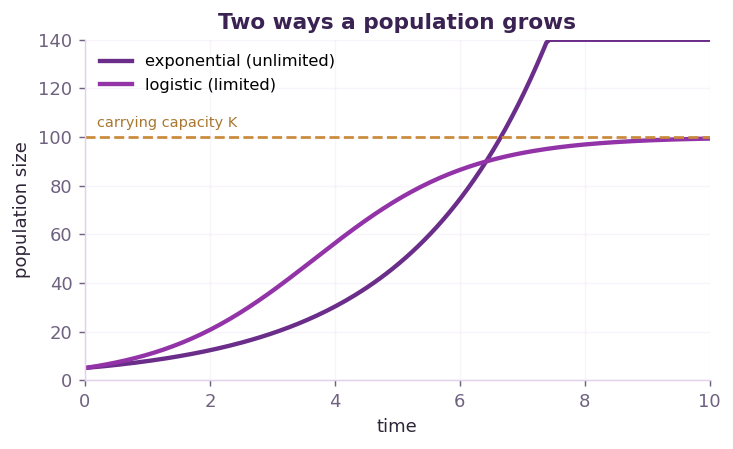
Diagram 1 – Population Growth
Fig 1. With unlimited resources growth is a J-shaped curve, but real limits give an S-shaped curve levelling at the carrying capacity. |
2. Responses to Factors |
Organisms cope with hard conditions in different ways. Some regulate, keeping their inner state steady whatever the outside does, as warm blooded animals keep their temperature. Some conform, letting their inner state change with the surroundings. Some migrate to a better place, and some suspend activity, resting through the bad season.
3. Adaptations |
An adaptation is a feature that helps an organism survive in its habitat. A desert plant stores water and cuts down loss, while a cold climate animal has thick fat and small ears to keep in heat. Such features are the fit between a living thing and its surroundings, built up over many generations.
4. Population Attributes |
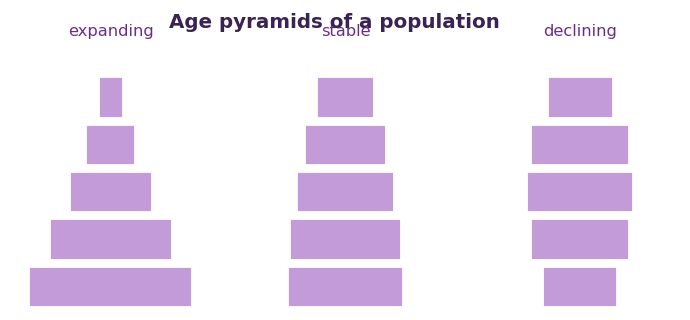
A population is a group of one species living in an area. Unlike a single organism it has attributes of its own: density, the number in a space, a birth rate and a death rate, a sex ratio, and an age distribution, often drawn as an age pyramid that shows whether it is growing, steady or shrinking.
|
Diagram 3 – Age Pyramids
Fig 2. A broad base means a growing population, an even shape a steady one, and a narrow base a shrinking one. |
5. Population Growth |
With unlimited resources a population grows faster and faster, an exponential or J-shaped growth. In reality resources are limited, so growth is logistic, an S-shaped curve that slows and levels off at the carrying capacity, written K, the largest number the environment can support.
6. Species Interactions |
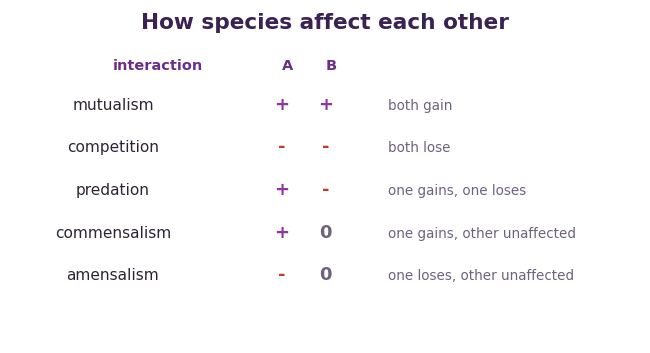
Species affect each other in set ways. Mutualism helps both, competition harms both, and predation and parasitism help one while harming the other. Commensalism helps one and leaves the other unaffected, while amensalism harms one and leaves the other unaffected.
|
Diagram 2 – Interactions
Fig 3. Each interaction can be written as a pair of signs for the two species, from both gaining to both losing. |
7. Key Reasoning (Principles) |
|
Principle 1: The environment shapes and limits life Abiotic factors decide where a species can live, and organisms regulate, conform, migrate or suspend activity to cope, or carry adaptations that fit them to the place. |
|
Principle 2: Populations grow until resources limit them Growth is exponential while resources are plenty, but limits bend it into a logistic curve that levels off at the carrying capacity K. |
|
Principle 3: Species interactions shape communities Each pairing helps or harms the species involved, from mutualism where both gain to competition where both lose, shaping the whole community. |
8. Worked Examples |
| Example 1 |
|
Q: Name the main abiotic factors. Show SolutionThe non living surroundings. Answer: Temperature, water, light and soil. |
| Example 2 |
|
Q: What does a regulator do? Show SolutionIt keeps a steady inner state. Answer: It keeps its internal state steady whatever the outside does. |
| Example 3 |
|
Q: Give one desert adaptation. Show SolutionTo save water. Answer: Storing water and cutting down its loss. |
| Example 4 |
|
Q: What is a population? Show SolutionA group in an area. Answer: A group of one species living in an area. |
| Example 5 |
|
Q: Name two attributes of a population. Show SolutionNot of a single organism. Answer: Density and birth rate (or death rate, sex ratio, age distribution). |
| Example 6 |
|
Q: What shape is exponential growth? Show SolutionUnlimited resources. Answer: A J-shaped curve. |
| Example 7 |
|
Q: What is the carrying capacity? Show SolutionThe environment’s limit. Answer: The largest number the environment can support, K. |
| Example 8 |
|
Q: What is mutualism? Show SolutionBoth benefit. Answer: An interaction that helps both species. |
| Example 9 |
|
Q: What signs describe predation? Show SolutionOne gains, one loses. Answer: Plus for one and minus for the other. |
| Example 10 |
|
Q: What is commensalism? Show SolutionOne gains, one unaffected. Answer: One species gains and the other is unaffected. |
9. Practice Sets A to D |
| Set A – Multiple Choice (Basic) |
|
1. The most important abiotic factor is often: (a) sound (b) temperature (c) colour (d) noise 2. A warm blooded animal keeping its temperature is a: (a) conformer (b) regulator (c) migrant (d) sleeper 3. Exponential growth gives a curve shaped like: (a) S (b) J (c) line (d) circle 4. The largest number an environment supports is the: (a) density (b) carrying capacity (c) sex ratio (d) birth rate 5. An interaction where both gain is: (a) competition (b) mutualism (c) predation (d) amensalism Reveal Answers1. (b) temperature. 2. (b) regulator. 3. (b) J. 4. (b) carrying capacity. 5. (b) mutualism. |
| Set B – Short Answer (Understanding) |
|
1. List the main abiotic factors. 2. Name the four ways organisms respond to hard conditions. 3. What is a population and give two attributes. 4. Distinguish exponential and logistic growth. 5. Give the sign pairs for mutualism and competition. Reveal Answers1. Temperature, water, light and soil. 2. They regulate, conform, migrate or suspend activity. 3. A group of one species in an area; its attributes include density and birth or death rate. 4. Exponential growth is unlimited and J-shaped; logistic growth is limited and S-shaped, levelling at K. 5. Mutualism is plus and plus; competition is minus and minus. |
| Set C – Application and Reasoning |
|
1. Why does temperature set where many species can live? 2. Why might an animal migrate rather than regulate? 3. Why does real population growth level off? 4. Why does a broad based age pyramid mean growth? 5. Why is mutualism common in nature? Reveal Answers1. It affects how the body works, so each species can only bear a certain range of temperature. 2. Regulating costs energy, so where possible moving to a milder place can be an easier way to cope. 3. Resources are limited, so as numbers rise competition slows growth until it stops at the carrying capacity. 4. A wide base means many young, who will grow and reproduce, so the population is set to increase. 5. When both partners gain, the interaction is favoured and tends to spread and persist over time. |
| Set D – Higher Order (Challenge) |
|
1. Explain how the four kinds of response help organisms survive. 2. Explain why the logistic curve is more realistic than the exponential. 3. Explain how age structure predicts a population’s future. 4. Explain how competition can shape which species live together. 5. Explain why the same interaction can be written as a pair of signs. Reveal Answers1. Regulating, conforming, migrating and suspending activity each offer a way to get through conditions the body could not otherwise bear. 2. Resources in nature are limited, so growth must slow and level at the carrying capacity rather than rise without end. 3. A broad base of young signals future growth, an even shape a steady population, and a narrow base a decline to come. 4. When two species need the same limited resource, the stronger competitor may exclude the other or push it to a different niche. 5. Each species is either helped, harmed or unaffected, so a plus, minus or zero for each captures the whole relationship. |
|
Chapter Summary
|
|||||||||||||||||||||||||||||||
| Eight Point Exam Quick Check | ||||||||||||||||||||||||||||||||
|
||||||||||||||||||||||||||||||||
|
School Revise Virtual Lab Explore these ideas with interactive simulations and visual tools.
|
|
Class 12 Biology Chapter 11: Organisms and Populations, Complete Notes and Practice These free Class 12 Biology notes on Organisms and Populations follow the NCERT syllabus and cover abiotic factors, responses and adaptations, population attributes, exponential and logistic growth, and species interactions, with clear diagrams, worked examples and graded practice, free on SchoolRevise.com. |
 Google