Curriculum
Grade XII Biology
Biology Chapters
0/13
-
CH-1 Sexual-Reproduction-Flowering-Plants
 Preview
 -
CH-2 Human-Reproduction
Preview
-
CH-3 Reproductive-Health
Preview
-
CH-4 Inheritance-And-Variation
Preview
-
CH-5 Molecular-Basis-Of-Inheritance
Preview
-
CH-6 Evolution
Preview
-
CH-7 Human-Health-And-Disease
Preview
-
CH-8 Microbes-In-Human-Welfare
Preview
-
CH-9 Biotechnology-Principles
Preview
-
CH-10 Biotechnology-Applications
Preview
-
CH-11 -Organisms-And-Populations
Preview
-
CH-12 Ecosystem
Preview
-
CH-13 -Biodiversity-And-Conservation
Preview
Work Sheets
0/13

CH-9 Biotechnology-Principles
|
Grade 12 Science | Chapter 9 Biotechnology Principles and ProcessesBiotechnology uses living systems to make useful products. This chapter builds the tools of recombinant DNA technology, how a gene is cut and joined into a vector, how it is put into a host cell, and how the product is made on a large scale.
|
|
Contents
|
1. What Biotechnology Is |
Biotechnology is the use of living organisms, or their parts, to make useful products. Modern biotechnology joins two ideas: genetic engineering, which changes the DNA of an organism, and the growing of cells on a large scale to turn out the product. Together they let us make medicines, better crops and much more.
|
Core idea By cutting and pasting genes precisely and then growing the changed cells in large numbers, biotechnology turns a single useful gene into a useful product.
|
|
Diagram 1 – Cutting DNA
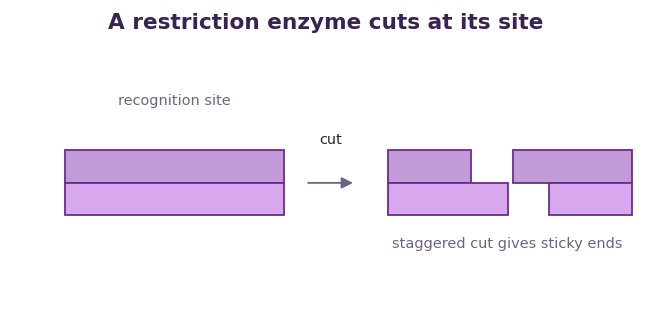
Fig 1. A restriction enzyme cuts DNA at its own site, and a staggered cut leaves matching sticky ends. |
2. Tools of the Trade |
A few key tools make this possible. Restriction enzymes are molecular scissors that cut DNA at a particular sequence, leaving sticky ends. A vector, often a plasmid, is a carrier that ferries a gene into a host. A host cell takes up and copies the DNA, and DNA ligase is the glue that joins pieces of DNA together.
3. Making Recombinant DNA |
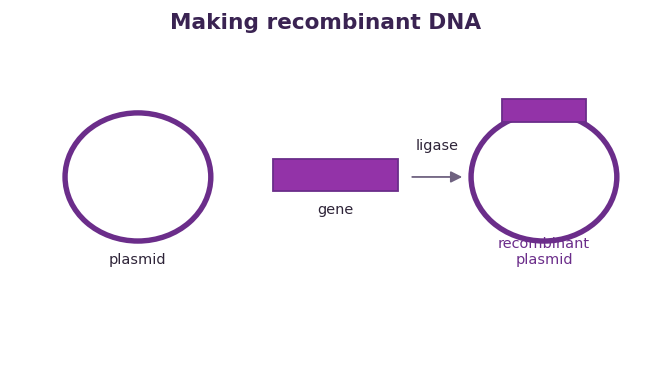
To make recombinant DNA, the wanted gene and the vector are cut with the same restriction enzyme, so their sticky ends match. The gene is then slotted into the vector, and ligase seals the joins. The result is a vector carrying the new gene, ready to be put into a host.
|
Diagram 2 – Recombinant DNA
Fig 2. The gene is joined into the plasmid by ligase, making a recombinant plasmid that carries the new gene. |
4. Into the Host Cell |
The recombinant vector is then put into a host cell, a step called transformation. The host, often a bacterium, now carries the new gene. Cells that have taken up the vector are picked out so that only they are grown on.
5. Cloning and Expression |
The host cell multiplies, and each time it divides it copies the gene, making many identical copies, which is called cloning. The host also expresses the gene, reading it out to make the wanted product, often a useful protein such as a medicine.
6. Bioreactors and Purifying |
To make a product in large amounts, the cells are grown in a bioreactor, a large vessel that gives them the right conditions of food, air and warmth. The product is then separated from the culture and cleaned up, a set of steps called downstream processing, before it is ready to use.
|
Diagram 3 – The Whole Process
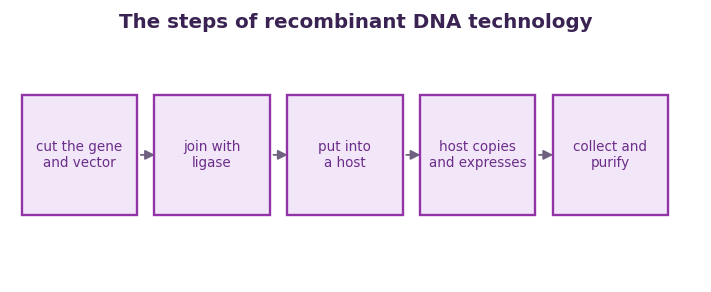
Fig 3. The gene is cut and joined into a vector, put into a host, copied and expressed, then collected and purified. |
7. Key Reasoning (Principles) |
|
Principle 1: Enzymes let us cut and paste genes Restriction enzymes cut DNA at exact sites and ligase joins the pieces, so a gene can be moved precisely from one place to another. |
|
Principle 2: A vector carries the gene into a host The recombinant vector ferries the new gene into a host cell, which then copies it many times and reads it out to make the product. |
|
Principle 3: Large scale needs bioreactors and purifying To make useful amounts, the cells are grown in bioreactors and the product is then separated and cleaned in downstream processing. |
8. Worked Examples |
| Example 1 |
|
Q: What is biotechnology? Show SolutionIt uses living things to make products. Answer: The use of living organisms to make useful products. |
| Example 2 |
|
Q: What do restriction enzymes do? Show SolutionThey act like scissors. Answer: They cut DNA at a particular sequence. |
| Example 3 |
|
Q: What are the ends left by a staggered cut called? Show SolutionThey can rejoin. Answer: Sticky ends. |
| Example 4 |
|
Q: What is a common vector? Show SolutionA small ring of DNA. Answer: A plasmid. |
| Example 5 |
|
Q: Why cut the gene and vector with the same enzyme? Show SolutionThe ends must fit. Answer: So their sticky ends match. |
| Example 6 |
|
Q: What joins the gene into the vector? Show SolutionThe molecular glue. Answer: DNA ligase. |
| Example 7 |
|
Q: What is putting recombinant DNA into a host called? Show SolutionThe host takes it up. Answer: Transformation. |
| Example 8 |
|
Q: What is making many copies of the gene called? Show SolutionThe host multiplies. Answer: Cloning. |
| Example 9 |
|
Q: Where are cells grown in large numbers? Show SolutionA large vessel. Answer: In a bioreactor. |
| Example 10 |
|
Q: What is separating and cleaning the product called? Show SolutionThe final steps. Answer: Downstream processing. |
9. Practice Sets A to D |
| Set A – Multiple Choice (Basic) |
|
1. Restriction enzymes act as: (a) glue (b) scissors (c) carriers (d) hosts 2. A common vector is a: (a) plasmid (b) ribosome (c) mitochondrion (d) nucleus 3. DNA pieces are joined by: (a) restriction enzyme (b) ligase (c) polymerase only (d) protease 4. Putting DNA into a host is called: (a) cloning (b) transformation (c) cutting (d) purifying 5. Cells are grown in large numbers in a: (a) test tube (b) bioreactor (c) plasmid (d) gel Reveal Answers1. (b) scissors. 2. (a) plasmid. 3. (b) ligase. 4. (b) transformation. 5. (b) bioreactor. |
| Set B – Short Answer (Understanding) |
|
1. Define biotechnology. 2. What is a restriction enzyme? 3. Why must the gene and vector be cut with the same enzyme? 4. What is transformation? 5. What is downstream processing? Reveal Answers1. The use of living organisms, or their parts, to make useful products. 2. A molecular scissor that cuts DNA at a particular sequence, often leaving sticky ends. 3. So that both have matching sticky ends and can be joined together neatly. 4. The putting of recombinant DNA into a host cell, which then carries the new gene. 5. The separating and cleaning of the product from the culture after it has been made. |
| Set C – Application and Reasoning |
|
1. Why are sticky ends useful for joining DNA? 2. Why is a plasmid a good vector? 3. Why is a bacterium often chosen as the host? 4. Why must only transformed cells be grown on? 5. Why is a bioreactor needed for large amounts? Reveal Answers1. Their matching single strands pair up, so two pieces cut by the same enzyme slot together easily. 2. It is a small ring of DNA that a host takes up readily and copies along with its own DNA. 3. It grows fast and copies its DNA quickly, so the gene is soon multiplied many times over. 4. Only they carry the new gene, so growing them alone means the whole culture makes the product. 5. It gives many cells the right food, air and warmth at once, so the product is made in useful quantity. |
| Set D – Higher Order (Challenge) |
|
1. Explain how cutting and pasting genes is made precise. 2. Explain the journey of a gene from cutting to product. 3. Explain why the same restriction enzyme is used on both pieces. 4. Explain the difference between cloning and expression. 5. Explain why downstream processing matters. Reveal Answers1. Restriction enzymes cut at exact sequences and ligase joins the matching ends, so the gene is moved with precision. 2. The gene is cut out, joined into a vector, put into a host, copied as the host divides, and read out to make the product. 3. It gives both pieces the same sticky ends, so they pair and join cleanly rather than in the wrong way. 4. Cloning makes many copies of the gene, while expression reads a copy out to make the actual product. 5. The raw culture is impure, so separating and cleaning the product is essential before it can be safely used. |
|
Chapter Summary
|
|||||||||||||||||||||||||||||||
| Eight Point Exam Quick Check | ||||||||||||||||||||||||||||||||
|
||||||||||||||||||||||||||||||||
|
School Revise Virtual Lab Explore these ideas with interactive simulations and visual tools.
|
|
Class 12 Biology Chapter 9: Biotechnology Principles and Processes, Complete Notes and Practice These free Class 12 Biology notes on Biotechnology Principles and Processes follow the NCERT syllabus and cover restriction enzymes, vectors, making recombinant DNA, host cells and bioreactors, with clear diagrams, worked examples and graded practice, free on SchoolRevise.com. |
 Google