Curriculum
Grade XII Biology
Biology Chapters
0/13
-
CH-1 Sexual-Reproduction-Flowering-Plants
 Preview
 -
CH-2 Human-Reproduction
Preview
-
CH-3 Reproductive-Health
Preview
-
CH-4 Inheritance-And-Variation
Preview
-
CH-5 Molecular-Basis-Of-Inheritance
Preview
-
CH-6 Evolution
Preview
-
CH-7 Human-Health-And-Disease
Preview
-
CH-8 Microbes-In-Human-Welfare
Preview
-
CH-9 Biotechnology-Principles
Preview
-
CH-10 Biotechnology-Applications
Preview
-
CH-11 -Organisms-And-Populations
Preview
-
CH-12 Ecosystem
Preview
-
CH-13 -Biodiversity-And-Conservation
Preview
Work Sheets
0/13

CH-12 Ecosystem
|
Grade 12 Science | Chapter 12 EcosystemAn ecosystem is a community of living things and their surroundings working as a unit. This chapter builds its components, how much its producers make, how energy flows through food chains, the ecological pyramids, and how nutrients cycle round.
|
|
Contents
|
1. What an Ecosystem Is |
An ecosystem is all the living things in an area, the biotic part, together with their non living surroundings, the abiotic part, working as one unit. Its structure is what is present, and its function is how energy flows and nutrients cycle through it.
|
Core idea An ecosystem ties the living and the non living together. Energy flows through it in one direction, while the matter it is built from is cycled round again and again.
|
|
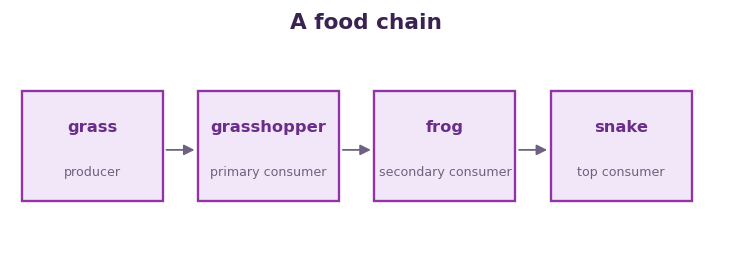
Diagram 1 – A Food Chain
Fig 1. Energy passes along a food chain from the producer through the consumers, level by level. |
2. Productivity |
Producers, the green plants, capture sunlight and make food. The rate at which they do this is the primary productivity. The total made is the gross primary productivity, and what is left after the plants use some for themselves is the net primary productivity, the food available to everything else.
3. Decomposition |
Decomposition is the breakdown of dead matter. Decomposers, mainly bacteria and fungi, break down dead plants and animals into simple substances, returning their nutrients to the soil. Without them nutrients would stay locked in dead matter and the cycle would stop.
4. Energy Flow |
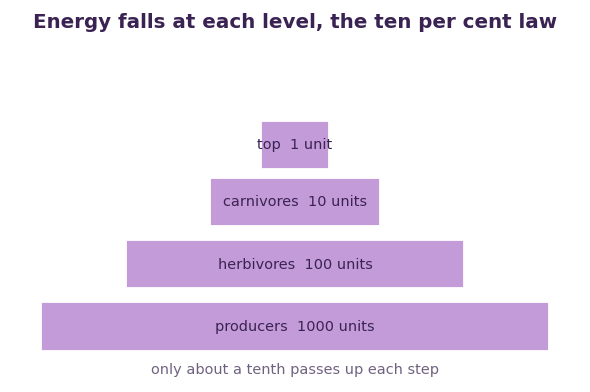
Energy enters as sunlight, captured by producers, and passes along a food chain through trophic levels: producer, then herbivore, then carnivore. Energy flows one way and much is lost as heat at each step, so only about ten per cent passes to the next level. This is the ten per cent law.
|
Diagram 2 – The Ten Per Cent Law
Fig 2. At each step most energy is lost, so only about a tenth passes up, which is why chains are short. |
5. Ecological Pyramids |
The trophic levels can be drawn as ecological pyramids of number, biomass or energy. The pyramid of energy is always upright, narrowing upward, because energy falls at every step. Pyramids of number or biomass can sometimes be inverted, but the energy pyramid never is.
6. Nutrient Cycling |
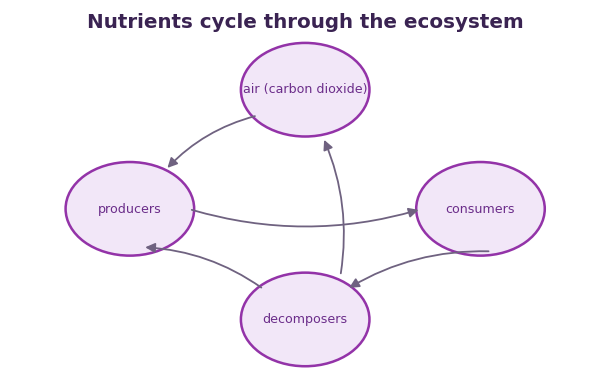
While energy flows through and is lost, the nutrients cycle round and are used again. Carbon, for example, moves from the air into producers, along to consumers, and back to the air and soil through respiration and decomposers. Ecosystems also give us services, such as clean air and water and the pollination of crops.
|
Diagram 3 – Nutrient Cycling
Fig 3. Nutrients pass from the air to producers, on to consumers, and back through decomposers, cycling round. |
7. Key Reasoning (Principles) |
|
Principle 1: Living and non living work as one An ecosystem joins its biotic and abiotic parts into a single working unit, with a structure of what is present and a function of energy flow and cycling. |
|
Principle 2: Energy flows one way and thins out Energy enters as sunlight and passes up the trophic levels, but most is lost as heat at each step, so only about a tenth reaches the next level. |
|
Principle 3: Matter cycles while energy flows Nutrients are returned by decomposers and used again and again, so matter cycles round even as energy flows through and is lost. |
8. Worked Examples |
| Example 1 |
|
Q: What two parts make up an ecosystem? Show SolutionLiving and non living. Answer: The biotic and the abiotic parts. |
| Example 2 |
|
Q: What captures the sunlight in an ecosystem? Show SolutionThe green organisms. Answer: The producers. |
| Example 3 |
|
Q: What is net primary productivity? Show SolutionAfter the plants’ own use. Answer: The food producers make that is left for others. |
| Example 4 |
|
Q: Who breaks down dead matter? Show SolutionBacteria and fungi. Answer: The decomposers. |
| Example 5 |
|
Q: In which direction does energy flow? Show SolutionIt is not cycled. Answer: One way, from producers upward. |
| Example 6 |
|
Q: About how much energy passes to the next level? Show SolutionMost is lost as heat. Answer: About ten per cent. |
| Example 7 |
|
Q: Which ecological pyramid is always upright? Show SolutionEnergy falls each step. Answer: The pyramid of energy. |
| Example 8 |
|
Q: Give one nutrient that cycles. Show SolutionIt moves through air and living things. Answer: Carbon. |
| Example 9 |
|
Q: Why are food chains short? Show SolutionEnergy runs low. Answer: Because so little energy passes up each level. |
| Example 10 |
|
Q: Name one service an ecosystem provides. Show SolutionBeyond food. Answer: Clean air (or water, or pollination). |
9. Practice Sets A to D |
| Set A – Multiple Choice (Basic) |
|
1. The living part of an ecosystem is the: (a) abiotic (b) biotic (c) mineral (d) climate 2. Producers capture: (a) sound (b) sunlight (c) soil (d) rain 3. Dead matter is broken down by: (a) producers (b) decomposers (c) herbivores (d) carnivores 4. Energy passing to the next level is about: (a) 1 percent (b) 10 percent (c) 50 percent (d) 90 percent 5. The always upright pyramid is of: (a) number (b) biomass (c) energy (d) water Reveal Answers1. (b) biotic. 2. (b) sunlight. 3. (b) decomposers. 4. (b) 10 percent. 5. (c) energy. |
| Set B – Short Answer (Understanding) |
|
1. What is an ecosystem? 2. What is net primary productivity? 3. What do decomposers do? 4. State the ten per cent law. 5. Why is the energy pyramid always upright? Reveal Answers1. All the living things in an area with their non living surroundings, working as one unit. 2. The food producers make that is left after their own use, available to the rest of the ecosystem. 3. They break down dead matter into simple substances, returning nutrients to the soil. 4. Only about ten per cent of the energy at one trophic level passes to the next. 5. Energy falls at every step, so each level always holds less than the one below it. |
| Set C – Application and Reasoning |
|
1. Why does an ecosystem need both producers and decomposers? 2. Why can energy not be cycled like nutrients? 3. Why are there rarely more than a few trophic levels? 4. Why can a pyramid of number sometimes be inverted? 5. Why do ecosystems matter to human life? Reveal Answers1. Producers bring energy in and decomposers return nutrients, so together they keep both energy flow and cycling going. 2. Energy is lost as heat at each step and cannot be reused, while matter stays and can be passed round again. 3. So little energy reaches each higher level that soon there is too little to support another one. 4. A single large producer, such as one tree, can feed many small consumers, so the numbers can invert. 5. They give us food, clean air and water, pollination and much more, so our lives depend upon them. |
| Set D – Higher Order (Challenge) |
|
1. Explain how energy flow and nutrient cycling differ. 2. Explain why net productivity, not gross, feeds the ecosystem. 3. Explain how the ten per cent law limits food chain length. 4. Explain why the energy pyramid cannot be inverted. 5. Explain how decomposers keep an ecosystem running. Reveal Answers1. Energy flows one way and is lost as heat, while nutrients are returned by decomposers and used over and over. 2. The plants use some of what they make for themselves, so only the net amount is left for other living things. 3. Because only a tenth passes up each step, energy soon runs too low to support more levels, keeping chains short. 4. Since energy falls at every step, each level must hold less than the one below, so the shape is always upright. 5. They free the nutrients locked in dead matter and return them to the soil, so producers can grow again. |
|
Chapter Summary
|
|||||||||||||||||||||||||||||||
| Eight Point Exam Quick Check | ||||||||||||||||||||||||||||||||
|
||||||||||||||||||||||||||||||||
|
School Revise Virtual Lab Explore these ideas with interactive simulations and visual tools.
|
|
Class 12 Biology Chapter 12: Ecosystem, Complete Notes and Practice These free Class 12 Biology notes on the Ecosystem follow the NCERT syllabus and cover its components, productivity, decomposition, energy flow and the ten per cent law, ecological pyramids and nutrient cycling, with worked examples and graded practice, free on SchoolRevise.com. |
 Google