Curriculum
Grade XII Biology
Biology Chapters
0/13
-
CH-1 Sexual-Reproduction-Flowering-Plants
 Preview
 -
CH-2 Human-Reproduction
Preview
-
CH-3 Reproductive-Health
Preview
-
CH-4 Inheritance-And-Variation
Preview
-
CH-5 Molecular-Basis-Of-Inheritance
Preview
-
CH-6 Evolution
Preview
-
CH-7 Human-Health-And-Disease
Preview
-
CH-8 Microbes-In-Human-Welfare
Preview
-
CH-9 Biotechnology-Principles
Preview
-
CH-10 Biotechnology-Applications
Preview
-
CH-11 -Organisms-And-Populations
Preview
-
CH-12 Ecosystem
Preview
-
CH-13 -Biodiversity-And-Conservation
Preview
Work Sheets
0/13

CH-4 Inheritance-And-Variation
|
Grade 12 Science | Chapter 4 Principles of Inheritance and VariationInheritance is how features pass from parents to offspring. This chapter builds Mendel’s laws from his pea experiments, the monohybrid and dihybrid crosses, genes on chromosomes and linkage, sex determination, and how mutation brings variation and some disorders.
|
|
Contents
|
1. Mendel and His Peas |
Gregor Mendel worked out the rules of inheritance by studying the garden pea. He chose clear contrasting features, such as tall and short plants, crossed pure breeding lines, and carefully counted the offspring over generations. His counts revealed simple, repeating ratios that pointed to hidden units of inheritance, which we now call genes.
|
Core idea A feature is controlled by a pair of factors, now called alleles, one from each parent. One allele can mask the other, and the pair separates when gametes are made.
|
|
Diagram 1 – Monohybrid Cross
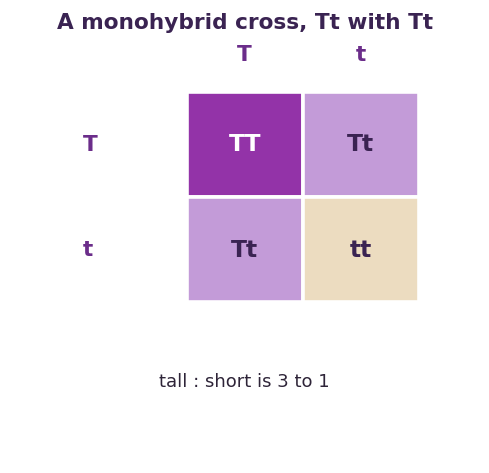
Fig 1. Crossing two Tt plants gives tall and short offspring in a ratio of three to one. |
2. Dominance and Segregation |
In a monohybrid cross, following one feature, the first generation all look like one parent. This is the law of dominance: one allele, the dominant one, masks the other, the recessive one. In the next generation both reappear in a ratio of three to one. This is the law of segregation: the two alleles of a pair separate cleanly into different gametes.
3. Independent Assortment |
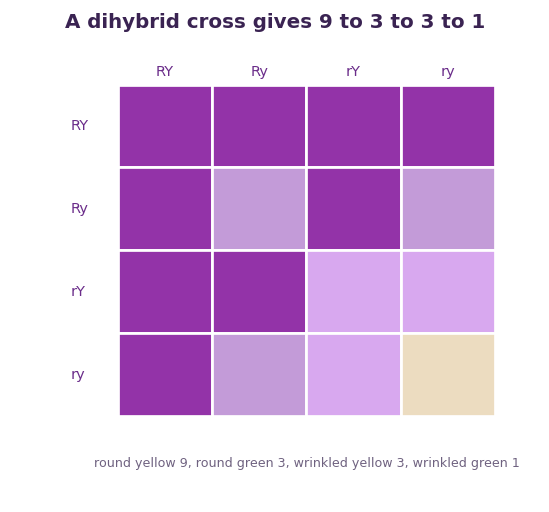
Following two features at once gives a dihybrid cross. The second generation appears in a ratio of nine to three to three to one. This is the law of independent assortment: the alleles for one feature separate into gametes independently of the alleles for another, so the features mix freely.
|
Diagram 2 – Dihybrid Cross
Fig 2. Following two features gives four kinds of offspring in a ratio of nine to three to three to one. |
4. Genes and Linkage |
Genes sit on chromosomes, and this chromosomal theory explains Mendel’s rules, since chromosomes separate into gametes just as the alleles do. Genes that lie close together on the same chromosome tend to be passed on together, an effect called linkage, which is an exception to independent assortment.
5. Sex Determination |
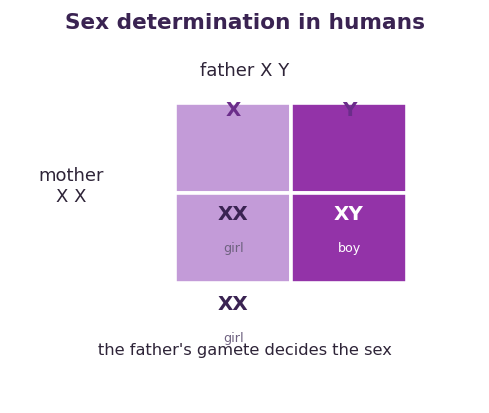
In humans, sex is decided by the chromosomes. A female has two X chromosomes and a male has one X and one Y. All eggs carry an X, while sperm carry either an X or a Y, so it is the father’s gamete that decides the sex of the child, with an even chance of each.
|
Diagram 3 – Sex Determination
Fig 3. The mother gives an X, and whether the father gives an X or a Y decides the sex, with equal chance. |
6. Mutation and Disorders |
A change in the DNA is a mutation, and it is a source of new variation. Most are harmless, but some cause genetic disorders. A few examples are colour blindness and haemophilia, which are carried on the X chromosome, sickle cell anaemia, from a single change in a gene, and Down syndrome, caused by an extra chromosome.
7. Key Reasoning (Principles) |
|
Principle 1: Alleles separate and recombine Each pair of alleles separates into different gametes, and fertilisation brings a new pair together, which is the heart of the law of segregation. |
|
Principle 2: Features assort independently The alleles for one feature usually separate independently of those for another, so features mix freely, unless their genes are linked on the same chromosome. |
|
Principle 3: Variation drives inheritance New combinations at fertilisation and changes in the DNA by mutation both create variation, the raw material on which inheritance and evolution work. |
8. Worked Examples |
| Example 1 |
|
Q: What plant did Mendel study? Show SolutionA common garden plant. Answer: The garden pea. |
| Example 2 |
|
Q: What is the F2 ratio of a monohybrid cross? Show SolutionOne feature, two forms. Answer: Three to one. |
| Example 3 |
|
Q: State the law of dominance. Show SolutionOne allele hides the other. Answer: The dominant allele masks the recessive one. |
| Example 4 |
|
Q: State the law of segregation. Show SolutionThe pair splits. Answer: The two alleles of a pair separate into different gametes. |
| Example 5 |
|
Q: What is the F2 ratio of a dihybrid cross? Show SolutionTwo features together. Answer: Nine to three to three to one. |
| Example 6 |
|
Q: What is linkage? Show SolutionGenes travel together. Answer: Genes close on a chromosome are inherited together. |
| Example 7 |
|
Q: Which parent’s gamete decides the sex of a child? Show SolutionOne gives only X, the other X or Y. Answer: The father’s. |
| Example 8 |
|
Q: What are the sex chromosomes of a human male? Show SolutionOne of each kind. Answer: X and Y. |
| Example 9 |
|
Q: What is a mutation? Show SolutionA change in the code. Answer: A change in the DNA. |
| Example 10 |
|
Q: Name one disorder carried on the X chromosome. Show SolutionIt affects clotting or colour vision. Answer: Haemophilia (or colour blindness). |
9. Practice Sets A to D |
| Set A – Multiple Choice (Basic) |
|
1. Mendel studied inheritance in the: (a) fruit fly (b) garden pea (c) mouse (d) bacterium 2. The F2 ratio of a monohybrid cross is: (a) 1 to 1 (b) 3 to 1 (c) 9 to 3 to 3 to 1 (d) 2 to 1 3. The dihybrid F2 ratio is: (a) 3 to 1 (b) 1 to 1 (c) 9 to 3 to 3 to 1 (d) 2 to 2 4. A human female has: (a) XY (b) XX (c) YY (d) X only 5. A change in the DNA is a: (a) gene (b) mutation (c) allele (d) trait Reveal Answers1. (b) garden pea. 2. (b) 3 to 1. 3. (c) 9 to 3 to 3 to 1. 4. (b) XX. 5. (b) mutation. |
| Set B – Short Answer (Understanding) |
|
1. What is an allele? 2. State the law of dominance. 3. State the law of segregation. 4. What is independent assortment? 5. How is sex determined in humans? Reveal Answers1. One of the alternative forms of a gene for a feature, one inherited from each parent. 2. In a pair of alleles the dominant one masks the recessive one in appearance. 3. The two alleles of a pair separate cleanly into different gametes. 4. The alleles for one feature separate independently of those for another. 5. By the sex chromosomes; XX is female and XY is male, and the father’s gamete decides it. |
| Set C – Application and Reasoning |
|
1. Why did Mendel choose contrasting features? 2. Why does the F1 of a monohybrid cross look uniform? 3. Why does linkage break independent assortment? 4. Why is the chance of a boy or a girl about equal? 5. Why is mutation important beyond causing disorders? Reveal Answers1. Clear opposites such as tall and short let him tell the offspring apart and count them exactly. 2. The dominant allele masks the recessive one, so all the offspring show the dominant feature. 3. Genes close together on one chromosome travel to the gamete together, so they do not assort freely. 4. The father makes equal numbers of X and Y sperm, so each fertilisation has an even chance either way. 5. It creates new variation, the raw material that lets populations adapt and evolve over time. |
| Set D – Higher Order (Challenge) |
|
1. Explain how the chromosomal theory supports Mendel’s laws. 2. Explain why a dihybrid ratio is built from two three to one ratios. 3. Explain how linkage can be used to map genes. 4. Explain why a carrier mother can pass haemophilia to a son. 5. Explain how variation feeds evolution. Reveal Answers1. Chromosomes separate into gametes and pair again at fertilisation, exactly as Mendel’s alleles do, so the theory fits his rules. 2. Each feature alone gives three to one, and combining two independent features multiplies these to give nine to three to three to one. 3. The closer two genes, the less often they are separated, so how often they part measures the distance between them. 4. She carries the allele on one X, and a son who inherits that X has no second X to mask it, so he is affected. 5. New combinations and mutations give a range of features, and those that suit the environment are favoured over generations. |
|
Chapter Summary
|
|||||||||||||||||||||||||||||||
| Eight Point Exam Quick Check | ||||||||||||||||||||||||||||||||
|
||||||||||||||||||||||||||||||||
|
School Revise Virtual Lab Explore these ideas with interactive simulations and visual tools.
|
|
Class 12 Biology Chapter 4: Principles of Inheritance and Variation, Complete Notes and Practice These free Class 12 Biology notes on Principles of Inheritance and Variation follow the NCERT syllabus and cover Mendel’s laws, monohybrid and dihybrid crosses, linkage, sex determination and genetic disorders, with clear diagrams, worked examples and graded practice, free on SchoolRevise.com. |
 Google