Curriculum
Science Grade IX
Science Grade 9
0/13
-
Chapter 1: Exploration: Entering the World of Secondary Science
 Preview
 -
Chapter 2: Cell: The Building Block of Life
Preview
-
Chapter 3: Tissues in Action
Preview
-
Chapter 4: Describing Motion Around Us
Preview
-
Chapter 5: Exploring Mixtures and Their Separation
Preview
-
Chapter 6: How Forces Affect Motion
Preview
-
Chapter 7: Work, Energy, and Simple Machines
Preview
-
Chapter 8: Journey Inside the Atom
Preview
-
Chapter 9: Atomic Foundations of Matter
Preview
-
Chapter 10: Sound Waves: Characteristics and Applications
Preview
-
Chapter 11: Reproduction: How Life Continues
Preview
-
Chapter 12: Patterns in Life: Diversity and Classification
Preview
-
Chapter 13: Earth as a System: Energy, Matter, and Life
Preview
Exploration Work Sheets
0/13

Advanced
0/10
Chapter 1: Exploration: Entering the World of Secondary Science
|
Grade 9 Science | Chapter 1 Exploration: Entering the World of Secondary ScienceEverything we study in science begins with a way of thinking. In this chapter we explore how scientists ask questions, build models, measure carefully and reason in powers of ten.
|
|
Contents
|
1. Introduction: How Science Works |
Science is not a fixed list of facts to be repeated. It is a careful, honest way of asking questions about the world and then testing the answers against evidence. Before we study cells, motion or atoms, it helps to understand the method itself: how a scientist moves from a puzzling observation to a tested explanation, and why that explanation can always be improved when better evidence arrives.
This chapter introduces that method. We see how observations become testable hypotheses, how scientists build simplified models to make predictions, how careful measurement in shared units lets results be compared anywhere, and how estimation and powers of ten let us handle quantities from the size of an atom to the distance across the Solar System.
|
Core idea A scientific claim earns trust not because an expert stated it, but because it has been tested against evidence and survived. When new evidence disagrees, the claim is revised. This willingness to change in the light of data is the heart of science.
|
2. Observation, Questions and Hypotheses |
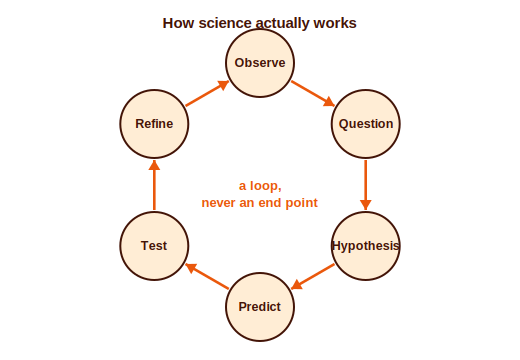
Science begins when a careful observation raises a question that evidence can answer. A useful scientific question is one the world itself can settle, such as does a heavier ball fall faster, rather than one it cannot, such as which colour is most beautiful. A hypothesis is a proposed explanation stated clearly enough that it could be shown to be wrong, and from it we work out a prediction to test.
|
Diagram 1 – The Scientific Enquiry Cycle
Fig 1. Science moves in a loop: an observation raises a question, a hypothesis is proposed, a prediction is tested, and the result refines the next question. |
| Feature | Scientific Question | Non-Scientific Question |
| Can be tested | Yes, by observation or experiment | No |
| Example | Does salt water boil at a higher temperature? | Is salt water tastier than fresh water? |
| Answer comes from | Evidence and measurement | Opinion or preference |
3. Models and Predictions |
A model is a deliberately simplified version of reality that keeps the features we care about and ignores the rest. A road map is a model of a city; it leaves out most detail yet still gets you there. Scientific models, like a shell picture of the atom, are judged not by whether they are perfectly true but by how well they predict. Every model has limits, and knowing those limits is part of using it well.
|
A good hypothesis is testable If no possible observation could ever disagree with a claim, it is not scientific, however interesting it may be. |
|
A good model makes predictions We trust a model when its predictions match what really happens, and we improve it when they do not. |
4. Measurement and SI Units |
A measurement is only meaningful when it carries a unit. Saying a rope is 5 means nothing until we add metres. To let results be compared anywhere in the world, scientists use the SI system of standard units, with prefixes for larger and smaller amounts. Always convert quantities to the same unit before comparing or calculating with them.
| Quantity | SI Unit | Symbol | Everyday Note |
| Length | metre | m | 1 km = 1000 m; 1 cm = 10 mm |
| Mass | kilogram | kg | 1 kg = 1000 g |
| Time | second | s | 1 min = 60 s; 1 h = 3600 s |
| Temperature | kelvin | K | 0 K is the lowest possible temperature |
|
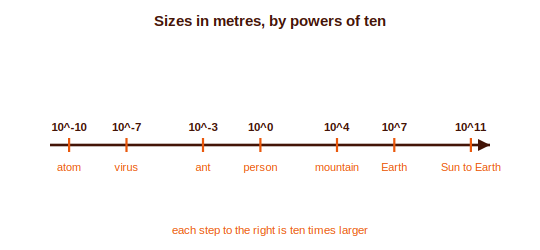
Diagram 2 – Thinking in Powers of Ten
Fig 2. A single scale, marked in powers of ten, stretches from the size of an atom to the distance from the Sun to the Earth. |
5. Estimation and Scientific Notation |
Scientists often need a quick, rough answer before a precise one, called an estimate or order of magnitude. By rounding each quantity to a single power of ten and combining, we can check whether a detailed answer is even sensible. Scientific notation writes a number as a value between 1 and 10 times a power of ten, which makes very large and very small numbers easy to write and compare.
| Ordinary Number | Scientific Notation | How |
| 45000 | 4.5 × 10⁴ | point moves 4 places left |
| 6020 | 6.02 × 10³ | point moves 3 places left |
| 0.00045 | 4.5 × 10⁻⁴ | point moves 4 places right |
| 0.0006 | 6 × 10⁻⁴ | point moves 4 places right |
6. Accuracy and Precision |
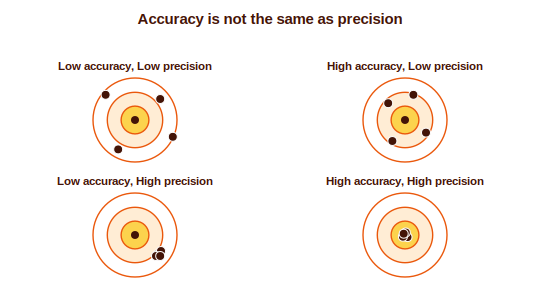
Accuracy means how close a measurement is to the true value; precision means how close repeated measurements are to one another. They are different: a set of readings can be precise yet all wrong, or scattered yet centred on the truth. Reporting the right number of significant figures is part of being honest about how precisely something was actually measured.
|
Diagram 3 – Accuracy versus Precision
Fig 3. Four targets show every combination: readings can be near the true value, tightly grouped, both, or neither. |
7. Key Reasoning (Principles) |
|
Principle 1: Units must match on both sides In any correct equation the units on the left equal those on the right. Since speed = distance ÷ time, its unit is metre per second (m/s). A unit mismatch is a sure sign of an error, so always carry units through a calculation. |
|
Principle 2: Any positive number has a scientific-notation form Move the decimal point until one non-zero digit sits in front of it; the number of places moved gives the power, positive if moved left and negative if moved right. So 45000 = 4.5 × 10⁴ and 0.0006 = 6 × 10⁻⁴. |
|
Principle 3: A fair test changes one variable at a time To learn the effect of one variable, hold every other variable fixed. If two things change at once, we cannot tell which caused the result. The variable we change is the independent variable; the one we measure is the dependent variable. |
8. Worked Examples |
| Example 1 |
|
Q: Convert 2.5 km into metres. ▶ Show SolutionSince 1 km = 1000 m, multiply by 1000. 2.5 × 1000 = 2500 m. Answer: 2500 m. |
| Example 2 |
|
Q: Convert 90 km/h into metres per second. ▶ Show SolutionUse 1 km = 1000 m and 1 h = 3600 s. 90 × 1000 ÷ 3600 = 90000 ÷ 3600. = 25 m/s. Answer: 25 m/s. |
| Example 3 |
|
Q: Write 0.00045 in scientific notation. ▶ Show SolutionMove the decimal point 4 places right to get 4.5. Moving right makes the power negative, so n = minus 4. 0.00045 = 4.5 × 10⁻⁴. Answer: 4.5 × 10⁻⁴. |
| Example 4 |
|
Q: Write 6.02 × 10³ in ordinary form. ▶ Show SolutionThe power is +3, so move the point 3 places right. 6.02 becomes 6020. Answer: 6020. |
| Example 5 |
|
Q: How many significant figures are in 0.03060? ▶ Show SolutionLeading zeros are not significant. The digits 3, 0, 6, 0 are all significant. So there are 4 significant figures. Answer: 4 significant figures. |
| Example 6 |
|
Q: Estimate the number of seconds in one day. ▶ Show Solution1 day = 24 h, 1 h = 60 min, 1 min = 60 s. 24 × 60 × 60 = 86400 s. That is about 9 × 10⁴ s. Answer: 86400 s (about 9 × 10⁴ s). |
| Example 7 |
|
Q: A car travels 150 m in 10 s. Find its average speed. ▶ Show SolutionAverage speed = distance ÷ time. 150 ÷ 10 = 15 m/s. Answer: 15 m/s. |
| Example 8 |
|
Q: Add 3.2 × 10⁴ and 5 × 10³ in scientific notation. ▶ Show SolutionWrite 5 × 10³ as 0.5 × 10⁴. 3.2 × 10⁴ + 0.5 × 10⁴ = 3.7 × 10⁴. Check: 32000 + 5000 = 37000. Answer: 3.7 × 10⁴. |
| Example 9 |
|
Q: A block has mass 240 g and volume 30 cm³. Find its density. ▶ Show SolutionDensity = mass ÷ volume. 240 ÷ 30 = 8 g/cm³. Answer: 8 g/cm³. |
| Example 10 |
|
Q: Round 3.14159 to 3 significant figures. ▶ Show SolutionThe first three figures are 3, 1, 4. The next figure is 1, below 5, so round down. 3.14159 → 3.14. Answer: 3.14. |
9. Practice Sets A to D |
| Set A – Multiple Choice (Basic) |
|
1. The SI unit of length is: (a) gram (b) metre (c) second (d) litre 2. Which is the SI unit of mass? (a) newton (b) litre (c) kilogram (d) pascal 3. 7000 written in scientific notation is: (a) 7 × 10² (b) 7 × 10³ (c) 0.7 × 10⁴ (d) 70 × 10² 4. How many millimetres are in 1 centimetre? (a) 1 (b) 10 (c) 100 (d) 1000 5. A testable proposed explanation is called a: (a) law (b) fact (c) hypothesis (d) result ▶ Reveal Answers1. (b) metre. 2. (c) kilogram. 3. (b) 7 × 10³. 4. (b) 10 mm. 5. (c) hypothesis. |
| Set B – Short Answer (Understanding) |
|
1. Why do scientists agree to use SI units? 2. State one difference between accuracy and precision. 3. What makes a question a scientific question? 4. Why do we change only one variable at a time in a fair test? 5. What is meant by an estimate or order of magnitude? ▶ Reveal Answers1. So measurements taken anywhere can be compared and communicated without confusion. 2. Accuracy is closeness to the true value; precision is how closely repeated readings agree. 3. It can be tested and answered by observation or experiment. 4. So that any change in the result can be linked to the single variable we changed. 5. A quick, rough answer found by rounding quantities to a single power of ten. |
| Set C – Application and Reasoning |
|
1. Convert 72 km/h into metres per second. 2. Write 0.0025 in scientific notation. 3. How many significant figures are in 105.0? 4. A runner covers 300 m in 25 s. Find the average speed. 5. A model predicts 20 m but the measured value is 18 m. Find the percentage error of the prediction. ▶ Reveal Answers1. 72 × 1000 ÷ 3600 = 20 m/s. 2. 2.5 × 10⁻³. 3. 4 significant figures. 4. 300 ÷ 25 = 12 m/s. 5. (20 minus 18) ÷ 18 × 100 = about 11.1%. |
| Set D – Higher Order (Challenge) |
|
1. A heart beats about 72 times each minute. Estimate the beats in one day, in scientific notation. 2. A stone of mass 500 g has volume 250 cm³. Find its density in g/cm³, then in kg/m³. 3. Add 4.5 × 10⁶ and 9 × 10⁵, giving the answer in scientific notation. 4. Explain why a calculation that gives speed in units of m/s² must contain a mistake. 5. A length is measured three times as 4.51 cm, 4.52 cm and 4.50 cm. Are these readings precise? Explain. ▶ Reveal Answers1. 72 × 1440 = 103680, which is about 1.0 × 10⁵ beats. 2. 500 ÷ 250 = 2 g/cm³; since 1 g/cm³ = 1000 kg/m³, this is 2000 kg/m³. 3. Write 9 × 10⁵ as 0.9 × 10⁶; then 4.5 + 0.9 = 5.4, giving 5.4 × 10⁶. 4. Speed must have units of metre per second; m/s² is the unit of acceleration, so the working is wrong. 5. Yes; the three readings are very close to one another, which is what precision means, though closeness to the true value would be accuracy. |
|
Chapter Summary
|
||||||||||||||||||||||||||||||||||||||||
| 8-Point Exam Quick-Check | ||||||||||||||||||||||||||||||||
|
||||||||||||||||||||||||||||||||
|
School Revise Virtual Lab Explore these ideas with interactive simulations and visual tools.
|
|
Class 9 Science Chapter 1: Exploration and the Scientific Method, Complete Notes and Practice This revision guide follows the NCERT 2026 to 27 Exploration syllabus and introduces how science works, covering observation and hypotheses, models and predictions, SI units, measurement, estimation, scientific notation, and the difference between accuracy and precision, with three diagrams, ten worked examples and graded practice. Visit SchoolRevise.com to revise, practise and excel. |
 Google