Curriculum
Science Grade IX
Science Grade 9
0/13
-
Chapter 1: Exploration: Entering the World of Secondary Science
 Preview
 -
Chapter 2: Cell: The Building Block of Life
Preview
-
Chapter 3: Tissues in Action
Preview
-
Chapter 4: Describing Motion Around Us
Preview
-
Chapter 5: Exploring Mixtures and Their Separation
Preview
-
Chapter 6: How Forces Affect Motion
Preview
-
Chapter 7: Work, Energy, and Simple Machines
Preview
-
Chapter 8: Journey Inside the Atom
Preview
-
Chapter 9: Atomic Foundations of Matter
Preview
-
Chapter 10: Sound Waves: Characteristics and Applications
Preview
-
Chapter 11: Reproduction: How Life Continues
Preview
-
Chapter 12: Patterns in Life: Diversity and Classification
Preview
-
Chapter 13: Earth as a System: Energy, Matter, and Life
Preview
Exploration Work Sheets
0/13

Advanced
0/10
Chapter 6: How Forces Affect Motion
|
Grade 9 Science | Chapter 6 How Forces Affect MotionWhy do objects start, stop or change direction? This chapter introduces force, inertia and momentum, and sets out Newton’s three laws with clear reasoning and diagrams.
|
|
Contents
|
1. Introduction: What Is a Force? |
A force is a push or a pull that can change the speed, direction or shape of an object. Force is a vector, so it has both size and direction, and its SI unit is the newton (N). Forces never act alone in our experience; several usually act on an object at once, and it is their combined effect, the net force, that decides how the object moves.
This chapter explains how forces affect motion through the work of Isaac Newton, whose three laws connect force, mass and motion. Along the way we meet inertia, the reluctance of objects to change their motion, and momentum, a measure of how much motion an object has.
|
Core idea A single force, or an unbalanced set of forces, changes an object’s motion. The net force is what remains after all the forces on an object are combined.
|
2. Balanced and Unbalanced Forces |
When the forces on an object cancel out, they are balanced and the net force is zero; the object stays at rest or keeps moving steadily. When they do not cancel, they are unbalanced and the net force changes the object’s motion, speeding it up, slowing it down or turning it.
| Forces | Net Force | Effect on Motion |
| Balanced | Zero | No change: stays at rest or moves steadily |
| Unbalanced | Not zero | Motion changes: speeds up, slows down or turns |
3. Newton’s First Law and Inertia |
Newton’s first law states that an object stays at rest, or keeps moving in a straight line at steady speed, unless an unbalanced force acts on it. This tendency to resist a change in motion is called inertia, and it is greater for objects of greater mass. A heavy lorry is harder to start or stop than a light bicycle because it has more inertia.
4. Newton’s Second Law and Momentum |
Momentum is the product of mass and velocity, p = m v, a measure of how much motion an object has. Newton’s second law says that the net force equals the rate of change of momentum, which for constant mass gives the familiar form F = m a: the net force equals mass times acceleration. A larger force gives a larger acceleration, and a heavier object accelerates less for the same force.
|
Watch out F = ma uses the net force, not just one of the forces acting. Always combine the forces first to find the net force before using the equation.
|
5. Newton’s Third Law |
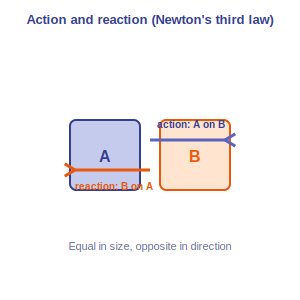
Newton’s third law states that for every action there is an equal and opposite reaction. When one object pushes on a second, the second pushes back equally hard in the opposite direction. These two forces act on different objects, which is why they do not simply cancel. A swimmer pushes water backward and the water pushes the swimmer forward.
|
Diagram 1 – Action and Reaction
Fig 1. Block A pushes on block B; block B pushes back on A with an equal force in the opposite direction. The two forces act on different objects. |
6. Free Body Diagrams |
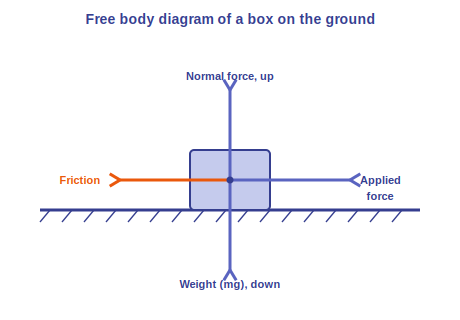
A free body diagram shows all the forces acting on a single object as labelled arrows. For a box resting on the ground there is its weight pulling down, the normal force pushing up, an applied force if it is pushed, and friction opposing motion. Drawing these arrows makes it easy to see whether the forces are balanced and to find the net force.
|
Diagram 2 – Free Body Diagram
Fig 2. The forces on a box: weight downward, normal force upward, an applied force forward and friction backward. Their combined effect is the net force. |
7. Key Reasoning (Principles) |
|
Principle 1: Net force decides the motion Only the net force, found by combining all the forces, changes an object’s motion. If the net force is zero, the motion does not change. |
|
Principle 2: F = ma links force, mass and acceleration For a given net force, a heavier object accelerates less, and for a given mass, a larger force gives a larger acceleration. Force and acceleration are in the same direction. |
|
Principle 3: Action and reaction act on different bodies The equal and opposite forces of Newton’s third law act on two different objects, so they do not cancel each other and can still produce motion. |
8. Worked Examples |
| Example 1 |
|
Q: A force of 6 N acts on a 2 kg object. Find its acceleration. ▶ Show Solutiona = F ÷ m = 6 ÷ 2. = 3 m/s². Answer: 3 m/s². |
| Example 2 |
|
Q: Find the force needed to give a 4 kg object an acceleration of 5 m/s². ▶ Show SolutionF = m a = 4 × 5. = 20 N. Answer: 20 N. |
| Example 3 |
|
Q: Find the momentum of a 5 kg object moving at 4 m/s. ▶ Show Solutionp = m v = 5 × 4. = 20 kg m/s. Answer: 20 kg m/s. |
| Example 4 |
|
Q: Two forces act on a box: 10 N right and 4 N left. Find the net force. ▶ Show SolutionNet force = 10 minus 4 = 6 N, to the right. Answer: 6 N to the right. |
| Example 5 |
|
Q: A net force of 12 N gives an object an acceleration of 2 m/s². Find its mass. ▶ Show Solutionm = F ÷ a = 12 ÷ 2. = 6 kg. Answer: 6 kg. |
| Example 6 |
|
Q: Find the weight of a 10 kg object (take g = 9.8 m/s²). ▶ Show SolutionWeight = m g = 10 × 9.8. = 98 N. Answer: 98 N. |
| Example 7 |
|
Q: An object of mass 3 kg speeds up from 2 m/s to 5 m/s. Find its change in momentum. ▶ Show SolutionChange in momentum = m (v minus u) = 3 × (5 minus 2). = 3 × 3 = 9 kg m/s. Answer: 9 kg m/s. |
| Example 8 |
|
Q: A 1000 kg car accelerates at 2 m/s². Find the driving force. ▶ Show SolutionF = m a = 1000 × 2. = 2000 N. Answer: 2000 N. |
| Example 9 |
|
Q: Why is it harder to stop a loaded lorry than an empty one? ▶ Show SolutionThe loaded lorry has more mass, so more inertia and more momentum, needing a larger force to stop. Answer: It has more mass, so more inertia and momentum. |
| Example 10 |
|
Q: A swimmer pushes water backward. What pushes the swimmer forward? ▶ Show SolutionBy Newton’s third law, the water pushes the swimmer forward with an equal and opposite force. Answer: The water pushes the swimmer forward (reaction). |
9. Practice Sets A to D |
| Set A – Multiple Choice (Basic) |
|
1. The SI unit of force is the: (a) joule (b) newton (c) watt (d) pascal 2. An object keeps moving steadily when the net force on it is: (a) large (b) zero (c) upward (d) backward 3. The resistance of an object to a change in motion is called: (a) momentum (b) inertia (c) friction (d) weight 4. F = ma uses which force? (a) weight only (b) friction only (c) the net force (d) the normal force 5. Action and reaction forces act on: (a) the same object (b) different objects (c) no object (d) the ground only ▶ Reveal Answers1. (b) newton. 2. (b) zero. 3. (b) inertia. 4. (c) the net force. 5. (b) different objects. |
| Set B – Short Answer (Understanding) |
|
1. Define momentum and give its unit. 2. State Newton’s first law of motion. 3. What is the difference between balanced and unbalanced forces? 4. Why do action and reaction forces not cancel each other? 5. Why does a heavier object need a larger force to give it the same acceleration? ▶ Reveal Answers1. Momentum is mass times velocity, p = mv; its unit is kilogram metre per second (kg m/s). 2. An object stays at rest or moves steadily in a straight line unless an unbalanced force acts on it. 3. Balanced forces cancel and give zero net force; unbalanced forces do not cancel and change the motion. 4. Because they act on two different objects, not the same one, so they do not cancel. 5. Because F = ma, so for the same acceleration a larger mass needs a proportionally larger force. |
| Set C – Application and Reasoning |
|
1. A 3 kg object is pushed with a net force of 9 N. Find its acceleration. 2. Find the momentum of a 2 kg ball moving at 6 m/s. 3. A 5 N force acts left and an 8 N force acts right on a box. Find the net force. 4. Find the force needed to accelerate a 0.5 kg ball at 4 m/s². 5. Why does a passenger lurch forward when a bus stops suddenly? ▶ Reveal Answers1. a = 9 ÷ 3 = 3 m/s². 2. p = 2 × 6 = 12 kg m/s. 3. 8 minus 5 = 3 N to the right. 4. F = 0.5 × 4 = 2 N. 5. By inertia, the passenger tends to keep moving forward when the bus suddenly stops. |
| Set D – Higher Order (Challenge) |
|
1. A 1200 kg car accelerates from rest to 20 m/s in 8 s. Find the driving force. 2. Explain, using Newton’s third law, how a rocket moves forward in space. 3. Two objects have the same momentum but different masses. Which moves faster, and why? 4. A 2 kg trolley changes velocity from 3 m/s to 7 m/s in 2 s. Find the force acting on it. 5. Why is wearing a seat belt important when a car stops suddenly? ▶ Reveal Answers1. First a = (20 minus 0) ÷ 8 = 2.5 m/s²; then F = ma = 1200 × 2.5 = 3000 N. 2. The rocket pushes hot gases backward (action); the gases push the rocket forward with an equal and opposite force (reaction). 3. The lighter object moves faster, because for the same momentum p = mv a smaller mass needs a larger velocity. 4. a = (7 minus 3) ÷ 2 = 2 m/s²; F = ma = 2 × 2 = 4 N. 5. The body has inertia and tends to keep moving forward; the seat belt provides the force to stop it safely. |
|
Chapter Summary
|
|||||||||||||||||||||||||||||||
| 8-Point Exam Quick-Check | ||||||||||||||||||||||||||||||||
|
||||||||||||||||||||||||||||||||
|
School Revise Virtual Lab Explore these ideas with interactive simulations and visual tools.
|
|
Class 9 Science Chapter 6: How Forces Affect Motion, Complete Notes and Practice This revision guide follows the NCERT 2026 to 27 Exploration syllabus and explains how forces change motion, covering balanced and unbalanced forces, Newton’s three laws, inertia, momentum, the equation F equals ma and free body diagrams, with two labelled diagrams, ten worked examples and graded practice. Visit SchoolRevise.com to revise, practise and excel. |
 Google