Curriculum
Science Grade IX
Science Grade 9
0/13
-
Chapter 1: Exploration: Entering the World of Secondary Science
 Preview
 -
Chapter 2: Cell: The Building Block of Life
Preview
-
Chapter 3: Tissues in Action
Preview
-
Chapter 4: Describing Motion Around Us
Preview
-
Chapter 5: Exploring Mixtures and Their Separation
Preview
-
Chapter 6: How Forces Affect Motion
Preview
-
Chapter 7: Work, Energy, and Simple Machines
Preview
-
Chapter 8: Journey Inside the Atom
Preview
-
Chapter 9: Atomic Foundations of Matter
Preview
-
Chapter 10: Sound Waves: Characteristics and Applications
Preview
-
Chapter 11: Reproduction: How Life Continues
Preview
-
Chapter 12: Patterns in Life: Diversity and Classification
Preview
-
Chapter 13: Earth as a System: Energy, Matter, and Life
Preview
Exploration Work Sheets
0/13

Advanced
0/10
Chapter 7: Work, Energy, and Simple Machines
|
Grade 9 Science | Chapter 7 Work, Energy, and Simple MachinesWhat does it mean to do work, and where does energy go? This chapter connects force and motion to work, energy and power, and shows how simple machines make tasks easier.
|
|
Contents
|
1. Introduction: Work in Science |
In science, work is done when a force moves an object in the direction of the force. Work equals force multiplied by the distance moved in that direction, W = F × d, and it is measured in joules (J). If there is no movement, or the movement is at right angles to the force, no work is done, even if you feel tired holding something still.
Doing work transfers energy. Energy is the capacity to do work, also measured in joules. This chapter follows energy as it changes from one form to another, introduces power as the rate of doing work, and shows how simple machines let a small effort move a large load.
|
Core idea Work is done only when a force moves an object along its own direction: W = F × d. Doing work transfers energy, and both are measured in joules.
|
2. Energy and Its Forms |
Energy is the ability to do work. It comes in many forms, including kinetic, potential, heat, light, sound, chemical and electrical energy. Energy can change from one form to another but is never created or destroyed. A torch, for example, changes chemical energy in its cell into electrical energy and then into light and heat.
3. Kinetic and Potential Energy |
Kinetic energy is the energy of a moving object, given by KE = ½ m v², so it grows quickly as speed increases. Potential energy is stored energy due to position or condition; the gravitational potential energy of a raised object is PE = m g h, where h is the height. A raised hammer has potential energy that becomes kinetic energy as it falls.
| Energy | Formula | Depends On |
| Kinetic | KE = ½ m v² | mass and speed |
| Gravitational potential | PE = m g h | mass and height |
4. Conservation of Energy |
The law of conservation of energy states that energy cannot be created or destroyed, only changed from one form to another. The total energy stays the same. As a ball falls, its potential energy steadily becomes kinetic energy, but the sum of the two stays constant if we ignore air resistance.
|
Watch out Holding a heavy bag still feels tiring, but in the scientific sense no work is done on the bag, because it does not move in the direction of the force.
|
5. Power |
Power is the rate of doing work, or the rate at which energy is transferred, given by P = work ÷ time. Its SI unit is the watt (W), where one watt is one joule per second. Two machines may do the same work, but the more powerful one does it in less time.
6. Simple Machines |
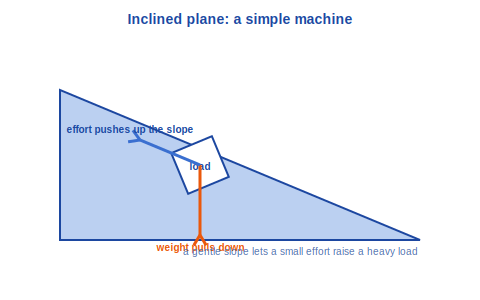
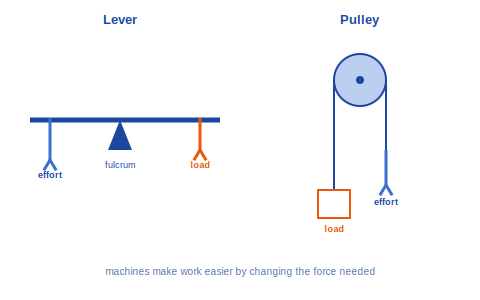
A simple machine makes a task easier by changing the size or direction of the force needed. A lever turns about a fulcrum so that a small effort can lift a large load; a pulley changes the direction of the effort, letting you pull down to lift up; and an inclined plane lets a load be raised gradually with a smaller force. The benefit is measured by the mechanical advantage, the load divided by the effort.
|
Diagram 1 – The Inclined Plane
Fig 1. A gentle slope lets a smaller effort raise a heavy load, although the load must move a longer distance along the slope. |
|
Diagram 2 – Lever and Pulley
Fig 2. A lever turns about a fulcrum so a small effort lifts a large load; a pulley changes the direction of the effort. |
7. Key Reasoning (Principles) |
|
Principle 1: No movement means no work Work needs a force and movement in the direction of that force. A force that causes no movement, or acts at right angles to the motion, does no work. |
|
Principle 2: Energy is conserved Energy only changes form; the total stays the same. As an object falls, lost potential energy reappears as kinetic energy. |
|
Principle 3: Machines trade force for distance A machine that reduces the effort needed makes the load move a shorter distance than the effort. The machine does not reduce the total work, it just spreads it out. |
8. Worked Examples |
| Example 1 |
|
Q: A force of 10 N moves a box 5 m in its own direction. Find the work done. ▶ Show SolutionW = F × d = 10 × 5. = 50 J. Answer: 50 J. |
| Example 2 |
|
Q: Find the kinetic energy of a 2 kg ball moving at 3 m/s. ▶ Show SolutionKE = ½ m v² = ½ × 2 × 9. = 9 J. Answer: 9 J. |
| Example 3 |
|
Q: Find the potential energy of a 2 kg object raised 5 m (take g = 10 m/s²). ▶ Show SolutionPE = m g h = 2 × 10 × 5. = 100 J. Answer: 100 J. |
| Example 4 |
|
Q: A machine does 200 J of work in 10 s. Find its power. ▶ Show SolutionP = work ÷ time = 200 ÷ 10. = 20 W. Answer: 20 W. |
| Example 5 |
|
Q: A force of 25 N drags a load 4 m. Find the work done. ▶ Show SolutionW = 25 × 4. = 100 J. Answer: 100 J. |
| Example 6 |
|
Q: Find the kinetic energy of a 4 kg object moving at 5 m/s. ▶ Show SolutionKE = ½ × 4 × 25. = 50 J. Answer: 50 J. |
| Example 7 |
|
Q: A 5 kg box is lifted 2 m (take g = 10 m/s²). Find its gain in potential energy. ▶ Show SolutionPE = m g h = 5 × 10 × 2. = 100 J. Answer: 100 J. |
| Example 8 |
|
Q: A crane does 600 J of work in 30 s. Find its power. ▶ Show SolutionP = 600 ÷ 30. = 20 W. Answer: 20 W. |
| Example 9 |
|
Q: A lever lifts a 200 N load with an effort of 50 N. Find the mechanical advantage. ▶ Show SolutionMechanical advantage = load ÷ effort = 200 ÷ 50. = 4. Answer: 4. |
| Example 10 |
|
Q: Why is no work done while holding a heavy bag still? ▶ Show SolutionWork needs movement in the direction of the force; the still bag does not move. Answer: Because the bag does not move, no work is done. |
9. Practice Sets A to D |
| Set A – Multiple Choice (Basic) |
|
1. The SI unit of work is the: (a) newton (b) joule (c) watt (d) pascal 2. The SI unit of power is the: (a) joule (b) newton (c) watt (d) metre 3. Kinetic energy is the energy of a body due to its: (a) position (b) motion (c) height (d) shape 4. Which is a simple machine? (a) battery (b) lever (c) magnet (d) thermometer 5. Energy can be: (a) created (b) destroyed (c) changed in form (d) made from nothing ▶ Reveal Answers1. (b) joule. 2. (c) watt. 3. (b) motion. 4. (b) lever. 5. (c) changed in form. |
| Set B – Short Answer (Understanding) |
|
1. When is work said to be done in science? 2. State the law of conservation of energy. 3. Define power and give its SI unit. 4. How does a simple machine make work easier? 5. Give one example of energy changing form. ▶ Reveal Answers1. When a force moves an object in the direction of the force. 2. Energy cannot be created or destroyed, only changed from one form to another. 3. Power is the rate of doing work; its SI unit is the watt (W). 4. By changing the size or direction of the force needed to move a load. 5. A torch changes chemical energy into electrical energy and then into light and heat. |
| Set C – Application and Reasoning |
|
1. A force of 15 N moves a load 6 m. Find the work done. 2. Find the kinetic energy of a 3 kg object moving at 2 m/s. 3. A 4 kg object is raised 3 m (g = 10 m/s²). Find its potential energy. 4. A motor does 900 J of work in 45 s. Find its power. 5. A pulley lifts a 300 N load with an effort of 100 N. Find the mechanical advantage. ▶ Reveal Answers1. W = 15 × 6 = 90 J. 2. KE = ½ × 3 × 4 = 6 J. 3. PE = 4 × 10 × 3 = 120 J. 4. P = 900 ÷ 45 = 20 W. 5. Mechanical advantage = 300 ÷ 100 = 3. |
| Set D – Higher Order (Challenge) |
|
1. A ball of mass 1 kg is dropped from 5 m (g = 10 m/s²). Find its potential energy at the top, and its kinetic energy just before landing. 2. Explain why a machine that reduces effort makes the load travel a shorter distance than the effort. 3. A pump raises 50 kg of water through 4 m in 20 s (g = 10 m/s²). Find the work done and the power. 4. Two cranes do the same work, but crane A is more powerful. What does this tell you? 5. Why does kinetic energy increase fourfold when the speed of an object doubles? ▶ Reveal Answers1. PE at top = 1 × 10 × 5 = 50 J; by conservation of energy, KE just before landing = 50 J. 2. A machine does not reduce the total work, so if the effort is smaller, it must act over a longer distance, meaning the load moves a shorter distance. 3. Work = m g h = 50 × 10 × 4 = 2000 J; power = 2000 ÷ 20 = 100 W. 4. Crane A does the same work in less time, because power is the rate of doing work. 5. Because KE = ½ m v² depends on the square of the speed, so doubling the speed multiplies the energy by 2 squared, that is four times. |
|
Chapter Summary
|
|||||||||||||||||||||||||||||||
| 8-Point Exam Quick-Check | ||||||||||||||||||||||||||||||||
|
||||||||||||||||||||||||||||||||
|
School Revise Virtual Lab Explore these ideas with interactive simulations and visual tools.
|
|
Class 9 Science Chapter 7: Work, Energy and Simple Machines, Complete Notes and Practice This revision guide follows the NCERT 2026 to 27 Exploration syllabus and connects force and motion to work and energy, covering the meaning of work, kinetic and potential energy, the conservation of energy, power, and the simple machines lever, pulley and inclined plane, with two labelled diagrams, ten worked examples and graded practice. Visit SchoolRevise.com to revise, practise and excel. |
 Google