Curriculum
Science Grade IX
Science Grade 9
0/13
-
Chapter 1: Exploration: Entering the World of Secondary Science
 Preview
 -
Chapter 2: Cell: The Building Block of Life
Preview
-
Chapter 3: Tissues in Action
Preview
-
Chapter 4: Describing Motion Around Us
Preview
-
Chapter 5: Exploring Mixtures and Their Separation
Preview
-
Chapter 6: How Forces Affect Motion
Preview
-
Chapter 7: Work, Energy, and Simple Machines
Preview
-
Chapter 8: Journey Inside the Atom
Preview
-
Chapter 9: Atomic Foundations of Matter
Preview
-
Chapter 10: Sound Waves: Characteristics and Applications
Preview
-
Chapter 11: Reproduction: How Life Continues
Preview
-
Chapter 12: Patterns in Life: Diversity and Classification
Preview
-
Chapter 13: Earth as a System: Energy, Matter, and Life
Preview
Exploration Work Sheets
0/13

Advanced
0/10
Chapter 11: Reproduction: How Life Continues
|
Grade 9 Science | Chapter 11 Reproduction: How Life ContinuesHow do living things make more of their own kind? This chapter compares asexual and sexual reproduction and looks at the flower as the reproductive part of a plant.
|
|
Contents
|
1. Introduction: Why Reproduction Matters |
Reproduction is the process by which living things produce new individuals of their own kind. No organism lives forever, so reproduction is how a species continues across generations. There are two broad ways it happens: asexual reproduction, which involves a single parent, and sexual reproduction, which usually involves two.
This chapter, now placed in Class 9, compares the two methods, looks closely at the flower as the reproductive organ of many plants, and explains why the variation produced by sexual reproduction is so valuable for survival.
|
Core idea Reproduction produces new individuals so a species can continue. Asexual reproduction needs one parent and gives identical offspring; sexual reproduction usually needs two and gives varied offspring.
|
2. Asexual Reproduction |
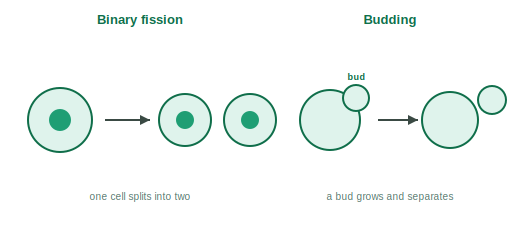
In asexual reproduction a single parent produces offspring that are genetically identical to it. Common methods include binary fission, where a single-celled organism splits into two, and budding, where a small outgrowth on the parent grows and then separates. Asexual reproduction is fast and needs no partner, but the offspring show little variation.
|
Diagram 1 – Asexual Reproduction
Fig 1. In binary fission one cell divides into two identical cells; in budding a small bud grows on the parent and then separates. |
3. Sexual Reproduction |
In sexual reproduction, special cells called gametes from two parents join in a process called fertilisation. Because the offspring receive a mix of features from both parents, they are not identical to either parent or to one another. This mixing is the source of variation, which is the main advantage of sexual reproduction.
| Feature | Asexual | Sexual |
| Number of parents | One | Usually two |
| Offspring | Identical to parent | Varied, a mix of both parents |
| Speed | Fast | Slower |
| Variation | Very little | Plenty |
4. The Flower: A Plant’s Reproductive Organ |
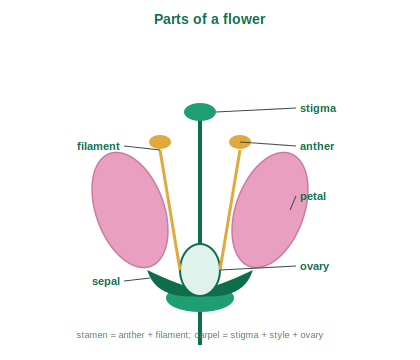
In many plants the flower is the reproductive organ. Its outer green sepals protect the bud, and the coloured petals often attract pollinators. The male part, the stamen, has an anther that makes pollen on a stalk called the filament. The female part, the carpel, has a sticky stigma, a style, and an ovary that holds the ovules.
|
Diagram 2 – Parts of a Flower
Fig 2. A flower showing sepals, petals, the stamen (anther and filament) and the carpel (stigma, style and ovary). |
5. From Pollination to Seed |
Pollination is the transfer of pollen from an anther to a stigma, carried by wind, water or animals. After pollination, a male cell from the pollen joins an egg cell in the ovule during fertilisation. The fertilised ovule grows into a seed, and the ovary often grows into a fruit that protects and helps spread the seeds.
6. Variation and Survival |
Because sexual reproduction mixes features from two parents, the offspring vary from one another. This variation means that if conditions change, some individuals may have features that help them survive. Over many generations, this is how populations are able to adapt, which is why the variation from sexual reproduction is so important.
|
Watch out Asexual offspring are identical, so a single harmful change could affect all of them. Sexual reproduction spreads the risk by producing varied offspring.
|
7. Key Reasoning (Principles) |
|
Principle 1: One parent gives identical offspring Asexual reproduction copies a single parent, so the offspring are genetically identical, with very little variation. |
|
Principle 2: Two parents give variation Sexual reproduction mixes features from two parents, so the offspring differ from each other, creating variation. |
|
Principle 3: Variation aids survival When offspring vary, some may cope better with a change in conditions, helping the population survive over time. |
8. Worked Examples |
| Example 1 |
|
Q: Define reproduction. ▶ Show SolutionReproduction is the process by which living things produce new individuals of their own kind. Answer: Producing new individuals of the same kind. |
| Example 2 |
|
Q: Name the two main types of reproduction. ▶ Show SolutionThe two types are asexual and sexual reproduction. Answer: Asexual and sexual reproduction. |
| Example 3 |
|
Q: Which type of reproduction needs only one parent? ▶ Show SolutionAsexual reproduction needs a single parent. Answer: Asexual reproduction. |
| Example 4 |
|
Q: Name the process where a single cell splits into two. ▶ Show SolutionA single cell dividing into two is binary fission. Answer: Binary fission. |
| Example 5 |
|
Q: Name the male part of a flower. ▶ Show SolutionThe stamen, made of anther and filament, is the male part. Answer: The stamen (anther and filament). |
| Example 6 |
|
Q: Name the female part of a flower. ▶ Show SolutionThe carpel, made of stigma, style and ovary, is the female part. Answer: The carpel (stigma, style and ovary). |
| Example 7 |
|
Q: What is pollination? ▶ Show SolutionPollination is the transfer of pollen from an anther to a stigma. Answer: Transfer of pollen from anther to stigma. |
| Example 8 |
|
Q: What grows from a fertilised ovule? ▶ Show SolutionA fertilised ovule develops into a seed. Answer: A seed. |
| Example 9 |
|
Q: Why do offspring from sexual reproduction show variation? ▶ Show SolutionThey receive a mix of features from two parents, so they differ. Answer: Because they mix features from two parents. |
| Example 10 |
|
Q: Give one advantage of asexual reproduction. ▶ Show SolutionIt is fast and needs no partner. Answer: It is fast and needs only one parent. |
9. Practice Sets A to D |
| Set A – Multiple Choice (Basic) |
|
1. Reproduction with a single parent is: (a) sexual (b) asexual (c) pollination (d) fertilisation 2. Binary fission is an example of: (a) sexual reproduction (b) asexual reproduction (c) pollination (d) variation 3. The male part of a flower is the: (a) carpel (b) stigma (c) stamen (d) ovary 4. Transfer of pollen to a stigma is called: (a) fertilisation (b) pollination (c) budding (d) fission 5. A fertilised ovule grows into a: (a) flower (b) seed (c) petal (d) sepal ▶ Reveal Answers1. (b) asexual. 2. (b) asexual reproduction. 3. (c) stamen. 4. (b) pollination. 5. (b) seed. |
| Set B – Short Answer (Understanding) |
|
1. State one difference between asexual and sexual reproduction. 2. Name two methods of asexual reproduction. 3. What is fertilisation? 4. Why are the petals of many flowers brightly coloured? 5. What is the main advantage of sexual reproduction? ▶ Reveal Answers1. Asexual needs one parent and gives identical offspring; sexual usually needs two and gives varied offspring. 2. Binary fission and budding. 3. The joining of a male gamete with a female gamete to form a new cell. 4. To attract pollinators that carry pollen from flower to flower. 5. It produces variation, which can help a population survive changing conditions. |
| Set C – Application and Reasoning |
|
1. A pond organism reproduces by splitting in two. Name the method. 2. Why do offspring of asexual reproduction look identical to the parent? 3. Identify the parts of the carpel. 4. Explain why a flower needs both an anther and a stigma. 5. Suggest why variation is useful if the climate changes. ▶ Reveal Answers1. Binary fission. 2. Because they come from a single parent and are genetic copies of it. 3. Stigma, style and ovary. 4. The anther makes pollen (male), and the stigma receives pollen so that fertilisation can occur (female). 5. Some varied individuals may have features that suit the new climate, so they survive and reproduce. |
| Set D – Higher Order (Challenge) |
|
1. Compare the advantages and disadvantages of asexual and sexual reproduction. 2. Trace the steps from pollination to the forming of a seed. 3. Explain why a disease could wipe out a whole population produced asexually. 4. Why might a plant produce brightly coloured, scented flowers rather than dull ones? 5. Explain how variation links reproduction to the survival of a species. ▶ Reveal Answers1. Asexual is fast and needs one parent but gives no variation; sexual is slower and needs two parents but gives variation that aids survival. 2. Pollen is transferred to the stigma (pollination), a male cell joins an egg in the ovule (fertilisation), and the fertilised ovule grows into a seed. 3. All the offspring are identical, so if the disease harms one, it can harm them all in the same way. 4. Bright colour and scent attract pollinators, improving the chance of pollination and successful reproduction. 5. Sexual reproduction creates varied offspring; when conditions change, some variants survive, so the species continues. |
|
Chapter Summary
|
|||||||||||||||||||||||||||||||
| 8-Point Exam Quick-Check | ||||||||||||||||||||||||||||||||
|
||||||||||||||||||||||||||||||||
|
School Revise Virtual Lab Explore these ideas with interactive simulations and visual tools.
|
|
Class 9 Science Chapter 11: Reproduction, How Life Continues, Complete Notes and Practice This revision guide follows the NCERT 2026 to 27 Exploration syllabus and explains how living things continue, covering asexual reproduction such as binary fission and budding, sexual reproduction and fertilisation, the parts of a flower, pollination and seed formation, and the value of variation for survival, with two labelled diagrams, ten worked examples and graded practice. Visit SchoolRevise.com to revise, practise and excel. |
 Google