Curriculum
Science Grade IX
Science Grade 9
0/13
-
Chapter 1: Exploration: Entering the World of Secondary Science
 Preview
 -
Chapter 2: Cell: The Building Block of Life
Preview
-
Chapter 3: Tissues in Action
Preview
-
Chapter 4: Describing Motion Around Us
Preview
-
Chapter 5: Exploring Mixtures and Their Separation
Preview
-
Chapter 6: How Forces Affect Motion
Preview
-
Chapter 7: Work, Energy, and Simple Machines
Preview
-
Chapter 8: Journey Inside the Atom
Preview
-
Chapter 9: Atomic Foundations of Matter
Preview
-
Chapter 10: Sound Waves: Characteristics and Applications
Preview
-
Chapter 11: Reproduction: How Life Continues
Preview
-
Chapter 12: Patterns in Life: Diversity and Classification
Preview
-
Chapter 13: Earth as a System: Energy, Matter, and Life
Preview
Exploration Work Sheets
0/13

Advanced
0/10
Chapter 12: Patterns in Life: Diversity and Classification
|
Grade 9 Science | Chapter 12 Patterns in Life: Diversity and ClassificationMillions of living things share the planet. This chapter shows why we classify them and how organisms are grouped into a branching hierarchy by shared features.
|
|
Contents
|
1. Introduction: The Variety of Life |
The living world is astonishingly varied, from tiny bacteria to giant trees and great whales. This variety is called biodiversity. To study so many kinds of life, scientists sort them into groups based on shared features, a process called classification. Without it, the sheer number of living things would be impossible to organise or understand.
Classification is not random; it follows shared characteristics, so that organisms in the same group are more alike than those in different groups. This chapter explains the levels of classification, the major groups of life, and the system used to name every kind of organism.
|
Core idea Classification sorts living things into groups by shared features, arranged in a hierarchy from large, broad groups down to the single kind called a species.
|
2. Why We Classify |
We classify living things to bring order to their huge variety, to make them easier to study and identify, and to show how different kinds may be related. Grouping by shared features means that knowing the group an organism belongs to tells us a great deal about it at once, which is far more useful than treating every organism separately.
3. The Hierarchy of Classification |
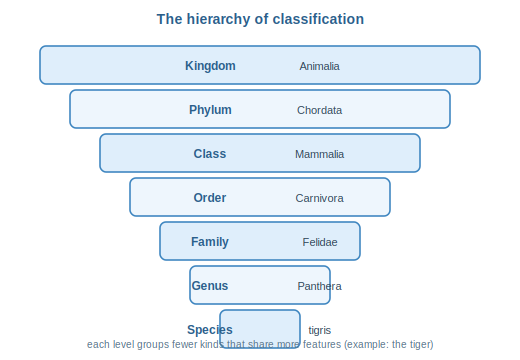
Organisms are sorted into a series of levels, each nested inside the one above. From the largest group to the smallest these are kingdom, phylum, class, order, family, genus and species. As we move down the levels, each group contains fewer kinds of organism, but those in it share more and more features.
|
Diagram 1 – The Hierarchy of Classification
Fig 1. Classification runs from the broad kingdom down to the single species; lower levels hold fewer kinds that share more features. |
4. The Major Groups |
Living things are first sorted into broad kingdoms. A widely used scheme has five: Monera (simple single cells such as bacteria), Protista (single-celled organisms with a true nucleus), Fungi (such as moulds and mushrooms), Plantae (plants that make their own food) and Animalia (animals that take in food). Each kingdom is then split further down the hierarchy.
| Kingdom | Typical Members | Key Feature |
| Monera | Bacteria | Single cell, no true nucleus |
| Protista | Single-celled pond life | Single cell, with a true nucleus |
| Fungi | Moulds, mushrooms | Absorb food from their surroundings |
| Plantae | Trees, grasses, ferns | Make their own food using light |
| Animalia | Insects, fish, mammals | Take in food, usually can move |
5. Characteristics Used to Classify |
Organisms are grouped by careful comparison of their features: whether they are made of one cell or many, whether the cell has a true nucleus, how they obtain food, and details of body structure. Plants, for example, have cell walls and make their own food, while animals take in food and can usually move. The more features two organisms share, the closer together they are placed.
6. Naming Living Things |
Every kind of organism is given a two-part scientific name in a system called binomial nomenclature. The first part is the genus and the second is the species, so the name is unique and understood everywhere, whatever the local language. Scientific names avoid the confusion of common names, which can differ from place to place.
|
Watch out Common names vary from region to region and can name different organisms, so scientists rely on the unique two-part scientific name to avoid confusion.
|
7. Key Reasoning (Principles) |
|
Principle 1: Shared features decide grouping Organisms are placed together when they share features. The more features they share, the closer the group they belong to. |
|
Principle 2: The hierarchy nests Each level sits inside a larger one: a species belongs to a genus, which belongs to a family, and so on up to a kingdom. |
|
Principle 3: Classification reflects relationships Grouping by shared features also tends to group organisms that are more closely related, so classification can show patterns of relationship. |
8. Worked Examples |
| Example 1 |
|
Q: What is classification? ▶ Show SolutionClassification is the sorting of living things into groups based on shared features. Answer: Sorting living things into groups by shared features. |
| Example 2 |
|
Q: List the levels of classification from largest to smallest. ▶ Show SolutionKingdom, phylum, class, order, family, genus, species. Answer: Kingdom, phylum, class, order, family, genus, species. |
| Example 3 |
|
Q: Which is the smallest group in the hierarchy? ▶ Show SolutionThe species is the smallest group. Answer: The species. |
| Example 4 |
|
Q: Name the five kingdoms of living things. ▶ Show SolutionMonera, Protista, Fungi, Plantae and Animalia. Answer: Monera, Protista, Fungi, Plantae, Animalia. |
| Example 5 |
|
Q: To which kingdom do mushrooms belong? ▶ Show SolutionMushrooms absorb food and belong to the fungi. Answer: Fungi. |
| Example 6 |
|
Q: Give one feature that places an organism in the plant kingdom. ▶ Show SolutionPlants have cell walls and make their own food using light. Answer: It makes its own food (and has cell walls). |
| Example 7 |
|
Q: What is the two-part naming system called? ▶ Show SolutionThe two-part scientific naming system is binomial nomenclature. Answer: Binomial nomenclature. |
| Example 8 |
|
Q: Why are scientific names preferred to common names? ▶ Show SolutionScientific names are unique and understood everywhere, while common names vary. Answer: They are unique and understood everywhere. |
| Example 9 |
|
Q: As we move down the hierarchy, how do the groups change? ▶ Show SolutionEach group has fewer kinds, and the members share more features. Answer: Fewer kinds, sharing more features. |
| Example 10 |
|
Q: To which kingdom does a bacterium belong? ▶ Show SolutionBacteria are single cells without a true nucleus, in Monera. Answer: Monera. |
9. Practice Sets A to D |
| Set A – Multiple Choice (Basic) |
|
1. The sorting of living things into groups is called: (a) variation (b) classification (c) reproduction (d) respiration 2. The smallest unit of classification is the: (a) kingdom (b) family (c) genus (d) species 3. Mushrooms belong to the kingdom: (a) Plantae (b) Animalia (c) Fungi (d) Monera 4. Bacteria belong to the kingdom: (a) Protista (b) Monera (c) Fungi (d) Plantae 5. The two-part scientific name system is called: (a) hierarchy (b) binomial nomenclature (c) biodiversity (d) taxonomy ▶ Reveal Answers1. (b) classification. 2. (d) species. 3. (c) Fungi. 4. (b) Monera. 5. (b) binomial nomenclature. |
| Set B – Short Answer (Understanding) |
|
1. Give two reasons why we classify living things. 2. List the seven levels of classification in order. 3. State one difference between the plant and animal kingdoms. 4. Why do scientists use scientific names rather than common names? 5. What happens to the number of shared features as we move down the hierarchy? ▶ Reveal Answers1. To bring order to their variety and to make them easier to study, identify and relate. 2. Kingdom, phylum, class, order, family, genus, species. 3. Plants make their own food and have cell walls; animals take in food and can usually move. 4. Because scientific names are unique and the same everywhere, while common names vary by place. 5. It increases; lower groups share more features. |
| Set C – Application and Reasoning |
|
1. Two organisms are placed in the same family. What does this tell you about them? 2. An organism is single-celled with no true nucleus. Which kingdom does it belong to? 3. Why is the species the most precise level of classification? 4. An organism makes its own food and has cell walls. Which kingdom is it likely in? 5. Explain why grouping organisms helps a scientist study a newly found organism. ▶ Reveal Answers1. They share many features and are closely related, more so than organisms only in the same kingdom. 2. Monera. 3. Because it is the smallest group and contains only one kind of organism, the most alike of all. 4. The plant kingdom (Plantae). 5. Once its group is known, much is known at once, since members of a group share features. |
| Set D – Higher Order (Challenge) |
|
1. Explain how the classification hierarchy moves from broad to precise, using an example. 2. Why might two organisms that look similar still be placed in different groups? 3. Discuss why a single agreed system of naming is important for science worldwide. 4. How does classification by shared features also suggest relationships between organisms? 5. Suggest features you would compare to decide whether an organism is a plant or an animal. ▶ Reveal Answers1. From kingdom down to species, each level narrows: a tiger is in Animalia, then Chordata, then Mammalia, and so on to its species, sharing more features at each step. 2. Because classification depends on many features, not appearance alone; deeper differences can place similar-looking organisms apart. 3. It lets scientists everywhere refer to the same organism without confusion, whatever their language. 4. Organisms grouped by shared features tend to be more closely related, so the grouping reflects patterns of relationship. 5. Whether it makes its own food, whether it can move, whether its cells have walls, and its body structure. |
|
Chapter Summary
|
|||||||||||||||||||||||||||||||
| 8-Point Exam Quick-Check | ||||||||||||||||||||||||||||||||
|
||||||||||||||||||||||||||||||||
|
School Revise Virtual Lab Explore these ideas with interactive simulations and visual tools.
|
|
Class 9 Science Chapter 12: Patterns in Life, Diversity and Classification, Complete Notes and Practice This revision guide follows the NCERT 2026 to 27 Exploration syllabus and brings order to the variety of life, covering why we classify, the hierarchy from kingdom to species, the five kingdoms, the features used to group organisms, and binomial nomenclature, with a labelled hierarchy diagram, ten worked examples and graded practice. Visit SchoolRevise.com to revise, practise and excel. |
 Google