Curriculum
Science Grade IX
Science Grade 9
0/13
-
Chapter 1: Exploration: Entering the World of Secondary Science
 Preview
 -
Chapter 2: Cell: The Building Block of Life
Preview
-
Chapter 3: Tissues in Action
Preview
-
Chapter 4: Describing Motion Around Us
Preview
-
Chapter 5: Exploring Mixtures and Their Separation
Preview
-
Chapter 6: How Forces Affect Motion
Preview
-
Chapter 7: Work, Energy, and Simple Machines
Preview
-
Chapter 8: Journey Inside the Atom
Preview
-
Chapter 9: Atomic Foundations of Matter
Preview
-
Chapter 10: Sound Waves: Characteristics and Applications
Preview
-
Chapter 11: Reproduction: How Life Continues
Preview
-
Chapter 12: Patterns in Life: Diversity and Classification
Preview
-
Chapter 13: Earth as a System: Energy, Matter, and Life
Preview
Exploration Work Sheets
0/13

Advanced
0/10
Chapter 3: Tissues in Action
|
Grade 9 Science | Chapter 3 Tissues in ActionCells of the same kind team up to do a job. In this chapter we explore plant and animal tissues, how each is built and the work it carries out.
|
|
Contents
|
1. Introduction: What Is a Tissue? |
A tissue is a group of cells that are similar in shape and work together to carry out a particular job. In a large organism, no single cell can do everything, so cells specialise and share out the work. This sharing, called division of labour, makes the whole organism more efficient and is why complex plants and animals are built from many kinds of tissue rather than identical cells.
Tissues are the level of organisation between cells and organs. Several tissues working together form an organ, and several organs form an organ system. Understanding tissues therefore prepares us to understand how whole bodies are built and run.
|
Core idea A tissue is a group of similar cells doing the same job. Grouping cells into tissues allows division of labour, so each tissue can be well suited to one task.
|
|
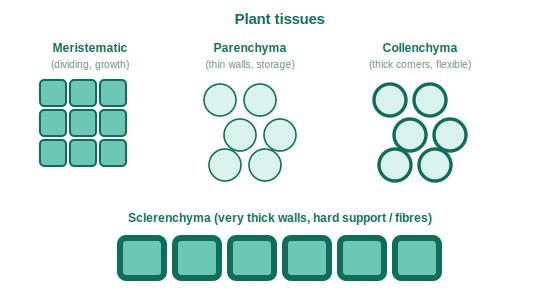
Diagram 1 – Plant Tissues
Fig 1. Dividing meristematic tissue and the three permanent tissues: thin-walled parenchyma, corner-thickened collenchyma and very thick sclerenchyma. |
2. Plant Tissues: Two Main Groups |
Plant tissues fall into two main groups. Meristematic tissue is made of small, actively dividing cells found at growing points, such as the tips of roots and shoots; it is responsible for growth. Permanent tissue is made of cells that have stopped dividing and have taken on a fixed shape and job. Permanent tissue forms most of the mature plant body.
| Group | Cells | Main Role | Where Found |
| Meristematic | Small, dividing, thin walls | Growth of the plant | Root and shoot tips |
| Permanent | Specialised, no longer dividing | Support, storage, transport | Most of the mature plant |
3. Permanent Plant Tissues |
There are three common permanent tissues. Parenchyma has thin walls and stores food and water. Collenchyma has walls thickened at the corners, giving flexible support to young, growing parts. Sclerenchyma has very thick, hard walls and provides strong, rigid support; its long cells form fibres.
|
Parenchyma Thin-walled, living cells for storage and basic functions; the most common plant tissue. |
|
Collenchyma Cells thickened at the corners, giving flexible support to young stems and leaves. |
|
Sclerenchyma Very thick-walled, often dead cells that give hard, rigid support; the source of plant fibres. |
4. Animal Tissues: An Overview |
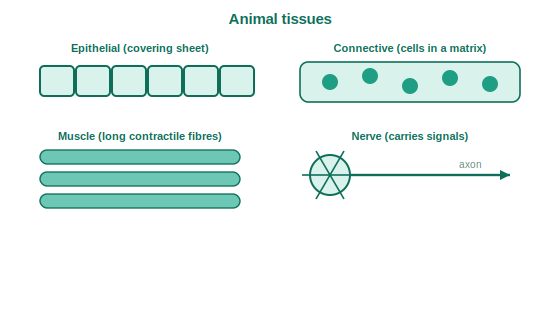
Animal tissues are grouped into four types. Epithelial tissue covers surfaces and lines cavities. Connective tissue joins, supports and packs other tissues. Muscular tissue contracts to produce movement. Nervous tissue carries messages rapidly around the body. Each type is built in a way that suits the job it does.
|
Diagram 2 – Animal Tissues
Fig 2. The four animal tissues: a covering sheet of epithelial cells, connective tissue with cells in a matrix, long muscle fibres, and a nerve cell with its long axon. |
5. Functions of Animal Tissues |
| Tissue | Structure | Function | Example |
| Epithelial | Tightly joined cells in sheets | Covers and protects, lines organs | Skin surface, gut lining |
| Connective | Cells spread in a matrix | Joins, supports and transports | Blood, bone, cartilage |
| Muscular | Long fibres that contract | Produces movement | Arm muscle, heart muscle |
| Nervous | Cells with long extensions | Carries electrical messages | Brain, spinal cord, nerves |
6. From Cells to Organ Systems |
Living bodies are organised in levels of increasing size and complexity. Specialised cells of one kind form a tissue; different tissues working together form an organ, such as the stomach or a leaf; several organs working together form an organ system, such as the digestive system; and the organ systems together make up the whole organism.
|
Watch out A tissue is not just any group of cells; the cells must be similar and must work together for the same purpose. A random mix of different cells is not a tissue.
|
7. Key Reasoning (Principles) |
|
Principle 1: Division of labour When cells specialise and group into tissues, each tissue can be very good at one task, so the whole organism works more efficiently than if every cell tried to do everything. |
|
Principle 2: Structure fits function Each tissue is built to suit its job: muscle fibres are long so they can contract, nerve cells have long extensions to carry signals far, and sclerenchyma has thick walls for strong support. |
|
Principle 3: Growth happens at meristems Because only meristematic cells divide, a plant grows in length mainly at its root and shoot tips, where this dividing tissue is found. |
8. Worked Examples |
| Example 1 |
|
Q: Define a tissue. ▶ Show SolutionA tissue is a group of similar cells that work together to carry out a particular job. Answer: A group of similar cells doing the same job. |
| Example 2 |
|
Q: Name the two main groups of plant tissue. ▶ Show SolutionPlant tissues are meristematic or permanent. Answer: Meristematic and permanent tissue. |
| Example 3 |
|
Q: Which plant tissue is responsible for growth in length? ▶ Show SolutionMeristematic tissue at the root and shoot tips divides to add length. Answer: Meristematic tissue (apical meristem). |
| Example 4 |
|
Q: Which plant tissue gives flexible support to young stems? ▶ Show SolutionCollenchyma has walls thickened at the corners, giving flexible support. Answer: Collenchyma. |
| Example 5 |
|
Q: Which plant tissue provides hard, rigid support and forms fibres? ▶ Show SolutionSclerenchyma has very thick walls and forms long fibres. Answer: Sclerenchyma. |
| Example 6 |
|
Q: Which animal tissue covers the body surface and lines organs? ▶ Show SolutionEpithelial tissue forms protective covering sheets. Answer: Epithelial tissue. |
| Example 7 |
|
Q: Which animal tissue carries messages around the body? ▶ Show SolutionNervous tissue carries rapid electrical signals. Answer: Nervous tissue. |
| Example 8 |
|
Q: Give one example of a connective tissue. ▶ Show SolutionConnective tissue includes blood, bone and cartilage. Answer: Blood (also bone or cartilage). |
| Example 9 |
|
Q: Why are muscle fibres long and able to contract? ▶ Show SolutionTheir long shape lets them shorten and pull, producing movement. Answer: So they can contract and produce movement. |
| Example 10 |
|
Q: Arrange in order of increasing size: organ, cell, organ system, tissue. ▶ Show SolutionCells form tissues, tissues form organs, organs form organ systems. Answer: Cell, tissue, organ, organ system. |
9. Practice Sets A to D |
| Set A – Multiple Choice (Basic) |
|
1. A group of similar cells doing the same job is a: (a) organ (b) tissue (c) system (d) cell 2. Growth in length of a plant is due to: (a) parenchyma (b) sclerenchyma (c) meristematic tissue (d) collenchyma 3. Which animal tissue produces movement? (a) epithelial (b) nervous (c) muscular (d) connective 4. Blood is an example of which tissue? (a) epithelial (b) connective (c) muscular (d) nervous 5. Flexible support in young stems is given by: (a) parenchyma (b) collenchyma (c) sclerenchyma (d) xylem ▶ Reveal Answers1. (b) tissue. 2. (c) meristematic tissue. 3. (c) muscular. 4. (b) connective. 5. (b) collenchyma. |
| Set B – Short Answer (Understanding) |
|
1. What is meant by division of labour in a body? 2. State one difference between meristematic and permanent tissue. 3. Name the four types of animal tissue. 4. Why is sclerenchyma good at giving support? 5. What level of organisation comes between tissue and organ system? ▶ Reveal Answers1. Cells specialise so that each tissue does one task well, making the body more efficient. 2. Meristematic cells divide and cause growth; permanent cells have stopped dividing and have a fixed job. 3. Epithelial, connective, muscular and nervous tissue. 4. Its very thick, hard walls make it strong and rigid. 5. The organ; tissues form organs, and organs form organ systems. |
| Set C – Application and Reasoning |
|
1. A gardener trims the shoot tips to stop a plant growing taller. Which tissue is being removed? 2. Why can a long nerve cell carry a message from the foot to the spinal cord? 3. Which tissue would you expect to find lining the inside of the mouth, and why? 4. Explain why bone and blood are both called connective tissue. 5. Suggest why a young, bending stem contains plenty of collenchyma. ▶ Reveal Answers1. Meristematic tissue, which is found at the shoot tip and causes growth in length. 2. Because it has a long extension (axon) that carries the electrical signal over a distance. 3. Epithelial tissue, because it forms a protective covering sheet over surfaces. 4. Both have cells set in a matrix and both join or support other parts of the body. 5. Collenchyma gives flexible support, letting the stem bend without breaking while it grows. |
| Set D – Higher Order (Challenge) |
|
1. Explain how the idea of structure fitting function applies to muscle tissue and to nerve tissue. 2. A plant fibre used to make rope is very strong. Which tissue is it likely made of, and why? 3. Arrange and explain the levels of organisation from cell to organism. 4. Why does removing the growing tip change the way a plant grows? 5. Compare the walls of parenchyma, collenchyma and sclerenchyma and link each to its job. ▶ Reveal Answers1. Muscle fibres are long so they can contract and move parts of the body; nerve cells have long extensions so they can carry signals over a distance. Each shape suits its task. 2. Sclerenchyma, because its very thick walls and long fibre cells make it strong enough for rope. 3. Cells form tissues, tissues form organs, organs form organ systems, and the systems together form the whole organism, each level larger and more complex. 4. The growing tip holds meristematic tissue; removing it removes the cells that divide to add length, so growth in height slows. 5. Parenchyma has thin walls for storage, collenchyma has corner-thickened walls for flexible support, and sclerenchyma has very thick walls for hard, rigid support. |
|
Chapter Summary
|
|||||||||||||||||||||||||||||||
| 8-Point Exam Quick-Check | ||||||||||||||||||||||||||||||||
|
||||||||||||||||||||||||||||||||
|
School Revise Virtual Lab Explore these ideas with interactive simulations and visual tools.
|
|
Class 9 Science Chapter 3: Tissues in Action, Complete Notes and Practice This revision guide follows the NCERT 2026 to 27 Exploration syllabus and explains tissues as groups of similar cells, covering meristematic and permanent plant tissues, parenchyma, collenchyma and sclerenchyma, the four animal tissues and their functions, and the levels of organisation from cell to organism, with two labelled diagrams, ten worked examples and graded practice. Visit SchoolRevise.com to revise, practise and excel. |
 Google