Curriculum
Science Grade IX
Science Grade 9
0/13
-
Chapter 1: Exploration: Entering the World of Secondary Science
 Preview
 -
Chapter 2: Cell: The Building Block of Life
Preview
-
Chapter 3: Tissues in Action
Preview
-
Chapter 4: Describing Motion Around Us
Preview
-
Chapter 5: Exploring Mixtures and Their Separation
Preview
-
Chapter 6: How Forces Affect Motion
Preview
-
Chapter 7: Work, Energy, and Simple Machines
Preview
-
Chapter 8: Journey Inside the Atom
Preview
-
Chapter 9: Atomic Foundations of Matter
Preview
-
Chapter 10: Sound Waves: Characteristics and Applications
Preview
-
Chapter 11: Reproduction: How Life Continues
Preview
-
Chapter 12: Patterns in Life: Diversity and Classification
Preview
-
Chapter 13: Earth as a System: Energy, Matter, and Life
Preview
Exploration Work Sheets
0/13

Advanced
0/10
Chapter 9: Atomic Foundations of Matter
|
Grade 9 Science | Chapter 9 Atomic Foundations of MatterFrom single atoms to the quantities chemists weigh out. This chapter covers atoms and molecules, atomic and molecular mass, chemical formulae and the mole concept.
|
|
Contents
|
1. Introduction: Atoms and Molecules |
An atom is the smallest particle of an element. Atoms often join to form molecules, which are groups of two or more atoms bonded together, such as the two oxygen atoms in an oxygen molecule or the three atoms in a water molecule. Chemistry is largely the study of how atoms combine and rearrange, so we need a way to count and weigh them.
Because atoms are far too small and too many to count one by one, chemists use relative masses and a special counting unit called the mole. This chapter builds those tools, which underpin every later calculation in chemistry.
|
Core idea Atoms combine in fixed, whole-number ratios to form molecules and compounds. A chemical formula shows which atoms are present and how many of each.
|
2. Elements, Compounds and Formulae |
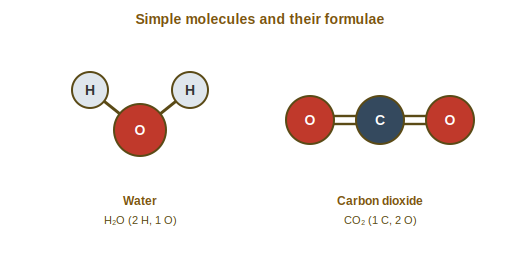
An element contains only one kind of atom; a compound contains two or more kinds chemically joined in a fixed ratio. A chemical formula records this: water is written as H two O, meaning two hydrogen atoms and one oxygen atom, while carbon dioxide is CO two, meaning one carbon and two oxygen atoms. The small numbers, called subscripts, give the count of each atom.
|
Diagram 1 – Simple Molecules
Fig 1. A water molecule has two hydrogen atoms bonded to one oxygen atom; a carbon dioxide molecule has one carbon atom bonded to two oxygen atoms. |
3. Atomic Mass |
Atoms are weighed by comparison, using relative atomic mass, which compares the mass of an atom with a standard. On this scale hydrogen is about 1, carbon about 12 and oxygen about 16. These relative masses let us work out the mass of a molecule by adding up the masses of its atoms.
| Element | Symbol | Relative Atomic Mass |
| Hydrogen | H | 1 |
| Carbon | C | 12 |
| Nitrogen | N | 14 |
| Oxygen | O | 16 |
| Sodium | Na | 23 |
| Chlorine | Cl | 35.5 |
4. Molecular and Formula Mass |
The molecular mass of a substance is the sum of the relative atomic masses of all the atoms in its formula. For water, H two O, it is 1 + 1 + 16 = 18. For carbon dioxide, CO two, it is 12 + 16 + 16 = 44. For substances that are not simple molecules, such as common salt, the same sum is called the formula mass.
5. The Mole Concept |
Because single atoms are so tiny, chemists count them in large, fixed groups called moles. One mole of any substance has a mass in grams equal to its molecular or formula mass, and it always contains the same huge number of particles, about 6 followed by 23 zeros, known as Avogadro’s number. The link is simple: number of moles = mass ÷ molar mass.
|
Watch out A mole is a count of particles, like a dozen is a count of twelve. One mole of water and one mole of carbon dioxide contain the same number of molecules, but they do not have the same mass.
|
6. Counting Particles |
Once we know the number of moles, we can find the number of particles by multiplying by Avogadro’s number. So 2 moles of any substance contain twice Avogadro’s number of particles. This is how chemists move between a measurable mass in grams and the actual number of atoms or molecules taking part in a reaction.
7. Key Reasoning (Principles) |
|
Principle 1: Molecular mass is a sum To find a molecular or formula mass, add the relative atomic mass of every atom shown in the formula, counting each atom the number of times it appears. |
|
Principle 2: Moles link mass and number Number of moles = mass ÷ molar mass. One mole has a mass in grams equal to the molecular mass and always contains Avogadro’s number of particles. |
|
Principle 3: Equal moles, equal counts Equal numbers of moles of any substances contain equal numbers of particles, even though their masses differ. |
8. Worked Examples |
| Example 1 |
|
Q: Find the molecular mass of water, H two O. (H = 1, O = 16) ▶ Show SolutionAdd the masses: 1 + 1 + 16. = 18. Answer: 18. |
| Example 2 |
|
Q: Find the molecular mass of carbon dioxide, CO two. (C = 12, O = 16) ▶ Show Solution12 + 16 + 16. = 44. Answer: 44. |
| Example 3 |
|
Q: Find the molecular mass of oxygen gas, O two. (O = 16) ▶ Show Solution16 + 16. = 32. Answer: 32. |
| Example 4 |
|
Q: How many moles are there in 36 g of water? (molar mass 18) ▶ Show SolutionMoles = mass ÷ molar mass = 36 ÷ 18. = 2 mol. Answer: 2 mol. |
| Example 5 |
|
Q: Find the mass of 0.5 mol of carbon dioxide. (molar mass 44) ▶ Show SolutionMass = moles × molar mass = 0.5 × 44. = 22 g. Answer: 22 g. |
| Example 6 |
|
Q: Find the formula mass of common salt, NaCl. (Na = 23, Cl = 35.5) ▶ Show Solution23 + 35.5. = 58.5. Answer: 58.5. |
| Example 7 |
|
Q: Find the molecular mass of methane, CH four. (C = 12, H = 1) ▶ Show Solution12 + 4 × 1 = 12 + 4. = 16. Answer: 16. |
| Example 8 |
|
Q: How many moles are there in 64 g of oxygen gas? (molar mass 32) ▶ Show SolutionMoles = 64 ÷ 32. = 2 mol. Answer: 2 mol. |
| Example 9 |
|
Q: Find the mass of 3 mol of water. (molar mass 18) ▶ Show SolutionMass = 3 × 18. = 54 g. Answer: 54 g. |
| Example 10 |
|
Q: Which contains more molecules: 1 mol of water or 1 mol of carbon dioxide? ▶ Show SolutionOne mole of any substance contains the same number of particles. Answer: They contain the same number of molecules. |
9. Practice Sets A to D |
| Set A – Multiple Choice (Basic) |
|
1. The smallest particle of an element is the: (a) molecule (b) atom (c) mole (d) compound 2. The formula H two O means: (a) 2 oxygen, 1 hydrogen (b) 2 hydrogen, 1 oxygen (c) 1 hydrogen, 1 oxygen (d) 2 of each 3. The relative atomic mass of oxygen is about: (a) 1 (b) 12 (c) 16 (d) 32 4. One mole of a substance has a mass in grams equal to its: (a) atomic number (b) molecular mass (c) charge (d) volume 5. Number of moles equals: (a) mass times molar mass (b) mass divided by molar mass (c) molar mass divided by mass (d) mass plus molar mass ▶ Reveal Answers1. (b) atom. 2. (b) 2 hydrogen, 1 oxygen. 3. (c) 16. 4. (b) molecular mass. 5. (b) mass divided by molar mass. |
| Set B – Short Answer (Understanding) |
|
1. What is the difference between an element and a compound? 2. How do you find the molecular mass of a substance? 3. What does one mole of a substance contain? 4. Write the relationship between moles, mass and molar mass. 5. Why do chemists use the mole instead of counting atoms one by one? ▶ Reveal Answers1. An element has only one kind of atom; a compound has two or more kinds chemically joined. 2. Add the relative atomic masses of all the atoms shown in its formula. 3. A mass in grams equal to its molecular mass, and Avogadro’s number of particles. 4. Number of moles = mass ÷ molar mass. 5. Because atoms are far too small and too many to count individually, so a fixed large group is used. |
| Set C – Application and Reasoning |
|
1. Find the molecular mass of ammonia, NH three. (N = 14, H = 1) 2. How many moles are in 90 g of water? (molar mass 18) 3. Find the mass of 2 mol of carbon dioxide. (molar mass 44) 4. Find the molecular mass of hydrogen gas, H two. (H = 1) 5. Which has more particles: 2 mol of oxygen or 1 mol of oxygen? ▶ Reveal Answers1. 14 + 3 × 1 = 17. 2. 90 ÷ 18 = 5 mol. 3. 2 × 44 = 88 g. 4. 1 + 1 = 2. 5. 2 mol of oxygen has more particles, twice as many as 1 mol. |
| Set D – Higher Order (Challenge) |
|
1. Find the molecular mass of glucose, C six H twelve O six. (C = 12, H = 1, O = 16) 2. How many moles are in 88 g of carbon dioxide? (molar mass 44) 3. Find the mass of 0.25 mol of water. (molar mass 18) 4. Explain why 1 mol of water and 1 mol of carbon dioxide have the same number of molecules but different masses. 5. Find the formula mass of calcium carbonate, CaCO three. (Ca = 40, C = 12, O = 16) ▶ Reveal Answers1. 6 × 12 + 12 × 1 + 6 × 16 = 72 + 12 + 96 = 180. 2. 88 ÷ 44 = 2 mol. 3. 0.25 × 18 = 4.5 g. 4. Both have one mole, so both hold Avogadro’s number of molecules; their masses differ because the molecules themselves have different molecular masses. 5. 40 + 12 + 3 × 16 = 40 + 12 + 48 = 100. |
|
Chapter Summary
|
|||||||||||||||||||||||||||||||
| 8-Point Exam Quick-Check | ||||||||||||||||||||||||||||||||
|
||||||||||||||||||||||||||||||||
|
School Revise Virtual Lab Explore these ideas with interactive simulations and visual tools.
|
|
Class 9 Science Chapter 9: Atomic Foundations of Matter, Complete Notes and Practice This revision guide follows the NCERT 2026 to 27 Exploration syllabus and builds from atoms to chemical quantities, covering atoms and molecules, elements, compounds and formulae, relative atomic mass, molecular and formula mass, and the mole concept linking mass to number, with a molecule diagram, ten worked examples and graded practice. Visit SchoolRevise.com to revise, practise and excel. |
 Google