Curriculum
Science Grade IX
Science Grade 9
0/13
-
Chapter 1: Exploration: Entering the World of Secondary Science
 Preview
 -
Chapter 2: Cell: The Building Block of Life
Preview
-
Chapter 3: Tissues in Action
Preview
-
Chapter 4: Describing Motion Around Us
Preview
-
Chapter 5: Exploring Mixtures and Their Separation
Preview
-
Chapter 6: How Forces Affect Motion
Preview
-
Chapter 7: Work, Energy, and Simple Machines
Preview
-
Chapter 8: Journey Inside the Atom
Preview
-
Chapter 9: Atomic Foundations of Matter
Preview
-
Chapter 10: Sound Waves: Characteristics and Applications
Preview
-
Chapter 11: Reproduction: How Life Continues
Preview
-
Chapter 12: Patterns in Life: Diversity and Classification
Preview
-
Chapter 13: Earth as a System: Energy, Matter, and Life
Preview
Exploration Work Sheets
0/13

Advanced
0/10
Chapter 5: Exploring Mixtures and Their Separation
|
Grade 9 Science | Chapter 5 Exploring Mixtures and Their SeparationMost things around us are mixtures. This chapter sorts substances into pure and mixed, classifies the kinds of mixture, and shows how their parts can be separated.
|
|
Contents
|
1. Introduction: Pure Substances and Mixtures |
A pure substance is made of only one kind of particle and has fixed properties, such as pure water or pure copper. A mixture contains two or more substances that are not chemically joined and keep their own properties, such as salt water or air. Because the parts of a mixture are only mixed, not bonded, they can be separated again by physical methods.
Separating mixtures matters everywhere, from getting clean drinking water to refining fuels. The method we choose always depends on some physical difference between the parts, such as particle size, boiling point or solubility.
|
Core idea The parts of a mixture keep their own properties and are not chemically joined, so they can be separated by a physical method chosen to suit some difference between them.
|
2. Types of Mixtures |
A homogeneous mixture has the same composition throughout and the parts cannot be seen separately, such as salt dissolved in water (a solution). A heterogeneous mixture has visibly different parts, such as sand in water. Mixtures of a solid in a liquid are further described as solutions, suspensions or colloids, depending on particle size.
| Type | Particle Size | Settles or Filters? | Example |
| Solution | Very small, dissolved | Does not settle or filter out | Salt water, sugar water |
| Suspension | Large, visible | Settles on standing; filters out | Sand in water, muddy water |
| Colloid | In between | Does not settle; scatters light | Milk, fog |
3. Why We Separate Mixtures |
We separate mixtures to obtain a pure substance, to remove a harmful or useless part, or to collect a valuable one. Clean water is made by removing dissolved and suspended impurities; sea water yields salt; and crude oil is split into petrol, diesel and other fuels. In each case the separation uses a physical difference between the parts.
4. Filtration and Evaporation |
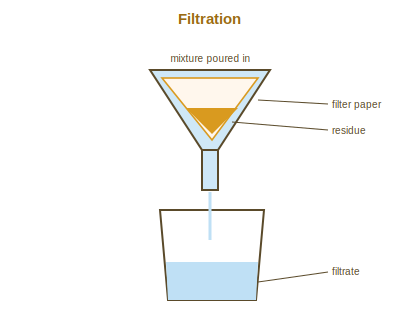
Filtration separates an insoluble solid from a liquid by passing the mixture through a filter paper. The solid stays on the paper as the residue, while the liquid passes through as the filtrate. Evaporation removes a liquid by heating, leaving a dissolved solid behind, which is how salt is obtained from salt water.
|
Diagram 1 – Filtration
Fig 1. The mixture is poured into a funnel lined with filter paper; the insoluble solid is held back as residue while the liquid passes through as filtrate. |
5. Distillation |
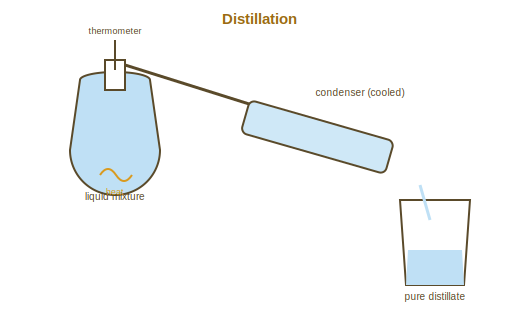
Distillation separates a liquid from a solution, or two liquids, using their different boiling points. The mixture is heated until a liquid boils to vapour; the vapour passes into a cooled condenser, where it turns back to liquid and is collected as the pure distillate. When two liquids have boiling points that are close, fractional distillation is used, separating them in stages.
|
Diagram 2 – Distillation
Fig 2. The mixture is heated, the vapour travels to a cooled condenser where it turns back to liquid, and the pure distillate is collected. |
6. The Separating Funnel and Other Methods |
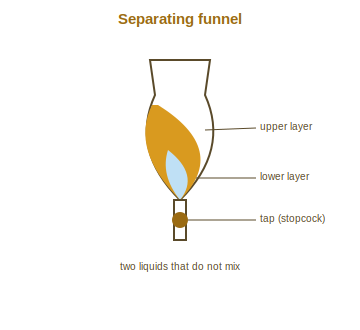
A separating funnel separates two liquids that do not mix, such as oil and water, which settle into layers. Opening the tap lets the lower layer run out first, leaving the upper layer behind. Other methods include using a magnet to remove iron filings, and hand-picking to remove large visible pieces. The right method always depends on the difference being exploited.
|
Diagram 3 – Separating Funnel
Fig 3. Two liquids that do not mix settle into layers; the tap is opened to run off the lower layer, separating the two. |
7. Key Reasoning (Principles) |
|
Principle 1: Separation needs a physical difference Every separation method works by exploiting a difference in a physical property between the parts of a mixture, such as size, boiling point, solubility or magnetism. |
|
Principle 2: Distillation uses boiling point Distillation works because the parts boil at different temperatures, so the one with the lower boiling point turns to vapour first and can be collected. |
|
Principle 3: Filtration uses particle size Filtration works because the filter paper has tiny holes that let small dissolved particles and liquid through but hold back larger insoluble particles. |
8. Worked Examples |
| Example 1 |
|
Q: State one difference between a pure substance and a mixture. ▶ Show SolutionA pure substance has only one kind of particle; a mixture has two or more not chemically joined. Answer: A pure substance has one kind of particle; a mixture has several. |
| Example 2 |
|
Q: Which method would separate sand from water? ▶ Show SolutionSand is insoluble and large, so filtration holds it back as residue. Answer: Filtration. |
| Example 3 |
|
Q: How would you obtain salt from salt water? ▶ Show SolutionHeat the solution so the water evaporates, leaving the salt behind. Answer: Evaporation. |
| Example 4 |
|
Q: Which property does distillation rely on? ▶ Show SolutionThe parts have different boiling points, so one boils off first. Answer: Difference in boiling point. |
| Example 5 |
|
Q: Name the apparatus used to separate oil from water. ▶ Show SolutionOil and water do not mix and form layers, separated using a separating funnel. Answer: A separating funnel. |
| Example 6 |
|
Q: In filtration, what is the solid left on the paper called? ▶ Show SolutionThe solid held back on the filter paper is the residue. Answer: The residue. |
| Example 7 |
|
Q: Is milk a solution, a suspension or a colloid? ▶ Show SolutionMilk does not settle and scatters light, so it is a colloid. Answer: A colloid. |
| Example 8 |
|
Q: How could you remove iron filings from a mixture of iron filings and sand? ▶ Show SolutionIron is magnetic, so a magnet attracts and removes the iron filings. Answer: Use a magnet. |
| Example 9 |
|
Q: A solution of 20 g of salt is made in 80 g of water. Find the percentage of salt by mass. ▶ Show SolutionTotal mass = 20 + 80 = 100 g. Percentage = (20 ÷ 100) × 100 = 20%. Answer: 20% salt by mass. |
| Example 10 |
|
Q: A sample of sea water contains 35 g of salt in 1000 g of sea water. Find the percentage of salt by mass. ▶ Show SolutionPercentage = (35 ÷ 1000) × 100. = 3.5%. Answer: 3.5% salt by mass. |
9. Practice Sets A to D |
| Set A – Multiple Choice (Basic) |
|
1. Salt water is an example of a: (a) pure substance (b) compound (c) mixture (d) element 2. An insoluble solid is separated from a liquid by: (a) distillation (b) filtration (c) a magnet (d) hand-picking 3. Distillation separates substances using their different: (a) colours (b) boiling points (c) masses (d) shapes 4. Milk is best described as a: (a) solution (b) suspension (c) colloid (d) pure substance 5. Iron filings can be removed from sand using a: (a) filter (b) funnel (c) magnet (d) flame ▶ Reveal Answers1. (c) mixture. 2. (b) filtration. 3. (b) boiling points. 4. (c) colloid. 5. (c) magnet. |
| Set B – Short Answer (Understanding) |
|
1. Define a mixture. 2. What is the difference between a residue and a filtrate? 3. Why does distillation need a condenser? 4. State one difference between a solution and a suspension. 5. Why can the parts of a mixture be separated by physical methods? ▶ Reveal Answers1. A mixture contains two or more substances that are not chemically joined and keep their own properties. 2. The residue is the solid left on the filter paper; the filtrate is the liquid that passes through. 3. The condenser cools the vapour so it turns back into liquid that can be collected. 4. A solution does not settle and cannot be filtered; a suspension settles and can be filtered out. 5. Because the parts are only mixed, not chemically bonded, so a physical difference can be used to separate them. |
| Set C – Application and Reasoning |
|
1. Which method would separate a mixture of water and alcohol that have different boiling points? 2. A child mixes chalk powder with water. How would you recover the chalk? 3. Why is evaporation, not filtration, used to get salt from salt water? 4. A 50 g solution contains 5 g of sugar. Find the percentage of sugar by mass. 5. Suggest how petrol and diesel are separated from crude oil. ▶ Reveal Answers1. Distillation, because the two liquids boil at different temperatures. 2. Filter the mixture; the insoluble chalk stays on the paper as residue. 3. Salt is dissolved, so it passes through a filter; evaporating the water leaves the salt behind. 4. (5 ÷ 50) × 100 = 10% sugar by mass. 5. By fractional distillation, which separates the parts in stages using their different boiling points. |
| Set D – Higher Order (Challenge) |
|
1. Explain how you would obtain pure water from muddy, salty water, naming each step. 2. A mixture contains sand, iron filings and salt dissolved in water. Outline how to separate all three. 3. Why does a colloid scatter light while a true solution does not? 4. A 200 g salt solution is found to be 8% salt by mass. Find the mass of salt present. 5. Explain why the choice of separation method always depends on a physical property. ▶ Reveal Answers1. Filter to remove the mud (residue), then distil the salty filtrate; the water boils off, condenses and is collected as pure water, leaving the salt behind. 2. Use a magnet to remove the iron filings, filter to remove the sand, then evaporate the filtrate to recover the salt. 3. A colloid has particles large enough to scatter light, while a true solution has particles too small to scatter it. 4. 8% of 200 g = (8 ÷ 100) × 200 = 16 g of salt. 5. Each method exploits a particular difference, such as boiling point or particle size, so the method must match the property that differs between the parts. |
|
Chapter Summary
|
|||||||||||||||||||||||||||||||
| 8-Point Exam Quick-Check | ||||||||||||||||||||||||||||||||
|
||||||||||||||||||||||||||||||||
|
School Revise Virtual Lab Explore these ideas with interactive simulations and visual tools.
|
|
Class 9 Science Chapter 5: Exploring Mixtures and Their Separation, Complete Notes and Practice This revision guide follows the NCERT 2026 to 27 Exploration syllabus and explains pure substances and mixtures, covering homogeneous and heterogeneous mixtures, solutions, suspensions and colloids, and the methods of filtration, evaporation, distillation, fractional distillation and the separating funnel, with three labelled diagrams, ten worked examples and graded practice. Visit SchoolRevise.com to revise, practise and excel. |
 Google