Curriculum
Science Grade IX
Science Grade 9
0/13
-
Chapter 1: Exploration: Entering the World of Secondary Science
 Preview
 -
Chapter 2: Cell: The Building Block of Life
Preview
-
Chapter 3: Tissues in Action
Preview
-
Chapter 4: Describing Motion Around Us
Preview
-
Chapter 5: Exploring Mixtures and Their Separation
Preview
-
Chapter 6: How Forces Affect Motion
Preview
-
Chapter 7: Work, Energy, and Simple Machines
Preview
-
Chapter 8: Journey Inside the Atom
Preview
-
Chapter 9: Atomic Foundations of Matter
Preview
-
Chapter 10: Sound Waves: Characteristics and Applications
Preview
-
Chapter 11: Reproduction: How Life Continues
Preview
-
Chapter 12: Patterns in Life: Diversity and Classification
Preview
-
Chapter 13: Earth as a System: Energy, Matter, and Life
Preview
Exploration Work Sheets
0/13

Advanced
0/10
Chapter 13: Earth as a System: Energy, Matter, and Life
|
Grade 9 Science | Chapter 13 Earth as a System: Energy, Matter, and LifeOur planet works as one connected system. This chapter explores Earth’s four spheres and how energy and matter flow between them through great natural cycles.
|
|
Contents
|
1. Introduction: Earth as a System |
The Earth is best understood not as separate parts but as one connected system, in which rock, water, air and living things constantly interact. A change in one part affects the others. This chapter, newly introduced in Class 9, looks at Earth’s major parts, called spheres, and at how energy and matter move between them.
Two big ideas run through the chapter. Energy, mostly from the Sun, flows through the system and drives its processes. Matter, such as water and carbon, is not used up but cycles round and round, used again and again. Together these ideas explain how the planet stays in balance.
|
Core idea Earth is a single system of interacting spheres. Energy flows through it from the Sun, while matter such as water and carbon is recycled through natural cycles.
|
2. The Four Spheres |
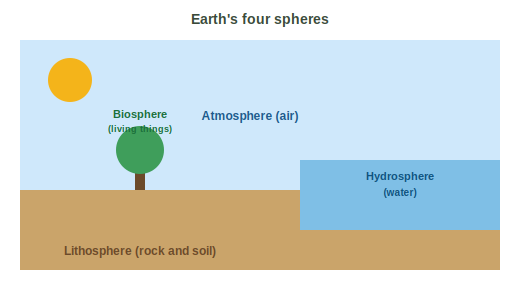
Scientists describe Earth using four overlapping spheres. The lithosphere is the solid rock and soil; the hydrosphere is all the water, in seas, rivers, ice and underground; the atmosphere is the layer of air around the planet; and the biosphere is all the living things. These spheres meet and interact, for example where a plant (biosphere) draws water (hydrosphere) from the soil (lithosphere) and gas from the air (atmosphere).
|
Diagram 1 – Earth’s Four Spheres
Fig 1. The lithosphere of rock and soil, the hydrosphere of water, the atmosphere of air, and the biosphere of living things, all meeting and interacting. |
3. Energy Flows from the Sun |
Almost all the energy that drives Earth’s processes comes from the Sun. Sunlight warms the land, sea and air, drives the winds and the water cycle, and is captured by plants to make food, which then supports nearly all life. Unlike matter, energy is not recycled within the system; it flows in from the Sun and is eventually lost back to space as heat.
4. Matter Cycles: An Overview |
While energy flows through and leaves, matter is recycled. The same atoms of water, carbon, nitrogen and other substances are used over and over as they move between the spheres. These repeating journeys are called biogeochemical cycles, because they involve living things (bio), the Earth (geo) and chemical change. The water cycle and the carbon cycle are two important examples.
5. The Water Cycle |
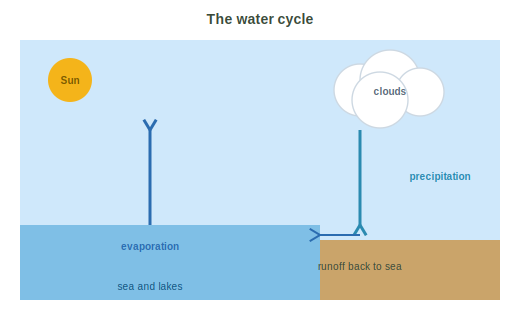
In the water cycle, the Sun’s heat causes water to evaporate from seas and lakes into the air. The vapour cools and condenses into clouds, then falls as precipitation, rain or snow. Some water soaks into the ground and some runs over the surface back to rivers and seas, where the cycle begins again. The same water is used endlessly.
|
Diagram 2 – The Water Cycle
Fig 2. The Sun drives evaporation from the sea; vapour condenses into clouds, falls as precipitation, and runs back to the sea, repeating endlessly. |
6. The Carbon Cycle |
In the carbon cycle, carbon moves between the air, living things and the Earth. Plants take carbon dioxide from the air to make food; animals eat plants and release carbon dioxide when they breathe out. Decay and burning also return carbon to the air. In this way the same carbon atoms move round the system again and again, linking the spheres together.
|
Watch out Energy flows through the Earth system and is lost to space, but matter cycles within it. Do not confuse the one-way flow of energy with the round-and-round cycling of matter.
|
7. Key Reasoning (Principles) |
|
Principle 1: The spheres interact The lithosphere, hydrosphere, atmosphere and biosphere are connected, so a change in one sphere can affect the others. |
|
Principle 2: Matter is recycled Substances such as water and carbon are not used up; the same atoms cycle through the spheres again and again. |
|
Principle 3: Energy flows one way Energy enters mostly from the Sun, drives the system’s processes, and is eventually lost to space; it is not recycled. |
8. Worked Examples |
| Example 1 |
|
Q: Name the four spheres of the Earth system. ▶ Show SolutionThe lithosphere, hydrosphere, atmosphere and biosphere. Answer: Lithosphere, hydrosphere, atmosphere, biosphere. |
| Example 2 |
|
Q: Which sphere contains all the living things? ▶ Show SolutionThe biosphere is made of all living things. Answer: The biosphere. |
| Example 3 |
|
Q: Which sphere is the layer of air around the Earth? ▶ Show SolutionThe atmosphere is the layer of air. Answer: The atmosphere. |
| Example 4 |
|
Q: Where does most of the energy for Earth’s processes come from? ▶ Show SolutionAlmost all of it comes from the Sun. Answer: The Sun. |
| Example 5 |
|
Q: In the water cycle, what is evaporation? ▶ Show SolutionEvaporation is water turning to vapour and rising into the air, driven by the Sun’s heat. Answer: Water turning to vapour and rising into the air. |
| Example 6 |
|
Q: What is precipitation? ▶ Show SolutionPrecipitation is water falling from clouds as rain or snow. Answer: Water falling from clouds as rain or snow. |
| Example 7 |
|
Q: Name two examples of biogeochemical cycles. ▶ Show SolutionThe water cycle and the carbon cycle. Answer: The water cycle and the carbon cycle. |
| Example 8 |
|
Q: In the carbon cycle, how do plants take in carbon? ▶ Show SolutionPlants take carbon dioxide from the air to make food. Answer: By taking carbon dioxide from the air. |
| Example 9 |
|
Q: Is energy recycled in the Earth system? Explain briefly. ▶ Show SolutionNo; energy flows in from the Sun and is lost to space, while matter is recycled. Answer: No; energy flows through and is lost, only matter cycles. |
| Example 10 |
|
Q: Give one example of two spheres interacting. ▶ Show SolutionA plant (biosphere) takes water (hydrosphere) from the soil (lithosphere). Answer: A plant drawing water from the soil (biosphere, hydrosphere, lithosphere). |
9. Practice Sets A to D |
| Set A – Multiple Choice (Basic) |
|
1. The solid rock and soil of the Earth is the: (a) hydrosphere (b) lithosphere (c) atmosphere (d) biosphere 2. All the water on Earth makes up the: (a) lithosphere (b) atmosphere (c) hydrosphere (d) biosphere 3. Most of the energy driving Earth’s processes comes from the: (a) Moon (b) Sun (c) wind (d) sea 4. Water turning to vapour and rising is called: (a) condensation (b) precipitation (c) evaporation (d) runoff 5. Rain and snow falling from clouds is called: (a) evaporation (b) precipitation (c) the biosphere (d) runoff ▶ Reveal Answers1. (b) lithosphere. 2. (c) hydrosphere. 3. (b) Sun. 4. (c) evaporation. 5. (b) precipitation. |
| Set B – Short Answer (Understanding) |
|
1. Name the four spheres of the Earth. 2. What is a biogeochemical cycle? 3. State one difference between how energy and matter move in the Earth system. 4. List the main steps of the water cycle. 5. Why is the Earth described as a system? ▶ Reveal Answers1. The lithosphere, hydrosphere, atmosphere and biosphere. 2. A natural cycle in which matter such as water or carbon moves repeatedly between the spheres. 3. Energy flows through and is lost to space, while matter is recycled within the system. 4. Evaporation, condensation into clouds, precipitation, and runoff back to the sea. 5. Because its parts are connected and interact, so a change in one affects the others. |
| Set C – Application and Reasoning |
|
1. A river carries rock fragments to the sea. Which two spheres are interacting? 2. Explain why the Sun is essential to the water cycle. 3. How do animals return carbon to the air? 4. Why does the same water get used again and again? 5. Give an example of the biosphere interacting with the atmosphere. ▶ Reveal Answers1. The hydrosphere (river water) and the lithosphere (rock). 2. The Sun’s heat causes evaporation, the first step that lifts water into the air. 3. By breathing out carbon dioxide, and through decay after they die. 4. Because water is recycled through the water cycle, not used up. 5. A plant takes carbon dioxide from the air, or an animal breathes air in and out. |
| Set D – Higher Order (Challenge) |
|
1. Explain how a single drop of water might move through three different spheres. 2. Discuss why cutting down many forests could affect more than just the biosphere. 3. Compare the flow of energy and the cycling of matter in the Earth system. 4. Trace how a carbon atom could move from the air into an animal and back to the air. 5. Explain how the four spheres might all take part in growing a single plant. ▶ Reveal Answers1. A drop may evaporate from the sea (hydrosphere) into the air (atmosphere), fall as rain and be taken up by a tree (biosphere), showing movement through three spheres. 2. Forests affect the atmosphere by exchanging gases, the hydrosphere by holding water, and the lithosphere by holding soil, so their loss affects all the spheres. 3. Energy flows one way, in from the Sun and out to space; matter such as water and carbon cycles round and is reused. 4. Carbon dioxide in the air is taken up by a plant to make food, an animal eats the plant, and the animal breathes the carbon back out as carbon dioxide. 5. The plant grows in soil (lithosphere), drinks water (hydrosphere), takes carbon dioxide from the air (atmosphere) and is itself part of the biosphere. |
|
Chapter Summary
|
|||||||||||||||||||||||||||||||
| 8-Point Exam Quick-Check | ||||||||||||||||||||||||||||||||
|
||||||||||||||||||||||||||||||||
|
School Revise Virtual Lab Explore these ideas with interactive simulations and visual tools.
|
|
Class 9 Science Chapter 13: Earth as a System, Energy, Matter and Life, Complete Notes and Practice This revision guide follows the NCERT 2026 to 27 Exploration syllabus and views the planet as one connected system, covering the four spheres of lithosphere, hydrosphere, atmosphere and biosphere, the flow of energy from the Sun, and the cycling of matter through the water cycle and the carbon cycle, with two labelled diagrams, ten worked examples and graded practice. Visit SchoolRevise.com to revise, practise and excel. |
 Google