Curriculum
Science Grade IX
Science Grade 9
0/13
-
Chapter 1: Exploration: Entering the World of Secondary Science
 Preview
 -
Chapter 2: Cell: The Building Block of Life
Preview
-
Chapter 3: Tissues in Action
Preview
-
Chapter 4: Describing Motion Around Us
Preview
-
Chapter 5: Exploring Mixtures and Their Separation
Preview
-
Chapter 6: How Forces Affect Motion
Preview
-
Chapter 7: Work, Energy, and Simple Machines
Preview
-
Chapter 8: Journey Inside the Atom
Preview
-
Chapter 9: Atomic Foundations of Matter
Preview
-
Chapter 10: Sound Waves: Characteristics and Applications
Preview
-
Chapter 11: Reproduction: How Life Continues
Preview
-
Chapter 12: Patterns in Life: Diversity and Classification
Preview
-
Chapter 13: Earth as a System: Energy, Matter, and Life
Preview
Exploration Work Sheets
0/13

Advanced
0/10
Chapter 8: Journey Inside the Atom
|
Grade 9 Science | Chapter 8 Journey Inside the AtomWhat is matter made of at its smallest scale? This chapter travels inside the atom, through the models of Thomson, Rutherford and Bohr, to protons, neutrons, electrons and shells.
|
|
Contents
|
1. Introduction: The Idea of the Atom |
An atom is the smallest particle of an element that keeps the properties of that element. For a long time atoms were thought to be solid, indivisible balls, but a series of clever experiments revealed a rich inner structure: a tiny, dense centre surrounded by mostly empty space in which lighter particles move. This chapter follows that discovery and builds the modern picture of the atom.
Understanding the atom matters because the way electrons are arranged decides how atoms join together, which in turn explains the whole of chemistry. The journey inside the atom is therefore the gateway to bonding, the periodic table and much more.
|
Core idea An atom has a tiny, positively charged nucleus of protons and neutrons, surrounded by light, negatively charged electrons arranged in shells. Most of the atom is empty space.
|
2. Inside the Atom: Three Particles |
Every atom is built from three subatomic particles. Protons carry a positive charge and sit in the nucleus. Neutrons carry no charge and also sit in the nucleus, adding mass. Electrons carry a negative charge, have almost no mass, and move in shells around the nucleus. In a neutral atom the number of protons equals the number of electrons, so the charges balance.
| Particle | Charge | Mass | Location |
| Proton | Positive (+) | About 1 unit | In the nucleus |
| Neutron | None (0) | About 1 unit | In the nucleus |
| Electron | Negative (−) | Almost zero | In shells around the nucleus |
3. How the Model Developed |
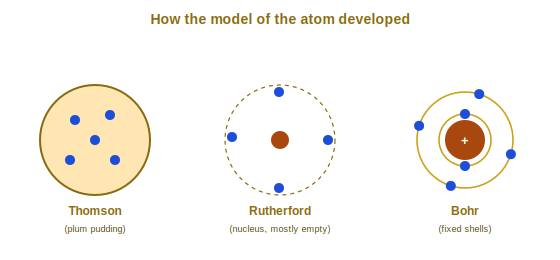
The picture of the atom changed as evidence grew. Thomson imagined a positive sphere with electrons dotted through it, like fruit in a pudding. Rutherford then showed that the positive charge and most of the mass sit in a tiny central nucleus, with electrons far out and most of the atom empty. Bohr refined this by placing the electrons in fixed shells at set distances from the nucleus.
|
Diagram 1 – The Developing Model of the Atom
Fig 1. From Thomson’s plum pudding, to Rutherford’s tiny nucleus in mostly empty space, to Bohr’s electrons in fixed shells. |
4. Atomic Number and Mass Number |
The atomic number (Z) is the number of protons in an atom, and it identifies the element. The mass number (A) is the total number of protons and neutrons. So the number of neutrons is A minus Z, and in a neutral atom the number of electrons equals the atomic number Z.
|
Watch out Mass number counts protons and neutrons, not electrons, because electrons have almost no mass. Number of neutrons = mass number minus atomic number.
|
5. Electron Shells and Configuration |
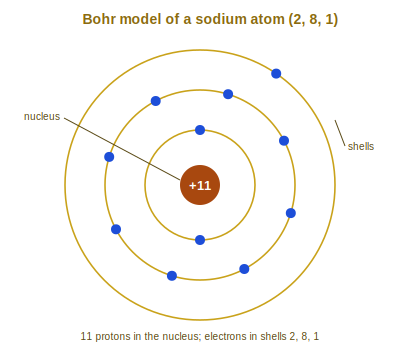
Electrons occupy shells around the nucleus, filling the inner shells first. The first shell holds up to 2 electrons and the next shells up to 8 for the light elements. Writing how the electrons are spread across the shells gives the electronic configuration, such as 2, 8, 1 for sodium. The electrons in the outermost shell largely decide how an atom reacts.
|
Diagram 2 – Bohr Model of a Sodium Atom
Fig 2. A sodium atom has 11 protons in the nucleus and 11 electrons arranged in shells as 2, 8, 1. |
6. Isotopes |
Isotopes are atoms of the same element that have the same number of protons but different numbers of neutrons, so they have the same atomic number but different mass numbers. Carbon, for example, exists as carbon with 6 neutrons and carbon with 8 neutrons. Isotopes behave the same chemically because they have the same number of electrons.
7. Key Reasoning (Principles) |
|
Principle 1: Protons define the element The atomic number, the number of protons, decides which element an atom is. Change the proton number and you change the element. |
|
Principle 2: Neutral atoms balance charge In a neutral atom the number of negative electrons equals the number of positive protons, so the charges cancel exactly. |
|
Principle 3: Outer electrons drive chemistry The electrons in the outermost shell decide how an atom bonds and reacts, which is why electronic configuration is so important. |
8. Worked Examples |
| Example 1 |
|
Q: An atom has atomic number 6 and mass number 12. Find its protons, electrons and neutrons. ▶ Show SolutionProtons = atomic number = 6. Electrons = 6 (neutral atom). Neutrons = 12 minus 6 = 6. Answer: 6 protons, 6 electrons, 6 neutrons. |
| Example 2 |
|
Q: Write the electronic configuration of carbon (atomic number 6). ▶ Show SolutionFirst shell holds 2, the rest go in the next shell. So 2, 4. Answer: 2, 4. |
| Example 3 |
|
Q: An atom has atomic number 11 and mass number 23. Find the number of neutrons. ▶ Show SolutionNeutrons = mass number minus atomic number = 23 minus 11. = 12. Answer: 12 neutrons. |
| Example 4 |
|
Q: Write the electronic configuration of sodium (atomic number 11). ▶ Show SolutionFill 2, then 8, then the rest. 2, 8, 1. Answer: 2, 8, 1. |
| Example 5 |
|
Q: An oxygen atom has atomic number 8 and mass number 16. Find its protons, electrons and neutrons. ▶ Show SolutionProtons = 8; electrons = 8; neutrons = 16 minus 8 = 8. Answer: 8 protons, 8 electrons, 8 neutrons. |
| Example 6 |
|
Q: Write the electronic configuration of oxygen (atomic number 8). ▶ Show Solution2 in the first shell, 6 in the second. 2, 6. Answer: 2, 6. |
| Example 7 |
|
Q: A chlorine atom has atomic number 17 and mass number 35. Find the number of neutrons. ▶ Show SolutionNeutrons = 35 minus 17 = 18. Answer: 18 neutrons. |
| Example 8 |
|
Q: Write the electronic configuration of chlorine (atomic number 17). ▶ Show SolutionFill 2, then 8, then 7. 2, 8, 7. Answer: 2, 8, 7. |
| Example 9 |
|
Q: Which particle in the atom decides which element it is? ▶ Show SolutionThe number of protons (the atomic number) identifies the element. Answer: The proton (atomic number). |
| Example 10 |
|
Q: Two atoms have the same protons but different neutrons. What are they called? ▶ Show SolutionSame protons, different neutrons means same element, different mass: isotopes. Answer: Isotopes. |
9. Practice Sets A to D |
| Set A – Multiple Choice (Basic) |
|
1. The positively charged particle in the nucleus is the: (a) electron (b) proton (c) neutron (d) ion 2. Most of the atom is: (a) nucleus (b) protons (c) empty space (d) electrons 3. The atomic number is the number of: (a) neutrons (b) protons (c) electrons and neutrons (d) shells 4. Which scientist placed electrons in fixed shells? (a) Thomson (b) Rutherford (c) Bohr (d) Dalton 5. Atoms with the same protons but different neutrons are: (a) ions (b) molecules (c) isotopes (d) elements ▶ Reveal Answers1. (b) proton. 2. (c) empty space. 3. (b) protons. 4. (c) Bohr. 5. (c) isotopes. |
| Set B – Short Answer (Understanding) |
|
1. Name the three subatomic particles and their charges. 2. How do you find the number of neutrons in an atom? 3. What does the atomic number tell you? 4. Why is a neutral atom electrically neutral? 5. What is an isotope? ▶ Reveal Answers1. Protons (positive), neutrons (no charge) and electrons (negative). 2. Number of neutrons = mass number minus atomic number. 3. It gives the number of protons, which identifies the element. 4. Because the number of negative electrons equals the number of positive protons, so the charges balance. 5. An atom of the same element with the same protons but a different number of neutrons. |
| Set C – Application and Reasoning |
|
1. An atom has atomic number 7 and mass number 14. Find its protons, electrons and neutrons. 2. Write the electronic configuration of an atom with 13 electrons. 3. An atom has 19 protons and 20 neutrons. Find its mass number. 4. Write the electronic configuration of an atom with atomic number 2. 5. Why do isotopes of an element behave the same chemically? ▶ Reveal Answers1. 7 protons, 7 electrons, 14 minus 7 = 7 neutrons. 2. 2, 8, 3. 3. Mass number = 19 + 20 = 39. 4. 2. 5. Because they have the same number of electrons, especially in the outer shell, which decides chemistry. |
| Set D – Higher Order (Challenge) |
|
1. An atom has mass number 40 and 21 neutrons. Find its atomic number and electronic configuration. 2. Explain how Rutherford’s model differs from Thomson’s. 3. An atom has the configuration 2, 8, 7. State its atomic number and predict whether it reacts easily. 4. A neutral atom gains one electron. What happens to its overall charge and why? 5. Why did the model of the atom change over time? ▶ Reveal Answers1. Atomic number = mass number minus neutrons = 40 minus 21 = 19, so configuration 2, 8, 8, 1. 2. Thomson imagined a positive sphere with electrons spread through it; Rutherford showed a tiny central nucleus with electrons far out and most of the atom empty. 3. Atomic number 8 + 7 = … it is 2 + 8 + 7 = 17, so atomic number 17; with 7 outer electrons it reacts easily to gain one more. 4. It becomes negatively charged, because it now has one more electron than protons. 5. Because new experiments gave evidence that the older model could not explain, so the model was revised to fit the data. |
|
Chapter Summary
|
|||||||||||||||||||||||||||||||
| 8-Point Exam Quick-Check | ||||||||||||||||||||||||||||||||
|
||||||||||||||||||||||||||||||||
|
School Revise Virtual Lab Explore these ideas with interactive simulations and visual tools.
|
|
Class 9 Science Chapter 8: Journey Inside the Atom, Complete Notes and Practice This revision guide follows the NCERT 2026 to 27 Exploration syllabus and explores the structure of the atom, covering protons, neutrons and electrons, the models of Thomson, Rutherford and Bohr, atomic number and mass number, electron shells and configuration, and isotopes, with two labelled diagrams, ten worked examples and graded practice. Visit SchoolRevise.com to revise, practise and excel. |
 Google