Curriculum
Science Grade IX
Science Grade 9
0/13
-
Chapter 1: Exploration: Entering the World of Secondary Science
 Preview
 -
Chapter 2: Cell: The Building Block of Life
Preview
-
Chapter 3: Tissues in Action
Preview
-
Chapter 4: Describing Motion Around Us
Preview
-
Chapter 5: Exploring Mixtures and Their Separation
Preview
-
Chapter 6: How Forces Affect Motion
Preview
-
Chapter 7: Work, Energy, and Simple Machines
Preview
-
Chapter 8: Journey Inside the Atom
Preview
-
Chapter 9: Atomic Foundations of Matter
Preview
-
Chapter 10: Sound Waves: Characteristics and Applications
Preview
-
Chapter 11: Reproduction: How Life Continues
Preview
-
Chapter 12: Patterns in Life: Diversity and Classification
Preview
-
Chapter 13: Earth as a System: Energy, Matter, and Life
Preview
Exploration Work Sheets
0/13

Advanced
0/10
Chapter 2: Cell: The Building Block of Life
|
Grade 9 Science | Chapter 2 Cell: The Building Block of LifeThe smallest unit of life. In this chapter we look inside the cell, from cell theory to the organelles that keep every living thing working, and compare plant and animal cells.
|
|
Contents
|
1. Introduction: The Smallest Living Unit |
Every living thing, from a single bacterium to a blue whale, is built from cells. A cell is the smallest unit that can carry out all the activities of life: taking in materials, releasing energy, growing and producing new cells. Some organisms are a single cell; others, like us, are made of trillions working together.
Inside each cell is a busy set of structures called organelles, each with its own job, much like the rooms and machines of a tiny factory. This chapter looks at what those structures are, what they do, and how plant cells differ from animal cells.
|
Core idea All living things are made of one or more cells, every cell comes from a pre-existing cell, and the cell is the basic unit of structure and function in life. Together these three statements are known as cell theory.
|
|
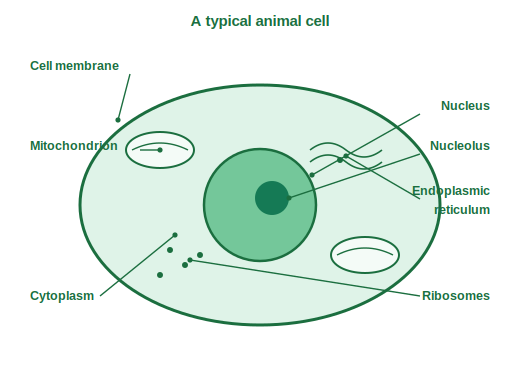
Diagram 1 – A Typical Animal Cell
Fig 1. An animal cell showing the cell membrane, cytoplasm, central nucleus with its nucleolus, mitochondria, endoplasmic reticulum and ribosomes. |
2. Cell Theory |
Cell theory rests on three ideas built up from many observations: first, every living thing is made of one or more cells; second, the cell is the basic unit of structure and function; third, all cells arise from cells that already exist. The third point matters: cells do not appear from non-living matter but form when an existing cell divides, which is why studying how cells divide is central to biology.
| Statement | What It Means |
| Made of cells | Every organism is built from one or more cells. |
| Basic unit | The cell is the smallest unit of structure and function in life. |
| From existing cells | New cells form only when a cell already present divides. |
3. The Cell Membrane and the Cell Wall |
The cell membrane surrounds every cell and decides what passes in and out; it is selectively permeable, letting useful materials enter while keeping others out. Plant cells have an extra layer outside the membrane, a tough cell wall made mainly of cellulose, which gives shape and support. Animal cells have no wall, which is one reason animal bodies are softer and more flexible than the rigid stems of plants.
|
Cell membrane (in all cells) A thin, selectively permeable boundary controlling what enters and leaves the cell. |
|
Cell wall (plant cells only) A rigid outer layer of cellulose that supports the cell and helps it keep its shape. |
4. The Nucleus: Control Centre |
The nucleus is usually the largest organelle and acts as the cell’s control centre. It stores the genetic instructions and directs activities such as growth, repair and division. Within it sits a dense region called the nucleolus. A cell without a working nucleus cannot manage itself or reproduce, which shows how central this organelle is to the life of the cell.
|
Watch out Do not confuse the nucleus with the nucleolus. The nucleolus is a small, dense body found inside the much larger nucleus.
|
5. Mitochondria, Chloroplasts and Energy |
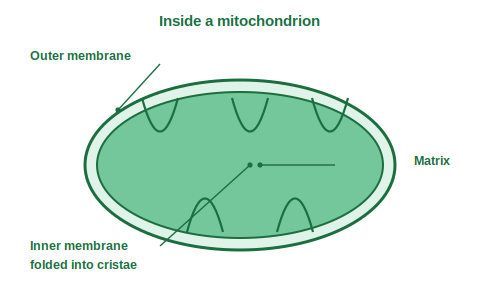
Mitochondria release the energy stored in food through respiration, supplying power for everything the cell does, which is why they are called the powerhouse of the cell. Their inner membrane is deeply folded into cristae, increasing the area available for these reactions. Chloroplasts, found only in plant cells and some others, capture light energy to make food. Together these organelles handle the cell’s energy supply, one releasing it and the other capturing it.
|
Diagram 2 – Inside a Mitochondrion
Fig 2. The mitochondrion has an outer membrane and an inner membrane folded into cristae, with the matrix inside; the folding packs in more reacting area. |
6. Plant Cell and Animal Cell |
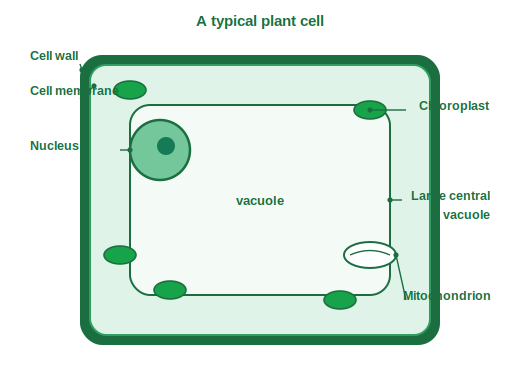
Plant and animal cells share many features: both have a cell membrane, cytoplasm, a nucleus and mitochondria. Plant cells, however, have three extra features: a cell wall for support, chloroplasts for making food, and a large central vacuole that stores cell sap and helps keep the cell firm. Animal cells lack all three and often have only small, temporary vacuoles.
|
Diagram 3 – A Typical Plant Cell
Fig 3. A plant cell showing the cell wall, cell membrane, large central vacuole, a nucleus pushed to one side, chloroplasts and a mitochondrion. |
| Feature | Plant Cell | Animal Cell |
| Cell wall | Present | Absent |
| Chloroplasts | Present | Absent |
| Vacuole | One large central vacuole | Small or absent |
| Shape | Fixed, often rectangular | Rounded, flexible |
| Nucleus | Present, often at the side | Present, often central |
7. Key Reasoning (Principles) |
|
Principle 1: Why cells stay small As a cell grows, its volume rises faster than its surface area. A cube of side 1 has surface area 6 and volume 1 (ratio 6 to 1); doubling the side to 2 gives surface area 24 and volume 8 (ratio 3 to 1). A higher surface area to volume ratio means faster exchange across the membrane, so most cells stay microscopic. |
|
Principle 2: Why plant cells need a wall Water tends to move into a cell, raising the pressure inside. A cell with only a membrane could swell and burst, but the rigid cell wall resists the outward pressure and holds the shape. The firm, pressurised cell is called turgid, and turgid cells support the plant. |
|
Principle 3: Form fits function The folded inner membrane of a mitochondrion packs far more area into a small space. Respiration happens on that membrane, so more area means more energy-releasing reactions. A cell that needs lots of energy therefore has mitochondria with many folds. |
8. Worked Examples |
| Example 1 |
|
Q: State the three points of cell theory. ▶ Show SolutionAll living things are made of one or more cells. The cell is the basic unit of structure and function. All cells come from pre-existing cells. Answer: The three statements above. |
| Example 2 |
|
Q: Name the organelle that controls the activities of the cell. ▶ Show SolutionThe nucleus stores instructions and directs the cell. Answer: The nucleus. |
| Example 3 |
|
Q: A cell of actual length 0.02 mm appears 4 mm long under a microscope. Find the magnification. ▶ Show SolutionMagnification = image size ÷ actual size. = 4 ÷ 0.02 = 200. Answer: 200 times (200×). |
| Example 4 |
|
Q: Under a magnification of 400 times, a structure’s image is 8 mm long. Find its actual size. ▶ Show SolutionActual size = image size ÷ magnification. = 8 ÷ 400 = 0.02 mm. Answer: 0.02 mm. |
| Example 5 |
|
Q: A cube-shaped cell has side 1 mm. Find its surface area to volume ratio. ▶ Show SolutionSurface area = 6 × (1 × 1) = 6 mm². Volume = 1 × 1 × 1 = 1 mm³. Ratio = 6 to 1. Answer: 6 to 1. |
| Example 6 |
|
Q: Repeat for a cube of side 3 mm. What happens to the ratio? ▶ Show SolutionSurface area = 6 × 9 = 54 mm². Volume = 27 mm³. Ratio = 54 to 27 = 2 to 1, smaller than before. Answer: 2 to 1; the ratio falls as the cell grows. |
| Example 7 |
|
Q: Which organelle releases energy from food for the cell to use? ▶ Show SolutionMitochondria carry out respiration to release energy. Answer: The mitochondrion. |
| Example 8 |
|
Q: Give two structures found in a plant cell but not an animal cell. ▶ Show SolutionA cell wall gives support; chloroplasts make food. Answer: Cell wall and chloroplast (also the large central vacuole). |
| Example 9 |
|
Q: Name the jelly-like material that fills the cell and holds the organelles. ▶ Show SolutionThe cytoplasm fills the cell around the organelles. Answer: The cytoplasm. |
| Example 10 |
|
Q: A structure’s image is 12 mm at a magnification of 2000 times. Find its actual size. ▶ Show SolutionActual size = image ÷ magnification. = 12 ÷ 2000 = 0.006 mm. Answer: 0.006 mm. |
9. Practice Sets A to D |
| Set A – Multiple Choice (Basic) |
|
1. The basic unit of life is the: (a) tissue (b) cell (c) organ (d) atom 2. The control centre of the cell is the: (a) membrane (b) vacuole (c) nucleus (d) wall 3. The green organelle that captures light is the: (a) ribosome (b) nucleus (c) chloroplast (d) vacuole 4. Which is present in a plant cell but not an animal cell? (a) nucleus (b) cell wall (c) cytoplasm (d) membrane 5. The powerhouse of the cell is the: (a) nucleus (b) mitochondrion (c) vacuole (d) ribosome ▶ Reveal Answers1. (b) cell. 2. (c) nucleus. 3. (c) chloroplast. 4. (b) cell wall. 5. (b) mitochondrion. |
| Set B – Short Answer (Understanding) |
|
1. State the three points of cell theory. 2. Why is the cell membrane called selectively permeable? 3. Give one function of the large central vacuole. 4. Why are most cells microscopic in size? 5. Give two differences between a plant cell and an animal cell. ▶ Reveal Answers1. All life is made of cells; the cell is the basic unit of life; all cells come from existing cells. 2. It allows some substances to pass through while keeping others out. 3. It stores cell sap and keeps the cell firm (turgid). 4. To keep a high surface area to volume ratio for efficient exchange of materials. 5. A plant cell has a cell wall and chloroplasts; an animal cell has neither (also vacuole size differs). |
| Set C – Application and Reasoning |
|
1. A cell of actual size 0.01 mm appears 5 mm under a microscope. Find the magnification. 2. At a magnification of 250 times, an image is 10 mm long. Find the actual size. 3. A cube-shaped cell has side 2 mm. Find its surface area to volume ratio. 4. Name three parts found in a plant cell but not an animal cell. 5. Which organelle would be most abundant in an active muscle cell, and why? ▶ Reveal Answers1. 5 ÷ 0.01 = 500 times. 2. 10 ÷ 250 = 0.04 mm. 3. Surface area = 24, volume = 8, so the ratio is 3 to 1. 4. Cell wall, chloroplast and large central vacuole. 5. Mitochondria, because muscle cells need a large supply of energy from respiration. |
| Set D – Higher Order (Challenge) |
|
1. Two cube-shaped cells have sides 1 mm and 2 mm. Compare their surface area to volume ratios and say which exchanges materials more efficiently. 2. A microscope magnifies 400 times. A structure’s image is 0.8 mm long. Find its actual size in micrometres (1 mm = 1000 micrometres). 3. Explain how the folded inner membrane of a mitochondrion suits its job. 4. A wilted plant is watered and becomes firm again. Explain the roles of the vacuole and the cell wall. 5. A cell loses its nucleus. Predict what will happen to it and explain why. ▶ Reveal Answers1. Side 1 mm gives 6 to 1; side 2 mm gives 24 to 8 = 3 to 1. The smaller cell has the higher ratio, so it exchanges materials more efficiently. 2. Actual size = 0.8 ÷ 400 = 0.002 mm, which is 2 micrometres. 3. Respiration happens on the inner membrane; folding packs in more area, allowing more energy-releasing reactions and more energy for the cell. 4. Water fills the vacuoles, which swell and press on the rigid cell walls; the walls resist, so the cells become turgid and the plant stands firm. 5. The cell can no longer control its activities or divide, so it will eventually stop working and die, because the nucleus holds the genetic instructions. |
|
Chapter Summary
|
|||||||||||||||||||||||||||||||
| 8-Point Exam Quick-Check | ||||||||||||||||||||||||||||||||
|
||||||||||||||||||||||||||||||||
|
School Revise Virtual Lab Explore these ideas with interactive simulations and visual tools.
|
|
Class 9 Science Chapter 2: Cell, the Building Block of Life, Complete Notes and Practice This revision guide follows the NCERT 2026 to 27 Exploration syllabus and explains the cell as the basic unit of life, covering cell theory, the cell membrane and wall, the nucleus, mitochondria and chloroplasts, the surface area to volume ratio, and the differences between plant and animal cells, with three labelled diagrams, ten worked examples and graded practice. Visit SchoolRevise.com to revise, practise and excel. |
 Google