Curriculum
Science Grade IX
Science Grade 9
0/13
-
Chapter 1: Exploration: Entering the World of Secondary Science
 Preview
 -
Chapter 2: Cell: The Building Block of Life
Preview
-
Chapter 3: Tissues in Action
Preview
-
Chapter 4: Describing Motion Around Us
Preview
-
Chapter 5: Exploring Mixtures and Their Separation
Preview
-
Chapter 6: How Forces Affect Motion
Preview
-
Chapter 7: Work, Energy, and Simple Machines
Preview
-
Chapter 8: Journey Inside the Atom
Preview
-
Chapter 9: Atomic Foundations of Matter
Preview
-
Chapter 10: Sound Waves: Characteristics and Applications
Preview
-
Chapter 11: Reproduction: How Life Continues
Preview
-
Chapter 12: Patterns in Life: Diversity and Classification
Preview
-
Chapter 13: Earth as a System: Energy, Matter, and Life
Preview
Exploration Work Sheets
0/13

Advanced
0/10
Chapter 10: Sound Waves: Characteristics and Applications
|
Grade 9 Science | Chapter 10 Sound Waves: Characteristics and ApplicationsHow does sound travel and reach our ears? This chapter explores sound as a wave, its properties, the echo, and how we hear, with clear diagrams and calculations.
|
|
Contents
|
1. Introduction: What Is Sound? |
Sound is produced by vibrating objects and travels as a wave through a material medium such as air, water or steel. A struck drum or a plucked string sets nearby particles vibrating, and that vibration passes from particle to particle, carrying energy outward. Because sound needs particles to pass on the vibration, it cannot travel through a vacuum.
To describe sound precisely we use the language of waves: wavelength, frequency, amplitude and speed. These quantities explain why one sound is high and another low, why one is loud and another soft, and how fast a sound reaches us.
|
Core idea Sound is a wave made by a vibrating object. It carries energy from particle to particle through a medium, and cannot travel through empty space.
|
2. The Anatomy of a Wave |
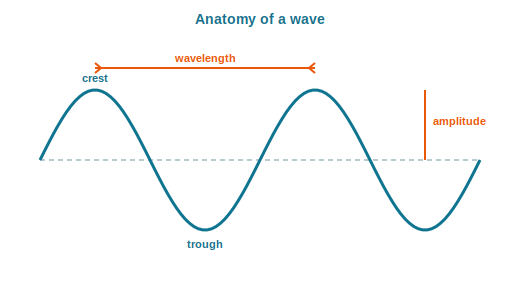
A wave can be drawn as a repeating curve. The high points are crests and the low points are troughs. The wavelength is the distance between two matching points, such as crest to crest. The amplitude is the greatest distance the wave rises from its rest position, and it decides how loud a sound is.
|
Diagram 1 – Anatomy of a Wave
Fig 1. The wavelength is the distance between two crests; the amplitude is the height from the rest line to a crest. Larger amplitude means a louder sound. |
3. Sound as a Pressure Wave |
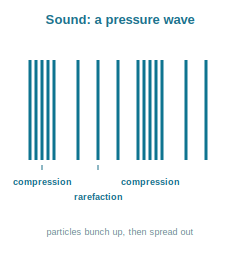
In air, sound travels as a pressure wave. As the source vibrates, it pushes particles together into regions of high pressure called compressions, then leaves regions of low pressure called rarefactions. These compressions and rarefactions move outward, carrying the sound, while the particles themselves only vibrate to and fro about their fixed positions.
|
Diagram 2 – Sound as a Pressure Wave
Fig 2. Sound moves as compressions, where particles bunch up, and rarefactions, where they spread out. |
4. Speed, Frequency and Wavelength |
The frequency of a sound is the number of waves passing a point each second, measured in hertz (Hz); it decides the pitch, with higher frequency giving a higher pitch. The speed, frequency and wavelength are linked by the wave equation, speed = frequency × wavelength, written v = f × λ. The time period is the time for one wave, equal to 1 ÷ frequency.
| Quantity | Symbol | Unit | Decides |
| Frequency | f | hertz (Hz) | pitch (high or low) |
| Amplitude | – | metre | loudness |
| Wavelength | λ | metre | – |
| Speed | v | metre per second | how fast sound travels |
5. Reflection of Sound and Echoes |
Sound reflects off hard surfaces. A reflected sound heard separately from the original is an echo. Because the sound travels to the surface and back, the distance to the surface is half of the speed multiplied by the time, distance = (speed × time) ÷ 2. This idea is used in sonar, which measures the depth of water by timing reflected sound.
6. How We Hear |
The ear collects sound and turns it into signals for the brain. The outer ear funnels sound to the eardrum, which vibrates; tiny bones pass the vibration to the inner ear, where it is changed into nerve signals sent to the brain. A healthy young person can usually hear frequencies from about 20 Hz to about 20000 Hz.
7. Key Reasoning (Principles) |
|
Principle 1: Sound needs a medium Sound passes from particle to particle, so it needs a material medium. In a vacuum there are no particles to carry it, so no sound travels. |
|
Principle 2: The wave equation links the quantities Speed = frequency × wavelength. If the speed is fixed, a higher frequency means a shorter wavelength. |
|
Principle 3: An echo travels twice the distance An echo goes to the reflecting surface and back, so the distance to the surface is half of speed multiplied by total time. |
8. Worked Examples |
| Example 1 |
|
Q: A wave has frequency 200 Hz and wavelength 1.5 m. Find its speed. ▶ Show Solutionv = f × λ = 200 × 1.5. = 300 m/s. Answer: 300 m/s. |
| Example 2 |
|
Q: Sound travels at 340 m/s with wavelength 2 m. Find the frequency. ▶ Show Solutionf = v ÷ λ = 340 ÷ 2. = 170 Hz. Answer: 170 Hz. |
| Example 3 |
|
Q: A 110 Hz sound travels at 330 m/s. Find its wavelength. ▶ Show Solutionλ = v ÷ f = 330 ÷ 110. = 3 m. Answer: 3 m. |
| Example 4 |
|
Q: Find the time period of a 50 Hz sound. ▶ Show SolutionT = 1 ÷ f = 1 ÷ 50. = 0.02 s. Answer: 0.02 s. |
| Example 5 |
|
Q: An echo returns after 2 s. If sound travels at 340 m/s, find the distance to the wall. ▶ Show SolutionDistance = (speed × time) ÷ 2 = (340 × 2) ÷ 2. = 340 m. Answer: 340 m. |
| Example 6 |
|
Q: A sound of speed 340 m/s has wavelength 0.5 m. Find the frequency. ▶ Show Solutionf = 340 ÷ 0.5. = 680 Hz. Answer: 680 Hz. |
| Example 7 |
|
Q: A tuning fork of 256 Hz makes sound of wavelength 1.3 m. Find the speed. ▶ Show Solutionv = 256 × 1.3. = 332.8 m/s. Answer: 332.8 m/s. |
| Example 8 |
|
Q: A wall is 170 m away and sound travels at 340 m/s. Find the time for the echo. ▶ Show SolutionTime = (2 × distance) ÷ speed = (2 × 170) ÷ 340. = 1 s. Answer: 1 s. |
| Example 9 |
|
Q: In water sound travels at 1500 m/s. Find the wavelength of a 300 Hz sound. ▶ Show Solutionλ = v ÷ f = 1500 ÷ 300. = 5 m. Answer: 5 m. |
| Example 10 |
|
Q: Two sounds have the same loudness but different pitch. Which property differs? ▶ Show SolutionPitch depends on frequency, so the frequencies differ. Answer: Their frequency (and so their pitch). |
9. Practice Sets A to D |
| Set A – Multiple Choice (Basic) |
|
1. Sound cannot travel through: (a) air (b) water (c) steel (d) a vacuum 2. The unit of frequency is the: (a) metre (b) hertz (c) newton (d) watt 3. Loudness of a sound depends on its: (a) speed (b) frequency (c) amplitude (d) wavelength 4. The wave equation is: (a) v = f + λ (b) v = f ÷ λ (c) v = f × λ (d) v = λ ÷ f 5. A reflected sound heard separately is called a(n): (a) echo (b) noise (c) pitch (d) beat ▶ Reveal Answers1. (d) a vacuum. 2. (b) hertz. 3. (c) amplitude. 4. (c) v = f × λ. 5. (a) echo. |
| Set B – Short Answer (Understanding) |
|
1. Why can sound not travel through a vacuum? 2. What is the difference between pitch and loudness? 3. Define wavelength. 4. State the wave equation in words. 5. What is an echo? ▶ Reveal Answers1. Because sound needs particles of a medium to pass on the vibration, and a vacuum has none. 2. Pitch depends on frequency (how high or low), while loudness depends on amplitude (how soft or loud). 3. The distance between two matching points on a wave, such as crest to crest. 4. Speed equals frequency multiplied by wavelength. 5. A reflected sound heard separately from the original sound. |
| Set C – Application and Reasoning |
|
1. A wave has frequency 500 Hz and wavelength 0.6 m. Find its speed. 2. Find the wavelength of a 340 m/s sound with frequency 170 Hz. 3. Find the time period of a 25 Hz sound. 4. An echo returns after 4 s with sound at 340 m/s. Find the distance to the wall. 5. Why does a higher pitched sound have a higher frequency? ▶ Reveal Answers1. v = 500 × 0.6 = 300 m/s. 2. λ = 340 ÷ 170 = 2 m. 3. T = 1 ÷ 25 = 0.04 s. 4. Distance = (340 × 4) ÷ 2 = 680 m. 5. Because pitch is decided by frequency, so a higher pitch means more waves per second. |
| Set D – Higher Order (Challenge) |
|
1. A ship’s sonar sends a pulse that returns from the seabed after 3 s. If sound travels at 1500 m/s in water, find the depth. 2. A 680 Hz sound travels at 340 m/s. Find its wavelength and time period. 3. Explain why you may see lightning before you hear thunder. 4. A sound has speed 330 m/s and wavelength 0.25 m. Find its frequency. 5. Why does increasing the amplitude of a sound not change its pitch? ▶ Reveal Answers1. Depth = (1500 × 3) ÷ 2 = 2250 m. 2. λ = 340 ÷ 680 = 0.5 m; T = 1 ÷ 680 = about 0.00147 s. 3. Light travels far faster than sound, so the flash reaches you almost at once while the thunder arrives later. 4. f = 330 ÷ 0.25 = 1320 Hz. 5. Because pitch depends on frequency, not amplitude; raising amplitude only makes the sound louder. |
|
Chapter Summary
|
|||||||||||||||||||||||||||||||
| 8-Point Exam Quick-Check | ||||||||||||||||||||||||||||||||
|
||||||||||||||||||||||||||||||||
|
School Revise Virtual Lab Explore these ideas with interactive simulations and visual tools.
|
|
Class 9 Science Chapter 10: Sound Waves, Characteristics and Applications, Complete Notes and Practice This revision guide follows the NCERT 2026 to 27 Exploration syllabus and explains sound as a wave, covering the anatomy of a wave, compressions and rarefactions, frequency, wavelength, amplitude and the wave equation, the reflection of sound and echoes, sonar, and how we hear, with two labelled diagrams, ten worked examples and graded practice. Visit SchoolRevise.com to revise, practise and excel. |
 Google